Bid Writing
How to Choose a Bid Writing Service for Care Tenders: 5 Mistakes to Avoid
Choosing a bid writing service for a care tender? The 5 mistakes that cost providers contracts, and what a specialist bid writer should do instead.
- Updated
- Reading time
- 17 min read
Many care providers assume that winning a tender comes down to delivering a good service. In reality, buyers can only score what they see in your submission. A well-run domiciliary care agency, supported living provider, or complex care service can still lose a contract if it fails to present its strengths clearly and compliantly.
This is where a specialist bid writing service becomes valuable.
Before looking at the mistakes that cost care providers contracts, it helps to understand what is bid writing and why it differs from general business writing.
Bid writing is the process of preparing structured responses to tender questions, demonstrating how your organisation will meet the buyer’s requirements, manage risks, deliver outcomes, and provide value for money. Every answer must align with the specification, evaluation criteria, and scoring methodology.
Many providers also ask, what is a bid writer? A bid writer is a specialist who turns operational knowledge into high-scoring tender responses.
They gather evidence, analyse buyer requirements, structure answers, and ensure every claim is supported by proof. When care providers ask what does a bid writer do, the simplest answer is this: they help buyers understand why your service deserves the contract.
In health and social care procurement, generic bid support often falls short because care contracts require sector-specific knowledge. Evaluators expect detailed responses on safeguarding, medication management, workforce development, continuity of care, quality assurance, CQC compliance, social value, and service-user outcomes.
A writer who understands construction, technology, or facilities management may not understand the evidence that local authorities, NHS commissioners, and Integrated Care Boards want to see.
A specialist bid writing service understands the realities of delivering care services. They know how to present inspection outcomes, workforce metrics, service-user feedback, mobilisation plans, and governance arrangements in a way that earns marks. More importantly, they understand the common mistakes that cause otherwise capable providers to lose contracts.
The five mistakes below appear repeatedly across domiciliary care, supported living, home care, and healthcare tenders throughout the UK. Fixing them can improve the quality of your submissions and significantly increase your chances of winning future contracts.
Key Facts About Bid Writing for Care Tenders
- Rejection before scoring: If one mandatory tender document is missing, expired, incomplete or uploaded incorrectly, the buyer may reject the submission before scoring begins.
- Bid management role: Bid management coordinates the entire tender process from opportunity review to submission, whilst bid writing focuses on persuasive, evidence-based responses.
- Progress review frequency: Tender progress reviews should be held weekly from the moment the tender is released, or every two or three days for shorter tenders.
- Procurement Act 2023: Under the Procurement Act 2023, buyers place greater emphasis on transparency, consistency and compliance, so small procedural mistakes can eliminate a strong submission.
- Tender portal updates: Portals such as Atamis, Jaggaer, In-tend, ProContract and Find a Tender regularly publish clarification responses and document updates during live procurements.
- ITT compliance: Buyers assess compliance with the Instructions to Tenderers (ITT), submission requirements, portal communications and document formats, not only the quality of written answers.
Mistake 1: Treating the Tender Like a Form Instead of a Scored Competition

This is one of the most expensive mistakes care providers make.
Many providers open a tender, read the question, and immediately start writing. They focus on completing the form rather than understanding how evaluators will score the answer. As a result, they submit responses that describe their service but fail to demonstrate why they should win the contract.
Understanding how to write a tender starts with recognising that every question exists for a reason. Buyers are not looking for generic statements about compassionate care or experienced staff. They want evidence that proves you can deliver the specific outcomes outlined in the specification.
For example, a question about continuity of care is not really asking whether you provide continuity of care. Every bidder will say they do. The evaluator wants to know:
- How you maintain continuity during staff sickness.
- What percentage of visits are delivered by regular carers.
- How you monitor missed calls.
- What systems you use to ensure consistency.
- What results you have achieved previously.
Care providers often lose marks because they answer the question they wish had been asked rather than the one in front of them.
Another common issue appears when providers research how to write a tender bid and follow generic online advice. Most of that advice is designed for broad commercial sectors and fails to reflect how health and social care contracts are evaluated.
Local authorities and NHS commissioners typically score responses against quality outcomes, safeguarding arrangements, workforce capability, governance, mobilisation plans, and measurable evidence.
A strong response follows a simple principle:
Requirement → Evidence → Outcome
Instead of saying:
“We provide excellent care and have highly trained staff.”
Say:
“During the last 12 months, 98% of care visits were delivered by regular care workers. We maintain this consistency through workforce planning software, monthly rota audits, and a dedicated contingency team, helping service users build trusted relationships while reducing missed visits.”
The difference is significant. The first statement makes a claim. The second statement provides evidence and demonstrates an outcome.
How to Fix This Mistake
Before drafting a single answer:
- Read the full specification from start to finish.
- Review the scoring criteria for every question.
- Build a compliance matrix mapping each requirement to evidence.
- Identify what proof supports every claim.
- Structure responses around outcomes the buyer wants to achieve.
Many providers bring in a specialist at this stage, because an external reviewer can quickly spot gaps between the buyer’s requirements and the proposed response. Our bid writing services for health and social care start with exactly this review. Fixing those gaps early often has a greater impact on scores than rewriting the answer later.
The providers that consistently win care contracts do not treat tenders as paperwork exercises. They treat them as competitive scoring events and write every response with the evaluator’s score sheet in mind.
RELATED: CQC Registration for Domiciliary Care Providers: Complete 2026 Guide
Mistake 2: Submitting Weak or Incomplete Tender Documents
Some care providers lose a tender before the evaluator even reads their method statements.
Why? Because the submission fails the compliance check.
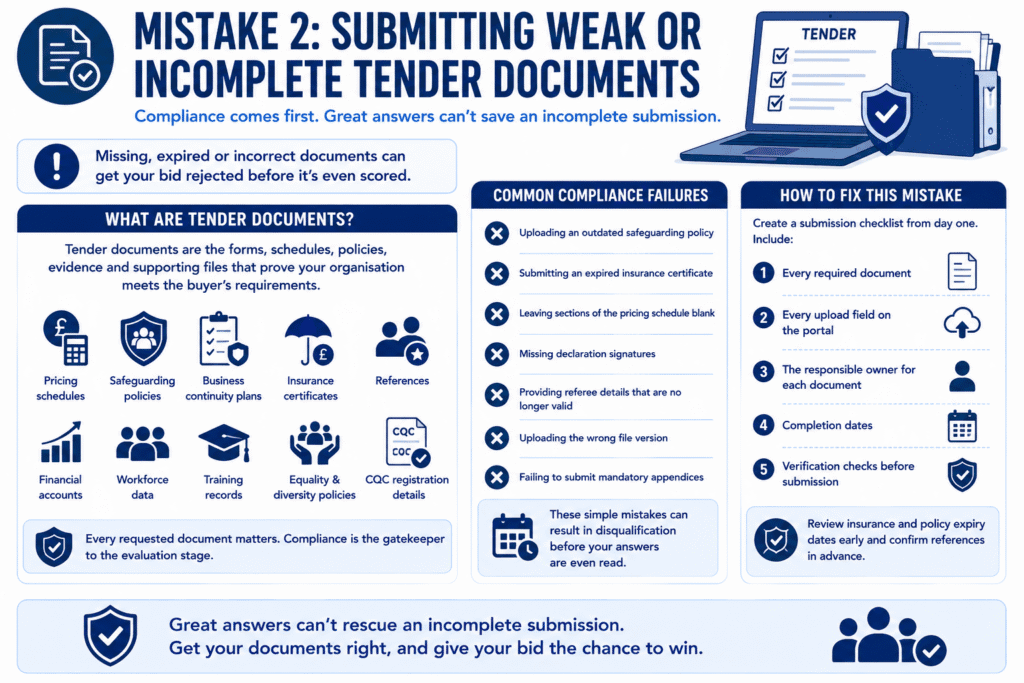
Every tender contains a collection of mandatory documents that prove your organisation meets the buyer’s requirements. If one document is missing, expired, incomplete, or uploaded incorrectly, the buyer may reject the submission before scoring begins.
This is why understanding what are tender documents is so important. Tender documents are the forms, schedules, declarations, policies, evidence files, and supporting information that accompany your bid response. Together, they demonstrate that your organisation has the legal, financial, operational, and regulatory capability to deliver the contract.
Many providers ask what is a tender document when preparing their first council or NHS submission. In reality, there is rarely just one document. Most health and social care tenders require a complete pack that may include:
- Pricing schedules.
- Safeguarding policies.
- Business continuity plans.
- Insurance certificates.
- References.
- Financial accounts.
- Workforce data.
- Training records.
- Equality and diversity policies.
- CQC registration details.
- Quality assurance evidence.
When providers ask what are the tender documents required for a care contract, the answer usually depends on the buyer, but the principle remains the same: every requested document matters.
Common compliance failures include:
- Uploading an outdated safeguarding policy.
- Submitting an expired insurance certificate.
- Leaving sections of the pricing schedule blank.
- Missing declaration signatures.
- Providing referee details that are no longer valid.
- Uploading the wrong file version.
- Failing to submit mandatory appendices.
These mistakes often happen because providers focus heavily on writing quality answers and leave compliance until the final few hours before submission.
Unfortunately, buyers do not award contracts for effort. They award contracts for compliant submissions.
How to Fix This Mistake
Create a submission checklist on the first day of the tender.
Your checklist should include:
- Every required document.
- Every upload field on the portal.
- The responsible owner for each document.
- Completion dates.
- Verification checks before submission.
It is also good practice to review insurance renewal dates, update policies before the tender starts, and confirm references in advance rather than scrambling to gather evidence at the last minute.
A specialist bid writing service often acts as an additional compliance safeguard by checking every document against the buyer’s requirements before submission. This extra review can prevent simple administrative errors from destroying weeks of bid preparation.
Winning care providers understand a simple truth: great answers cannot rescue an incomplete submission. Compliance comes first. Scoring comes second.
READ MORE: How to Start a Healthcare Recruitment Agency Uk in 2026
Mistake 3: Confusing Bid Writing With Bid Management
Many care providers believe that writing strong answers is enough to win contracts.
It is not.
Some of the best-written submissions still lose because nobody managed the process properly. Deadlines slip, clarification responses go unnoticed, pricing schedules remain incomplete, and key evidence never makes it into the final submission.
This is where many providers misunderstand what is bid management.
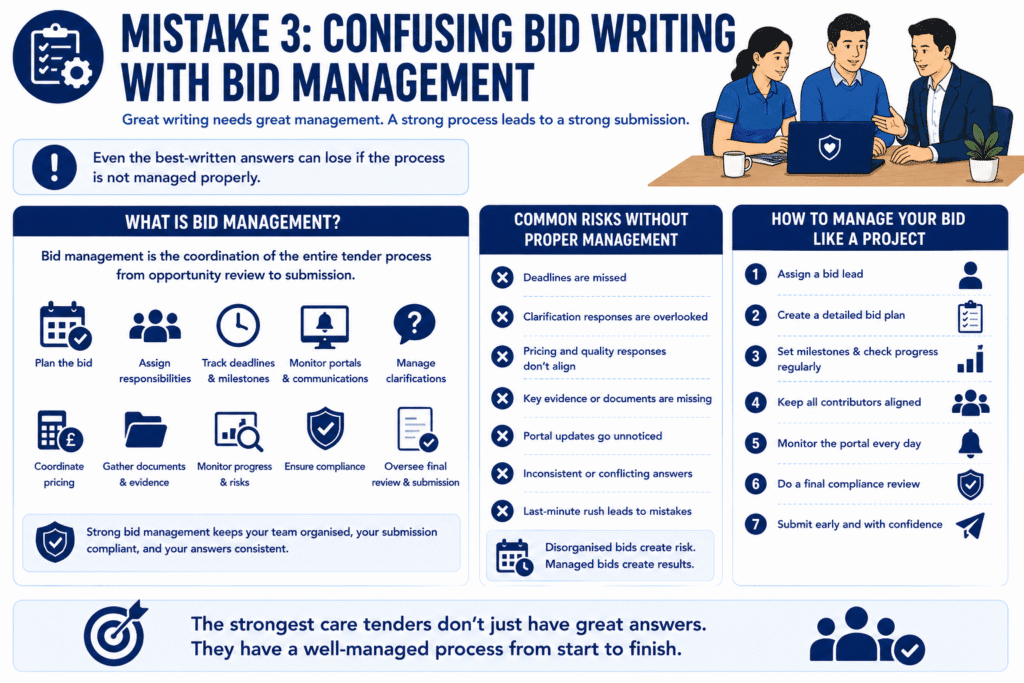
Bid writing focuses on creating persuasive, evidence-based responses. Bid management focuses on coordinating the entire tender process from opportunity review through to submission. Both are essential if you want to compete consistently for NHS, local authority, supported living, and domiciliary care contracts.
Providers often ask what is a bid manager and whether they need one. A bid manager oversees the tender from start to finish. They coordinate contributors, manage deadlines, track compliance requirements, gather evidence, monitor buyer communications, and ensure the final submission aligns with the evaluation criteria.
So, what does a bid manager do on a typical care tender?
They:
- Build the bid plan.
- Assign responsibilities.
- Monitor tender portals.
- Track clarification deadlines.
- Coordinate pricing inputs.
- Manage document collection.
- Review progress against milestones.
- Ensure the final submission remains compliant.
Without this oversight, even experienced care businesses can find themselves rushing during the final days before submission.
A common example occurs when the Registered Manager writes method statements while the finance team prepares pricing. Neither team realises that their assumptions conflict. The quality response promises enhanced staffing levels, while the pricing schedule reflects standard staffing ratios. Evaluators quickly spot the inconsistency and question the credibility of the submission.
Another frequent problem involves portal management. Many care providers assign portal notifications to one person’s inbox. When that person is on annual leave, clarification responses, addendums, and deadline updates go unnoticed. By the time the team discovers the changes, it is often too late.
How to Fix This Mistake
Treat every tender as a project.
Assign clear ownership for:
- Bid leadership.
- Quality responses.
- Pricing.
- Compliance documents.
- Portal monitoring.
- Final review.
Schedule weekly progress reviews from the moment the tender is released. For shorter tenders, hold reviews every two or three days.
Most importantly, separate writing from management. The person writing the answers should not carry sole responsibility for tracking deadlines, gathering evidence, managing contributors, and handling uploads.
Many care providers use a specialist bid writing service because it combines writing expertise with structured bid management. This reduces risk, improves coordination, and allows operational leaders to focus on running the service while the tender process remains under control.
The strongest care tenders do not succeed because they have the best writer. They succeed because they have the best-managed process.
Need a care specialist to write or review your bid? We write tenders for health and social care providers, with fixed-fee quotes from £1,500. See our bid and tender writing service.
Mistake 4: Writing Generic Answers That Ignore the Buyer’s Priorities
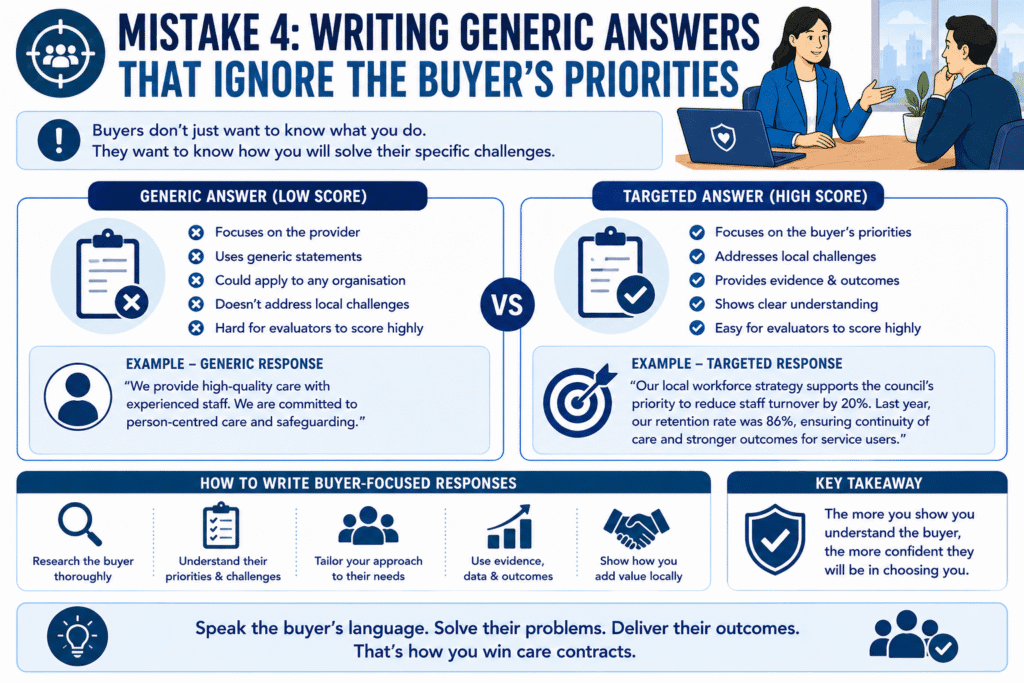
Many care providers spend hours writing detailed responses only to receive average scores.
The problem is not always the quality of the writing. The problem is relevance.
Buyers do not award contracts simply because you provide good care. They award contracts to providers who demonstrate that they understand the buyer’s specific challenges, priorities, and outcomes.
This is where many providers struggle with how to write a tender proposal that stands out.
A generic response focuses on the provider:
- Our staff are highly trained.
- We provide person-centred care.
- We have strong safeguarding processes.
- We deliver high-quality services.
Every bidder says the same thing.
A high-scoring response focuses on the buyer:
- How your service supports the council’s adult social care strategy.
- How your staffing model addresses local workforce shortages.
- How your approach reduces delayed discharges.
- How your service improves outcomes for people with complex needs.
- How your social value commitments benefit the local community.
Evaluators want evidence that you understand their environment, not just your own business.
For example, a local authority may identify hospital discharge delays as a major challenge. Another authority may prioritise workforce retention. An Integrated Care Board may focus on reducing emergency admissions. If your answers fail to address those priorities directly, evaluators often view your submission as generic.
This mistake becomes even more damaging when providers copy and paste content from previous bids. While reusing evidence can save time, reusing strategy rarely works. Every buyer has different priorities, different service pressures, and different success measures.
A response that scored highly in one borough may score poorly in another.
How to Fix This Mistake
Before writing any method statement, research the buyer thoroughly.
Review:
- Adult Social Care Strategies.
- Integrated Care Board plans.
- Joint Strategic Needs Assessments (JSNAs).
- Market Position Statements.
- Social Value Frameworks.
- Recent contract award notices.
- CQC local authority assessment findings where relevant.
Create a simple one-page buyer profile that highlights:
- Their strategic priorities.
- Their biggest service challenges.
- Their workforce pressures.
- Their social value objectives.
- Their expected outcomes.
Then build your responses around those priorities.
For example, instead of saying:
“We recruit skilled care workers.”
You could say:
“Our recruitment strategy directly supports the authority’s workforce sustainability objectives by maintaining a local talent pipeline, reducing vacancy rates, and improving continuity of care for service users.”
The second response speaks the buyer’s language.
A specialist bid writing service will usually spend significant time researching the commissioning landscape before drafting begins. This research often makes the difference between an average submission and a winning one.
The most successful care providers do not write about themselves. They write about the buyer’s challenges and show exactly how their service solves them.
Mistake 5: Ignoring the Tendering Process, Portal Updates, and ITT Rules
You can write excellent answers, submit strong evidence, and offer competitive pricing, yet still lose the contract because you ignored the process.
This happens more often than most care providers realise.
To avoid it, you need to understand what is tendering process in practical terms. The tendering process is the structured journey buyers use to evaluate suppliers fairly and consistently. It covers everything from publishing the opportunity and issuing clarification responses to evaluating submissions and awarding the contract.
Every stage matters.
Many care providers focus entirely on writing and forget that buyers also assess compliance with the Instructions to Tenderers (ITT), submission requirements, portal communications, and document formats.
Common examples include:
- Missing a clarification update that changes the scope of the contract.
- Exceeding the word count on a scored question.
- Uploading the wrong version of a pricing schedule.
- Submitting a PDF when the buyer requested an editable spreadsheet.
- Missing a mandatory declaration.
- Using appendices where the ITT explicitly prohibits them.
- Uploading documents after the deadline closes.
Under the Procurement Act 2023, buyers are placing even greater emphasis on transparency, consistency, and compliance. Small procedural mistakes can now eliminate an otherwise strong submission before evaluators consider its quality.
One of the most overlooked risks involves buyer portals. Platforms such as Atamis, Jaggaer, In-tend, ProContract, and Find a Tender regularly publish clarification responses and document updates during live procurements.
A single clarification response can completely change how you answer a question.
Yet many providers only log into the portal when they first download the documents and again on submission day.
By then, they may have missed crucial information.
How to Fix This Mistake
Build a process that protects your submission from avoidable compliance failures.
Best practice includes:
- Check the buyer portal every working day.
- Enable portal notifications for multiple team members.
- Submit clarification questions early rather than waiting until the final week.
- Capture every ITT rule inside your compliance matrix.
- Monitor word counts throughout drafting.
- Schedule submission at least 24 to 48 hours before the deadline.
- Complete a final compliance review before uploading any documents.
The strongest care providers also run an independent review of the entire submission before it goes live. This review focuses on compliance rather than content and often catches issues the drafting team no longer notices.
A professional bid writing service usually incorporates this review stage as part of the process. Experienced reviewers check every response against the specification, the scoring criteria, the ITT, and the submission requirements before the bid reaches the buyer.
Care providers often lose contracts because they focus on writing and neglect the rules surrounding the submission.
The reality is simple: buyers can only score a bid that reaches evaluation. Following the tendering process correctly ensures your hard work actually gets the chance to compete.
SEE MORE: How a Domiciliary Care Agency Can Prepare for 2026 and Grow Faster
How to Choose a Bid Writing Service for a Care Tender
Not all bid support delivers the same results.
Some providers hire a generalist writer to help complete a tender. Others invest in a specialist bid writing service that understands care regulations, commissioning priorities, safeguarding requirements, workforce challenges, and the realities of delivering care services.
The difference often shows in the final score.
A high-quality bid writing service does far more than write answers. It helps care providers build a stronger submission from the moment the tender arrives.
A specialist service should:
- Review the specification and identify risks early.
- Advise whether the opportunity is worth pursuing.
- Build a compliance matrix against the evaluation criteria.
- Gather evidence that supports every claim.
- Draft method statements that align with buyer priorities.
- Monitor clarification responses and procurement portals.
- Check all tender documents before submission.
- Run an independent red team review.
- Ensure the final bid complies with every ITT requirement.
This support becomes especially valuable for domiciliary care agencies, supported living providers, and healthcare organisations that already have demanding operational responsibilities.
Most Registered Managers do not have spare hours to monitor procurement portals, gather evidence, manage contributors, review pricing assumptions, and draft multiple quality responses at the same time.
A specialist bid writing service fills that gap.
The strongest providers also understand that winning a contract rarely starts when the tender is released. It starts months earlier through strong governance, updated policies, robust safeguarding systems, positive inspection outcomes, workforce development, and measurable service performance.
These are the same areas buyers assess during evaluation.
That is why the most successful care providers treat bid writing as part of a wider growth strategy rather than a last-minute administrative task.
Whether you are bidding for a local authority framework, an NHS Continuing Healthcare contract, a supported living opportunity, or a home care service agreement, the goal remains the same: demonstrate compliance, prove capability, and provide evidence that gives evaluators confidence in your delivery.
A specialist bid writing service helps you do exactly that.
The best submissions do not simply answer questions. They show buyers why your organisation is the safest, most capable, and most reliable choice for the people who depend on their services.
Questions to ask before you hire a bid writer
- Which care contracts have your clients won, and can I read the published results?
- Who will write my bid, and what care sector experience do they have?
- Will you read the specification and give me a fixed fee before I commit?
- Do you check my answers against my CQC, CIW or RQIA registration documents and policies?
- Will you build a compliance matrix and check the submission against the instructions to tenderers?
- What do you need from me, and by when?
- Do you claim a win rate? If so, how is it calculated?
Final Thoughts…
The most common tender losses in 2026 do not happen because care providers lack experience, skilled staff, or high-quality services. They happen because avoidable mistakes weaken the submission before evaluators can see the true value of the organisation.
The five biggest mistakes remain remarkably consistent:
- Treating the tender like a form instead of a scored competition.
- Submitting incomplete tender documents.
- Confusing bid writing with bid management.
- Writing generic responses that ignore buyer priorities.
- Ignoring the tendering process and ITT requirements.
The providers that win consistently approach tenders differently. They build systems, gather evidence early, understand the buyer’s objectives, and treat every submission as a strategic opportunity rather than an administrative exercise.
If your organisation wants to improve its success rate, a specialist bid writing service can provide the structure, sector expertise, and quality assurance needed to compete more effectively for NHS, local authority, supported living, domiciliary care, and healthcare contracts.
At Care Sync Experts, we help care providers strengthen every stage of the tender process, from specification review and compliance checks to bid management, tender writing, and final submission support, so that the next opportunity has the best possible chance of becoming your next contract.
FAQ
What Is a Bid Writer?
A bid writer is a specialist who prepares tender responses on behalf of a business. Their role is to analyse the specification, understand the evaluation criteria, gather evidence, and produce answers that demonstrate how the organisation will deliver the contract.
In health and social care, a bid writer must understand safeguarding, workforce management, quality assurance, CQC compliance, and service-user outcomes.
What Does a Bid Writer Do?
A bid writer transforms operational knowledge into high-scoring tender responses. They review tender documents, interview subject matter experts, gather supporting evidence, write method statements, and ensure every answer aligns with the buyer’s scoring criteria.
A specialist bid writing service also helps identify weaknesses before submission and improves the overall quality of the bid.
What Is Bid Management?
Bid management is the process of coordinating an entire tender submission from start to finish. While bid writing focuses on producing answers, bid management covers planning, timelines, document collection, compliance checks, pricing coordination, clarification responses, and final submission.
Successful care providers often combine strong writing with strong bid management to improve win rates.
How Do You Write a Tender Bid for a Care Contract?
To write a strong care tender bid:
Read the full specification and evaluation criteria.
Build a compliance matrix.
Gather evidence before drafting begins.
Research the buyer’s priorities and local challenges.
Write responses that focus on outcomes, not promises.
Support every claim with evidence.
Review against the scoring criteria.
Complete a final compliance check before submission.
Care providers that follow this process typically produce stronger and more competitive bids.
Topics
Bid Writing · Bid Writing Service · tender · Tender Writing
Written by
Care Sync Experts
Care Sync Experts helps care providers with CQC, Ofsted, CIW and RQIA registration, compliance and tenders. Our team has more than 10 years' experience and has supported over 1,200 providers.
Published 11 Jun, 2026 · Last updated 9 Oct, 2026
Want this handled for you?
Our team has supported over 1,200 care providers with registration, compliance and tenders, with a 94% first-time approval rate.