Where Care Excellence Meets Business Success. Transform your operations today - 0333 577 0877
We are here to help 24/7.



Carers Allowance Scotland:
What’s Changed in 2026?
Text to speech
Duration: 00:00
Font size
Published: 24 Feb, 2026
Share this on:
If you live in Scotland, Carers Allowance Scotland now operates as Carer Support Payment. The Scottish Government replaced the DWP benefit with Carer Support Payment, which Social Security Scotland now manages across the country.
If you already receive Carer’s Allowance from the DWP and live in Scotland, you usually do not need to reapply. Social Security Scotland transfers your award to Carer Support Payment automatically. You cannot receive both at the same time.
If you live in England, Wales, or Northern Ireland, you still claim through Gov UK Carer’s Allowance instead.
This guide explains who qualifies, how much you can get, how work affects your claim, and how to apply for Carer Support Payment in 2025/2026.
How much is Carer’s Allowance in 2025/2026?
If you’re asking “how much is Carer’s Allowance UK?”, the weekly rate for 2025/2026 is:
| Benefit | Weekly rate |
| Carer’s Allowance (England, Wales, NI) | £83.30 per week |
| Carer Support Payment (Scotland) | £83.30 per week |
So if you live in Scotland, Carer Support Payment currently matches the standard Carer’s Allowance rate.
Many carers search for “how much is carers allowance” or “carers allowance rate 2025”, and the answer is the same weekly amount unless the government announces an uprating.
How you’re paid
- In Scotland, Social Security Scotland normally pays you every 4 weeks in arrears.
- If you transferred from DWP Carer’s Allowance, you may keep a weekly payment schedule depending on your circumstances.
- Outside Scotland, you can usually choose weekly or 4-weekly payments under Gov UK Carer’s Allowance.
If you receive other benefits, the payment structure can affect your overall income, especially if you also claim Universal Credit carer element, which we’ll explain shortly.
RELATED: RQIA Registration for Domiciliary Care Agency in Northern Ireland (2026)
Who can claim? The rules for claiming Carer’s Allowance (and Carer Support Payment)
Before you apply, check the core rules for claiming Carer’s Allowance or Carer Support Payment. You must meet all of the following:
You must provide enough care
- You care for someone at least 35 hours a week.
- You do not need to live with them.
- You do not need to be related to them.
The person you care for must receive a qualifying benefit
They must receive a disability benefit such as:
- Personal Independence Payment (PIP) daily living component
- Disability Living Allowance (middle or highest care rate)
- Attendance Allowance
- Or certain other qualifying benefits
Only one person can usually claim for caring for the same individual.
You must meet age and residence rules
- You must be 16 or over.
- You must live in the UK (with specific rules for Scotland under Carer Support Payment).
Is Carer’s Allowance means tested?
Many carers ask: “Is carers allowance means tested?”
It is not means tested in the traditional way; your savings do not affect it. However, your earnings do matter, and you must stay below the weekly earnings limit after allowed deductions. We’ll break that down clearly in the next section.
If you’re unsure whether you qualify, especially if you work part time or receive other benefits, review the work and Universal Credit sections carefully before you apply.
Carer’s Allowance and part-time work: how the earnings limit works
You can work and still claim, but you must stay within the weekly earnings limit.
For 2026, you must not earn more than £196 per week after certain deductions. Many carers search for “carers allowance part time work” because this rule causes the most confusion.
What counts as earnings?
Your earnings include:
- Wages or salary
- Bonuses and commission
- Self-employed profits
Before the government applies the £196 limit, it allows certain deductions, including:
- Income tax
- National Insurance
- Half of your pension contributions
- Some work-related expenses (for example, care costs while you work)
If your earnings go even slightly above the limit in a week, you can lose entitlement for that period. That’s why tracking your income carefully matters.
What if your hours or pay change?
If your earnings fluctuate:
- Keep copies of payslips.
- Tell the relevant authority quickly (DWP for Gov UK Carer’s Allowance, Social Security Scotland for Carer Support Payment).
- Do not wait until the end of the year; overpayments can build up.
Working part time does not automatically disqualify you. Many carers successfully combine part-time work with their benefit, but you must manage your weekly earnings carefully.
READ MORE: When Does Child Benefit Stop in the UK? (2026 Guide)
Universal Credit carer element: how it works with Carer’s Allowance
If you claim Universal Credit, you may also qualify for the universal credit carer element. This is an extra monthly amount added to your Universal Credit award if you care for someone at least 35 hours a week.
Many carers search for:
- carers element universal credit
- universal credit carers element
- carer element
- how to apply for carers element of universal credit
Here’s what you need to know.
You do not need to receive Carer’s Allowance to get the carer element
You can qualify for the carer element even if you do not receive Carer’s Allowance, as long as:
- You provide at least 35 hours of care per week, and
- The person you care for receives a qualifying disability benefit.
How it interacts with Carer’s Allowance
If you receive both:
- Carer’s Allowance counts as income for Universal Credit.
- Universal Credit reduces by the same amount.
- However, you still receive the separate carer element within Universal Credit.
This means many carers are not “double paid,” but they still benefit from the additional element.
How to apply for carers element of Universal Credit
You do not submit a separate paper form. Instead:
- Log into your Universal Credit account.
- Report that you care for someone 35+ hours per week.
- Provide details about the person you care for and their disability benefit.
- Keep your journal updated if your caring hours change.
Always report changes promptly. Delays can lead to overpayments or missed entitlements.
Is Carer’s Allowance taxable?
Yes, Carer’s Allowance is taxable if your total annual income goes above the Personal Allowance.
Many carers search “is carers allowance taxable” because the payment feels like support rather than earnings. However, HMRC treats it as taxable income.
When do you actually pay tax?
You only pay tax if:
- Your total income (wages, pension, benefits, etc.) exceeds the yearly Personal Allowance.
- The combined amount pushes you into a taxable band.
If Carer’s Allowance (or Carer Support Payment in Scotland) is your only income, you will usually not pay tax because it sits below the Personal Allowance threshold.
If you work part time or receive a pension, your tax position can change. In those cases:
- Check your tax code.
- Review your total annual income.
- Contact HMRC if something looks incorrect.
Remember: being taxable does not automatically mean you will owe tax. It depends on your overall income for the year.
Can I claim Carer’s Allowance for myself?
Short answer: No.
You cannot claim Carer’s Allowance (or Carer Support Payment in Scotland) for caring for yourself. You claim it because you care for someone else who receives a qualifying disability benefit.
Many people search:
- Can I claim carers allowance for myself?
- Can I claim carers allowance for myself on PIP?
Here’s where the confusion comes from.
PIP is for the disabled person, not the carer
If you receive Personal Independence Payment (PIP) yourself, that does not make you eligible to claim Carer’s Allowance for your own condition.
However:
- If someone else cares for you for at least 35 hours a week,
- And you receive the daily living component of PIP (or another qualifying benefit),
Then they may be able to claim Carer’s Allowance or Carer Support Payment for caring for you.
You can claim even if you are disabled yourself
If you have your own health condition but still provide 35+ hours of care to someone else, you may qualify as long as you meet the earnings and eligibility rules.
The key rule stays the same: You must care for another person who receives a qualifying disability benefit.
SEE ALSO: Home Reversion Plan 2026: How It Works, Costs, Risks, Examples
Carer’s Allowance Supplement in Scotland (and what changes in 2026)
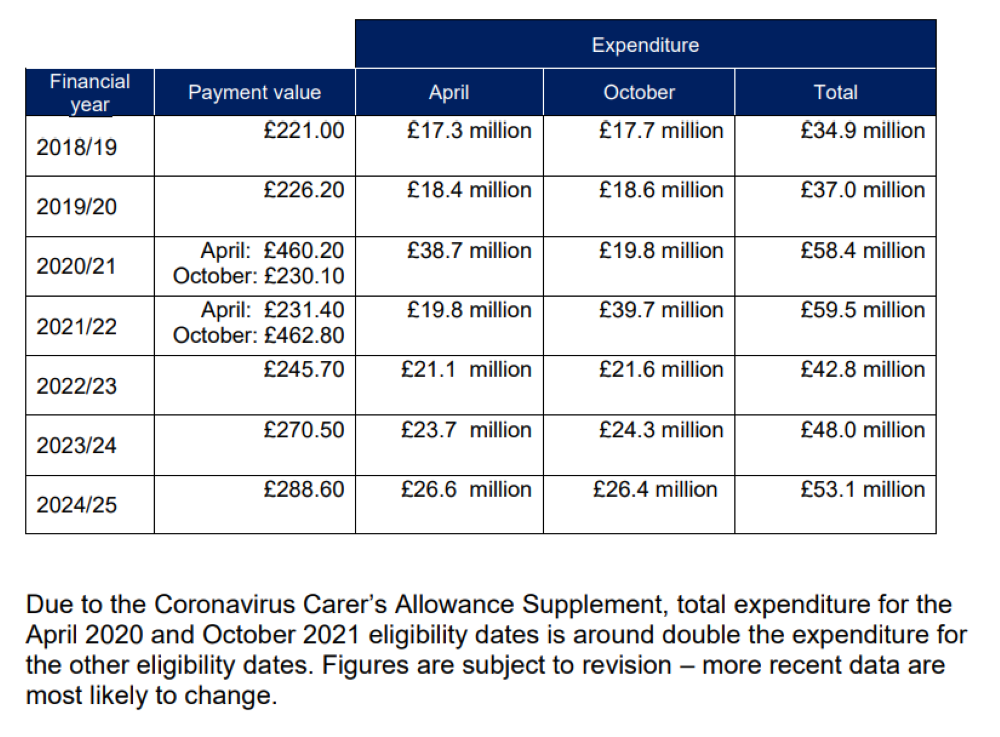
If you live in Scotland and receive Carer Support Payment, you may also qualify for the Carer’s Allowance Supplement.
This extra payment increases the overall value of support for carers in Scotland. The government pays it automatically; you do not need to submit a separate application.
How it currently works
- It is paid twice a year (traditionally in June and December).
- You receive it automatically if you qualify on the set eligibility dates.
- You do not need to apply separately.
What changes from March 2026?
From March 2026, Scotland plans to replace the twice-yearly Carer’s Allowance Supplement with a more regular payment structure (often referred to as the Scottish Carer Supplement).
This change aims to:
- Spread support more evenly through the year.
- Make payments more predictable.
- Align more closely with Scotland’s devolved social security system.
If you already receive Carer Support Payment, the transition should happen automatically. Always check official updates from Social Security Scotland to confirm current payment arrangements.
Apply for Carer Support Payment: step-by-step
If you live in Scotland and do not already receive Carer’s Allowance, you need to apply for Carer Support Payment through Social Security Scotland.
Follow these steps to apply confidently.
1. Check your eligibility first
Before you start your application, make sure:
- You provide at least 35 hours of care per week.
- The person you care for receives a qualifying disability benefit.
- Your weekly earnings stay below the limit after deductions.
If you are unsure, review the rules section above before submitting your claim.
2. Gather the information you’ll need
Have these ready:
- Your National Insurance number
- Bank account details
- Details about the person you care for
- Information about your work and earnings (if you work)
Preparing this in advance prevents delays.
3. Submit your application
You can apply:
- Online through the official Social Security Scotland website
- By phone
- By requesting and submitting a paper form
Most carers choose the online route because it’s faster and easier to track.
4. After you apply
Social Security Scotland will:
- Review your information
- Contact you if they need more details
- Confirm their decision in writing
If they approve your claim, they will tell you:
- Your payment amount
- Your payment schedule
- When your first payment will arrive
If you previously received Gov UK Carer’s Allowance and moved to Scotland, your claim may transfer automatically. If you move into Scotland from another part of the UK, you usually need to make a new claim.
MORE: What Are the 5 Stages of Palliative Care? 2026 Update
Can I check my Carer’s Allowance online?
Yes, but how you check it depends on where you live.
Many carers search “Can I check my carers allowance online?” because they want quick updates without calling.
If you live in Scotland
If you receive Carer Support Payment, you manage your claim through Social Security Scotland.
You can:
- Check correspondence and updates online (if you applied digitally)
- Contact Social Security Scotland directly by phone if you need clarification
- Report changes in your circumstances (for example, changes in work or caring hours)
Always report changes as soon as possible to avoid overpayments.
If you live in England, Wales or Northern Ireland
If you receive Gov UK Carer’s Allowance, you can:
- Sign in to your government account
- Report a change in circumstances
- Check payment dates
- Update personal details
If you cannot access your online account, you can contact the Carer’s Allowance Unit by phone.
Keeping your details up to date protects your payments and prevents unexpected repayment demands later.
Carer’s Allowance Scotland vs the rest of the UK: what’s different?
If you’re confused about whether to claim through Scotland or through Gov UK Carer’s Allowance, this quick breakdown will help.
If you live in Scotland
- You claim Carer Support Payment, not DWP Carer’s Allowance.
- Social Security Scotland manages your claim.
- You may receive the Carer’s Allowance Supplement (or its replacement from March 2026).
- If you previously received DWP Carer’s Allowance while living in Scotland, your claim usually transfers automatically.
If you live in England, Wales or Northern Ireland
- You claim through Gov UK Carer’s Allowance.
- The Department for Work and Pensions (DWP) manages your claim.
- Scotland-only supplements do not apply.
If you move between Scotland and the rest of the UK
You must report your move immediately.
- Moving into Scotland:
Your DWP Carer’s Allowance will stop after a transition period. You must apply for Carer Support Payment as soon as possible to avoid gaps in payment.
- Moving out of Scotland:
You must report the move to Social Security Scotland and apply for Gov UK Carer’s Allowance.
Your benefit does not automatically continue across borders without action.
Final thoughts…
If you live in Scotland, Carer’s Allowance Scotland now operates as Carer Support Payment. The weekly rate currently sits at £83.30; the 35-hour care rule still applies, and your earnings must stay below the weekly limit after deductions.
If you claim Universal Credit, check whether you qualify for the universal credit carer element. If you work part time, track your weekly income carefully. If you move across UK borders, report it immediately and apply under the correct system.
Small mistakes, missing a change in earnings, misunderstanding the transfer from Gov UK Carer’s Allowance, or assuming you can claim for yourself, can trigger overpayments or payment gaps.
When you care for someone else, you should not have to guess your own financial position.
Supporting UK Carers Through Benefit & Care Transitions?
If you searched “carers allowance scotland,” “how much is carers allowance,” “apply for carer support payment,” “carers allowance part time work,” “universal credit carer element,” or “is carers allowance taxable,” you are likely managing financial pressure while providing real, hands-on care.
Clear, accurate guidance matters. Misunderstanding earnings limits, reporting changes late, or confusing Carer Support Payment with Gov UK Carer’s Allowance can lead to overpayments, repayment demands, or avoidable stress.
Care Sync Experts supports carers and regulated care providers across the UK with:
- Clear interpretation of Scotland and DWP benefit rules
- Structured compliance guidance aligned with GOV.UK and Social Security Scotland frameworks
- Practical support on reporting obligations and documentation standards
- Financial clarity around earnings limits and Universal Credit interaction
- Governance advice for domiciliary and supported living providers supporting unpaid carers
- Policy development for organisations delivering structured carer support
- Tender-writing and compliance support for services assisting carers and families
- Inspection-readiness frameworks for providers delivering regulated care
Whether you are managing your own claim or leading a regulated care service supporting unpaid carers, we help you replace confusion with clarity and structured compliance.
Get in touch with Care Sync Experts today and ensure your benefit position remains accurate, compliant, and financially secure.
FAQ
How long is Carer’s Allowance taking to process in 2025?
Processing times vary depending on your circumstances and whether the authority needs additional information.
In straightforward cases:
Carer Support Payment (Scotland) decisions often take several weeks after you submit a complete application.
Gov UK Carer’s Allowance claims typically take a few weeks as well, but delays can occur if eligibility checks are complex.
Applications may take longer if:
– The person you care for has only recently been awarded a qualifying disability benefit.
– Your earnings require verification.
– You recently moved between Scotland and another UK nation.
– You can reduce delays by:
– Providing full details about the person you care for.
– Submitting accurate earnings information.
– Responding quickly to follow-up requests.
What stops you from getting Carer’s Allowance?
Several situations can stop or prevent entitlement:
– You earn more than the weekly earnings limit.
– You provide fewer than 35 hours of care per week.
– The person you care for stops receiving a qualifying disability benefit.
– Someone else successfully claims for caring for the same person.
– You move between Scotland and the rest of the UK and fail to apply under the correct system.
– You enter full-time education (in most cases).
– Reporting changes quickly protects you from overpayments and repayment demands.
Who pays for carers in Scotland?
If you receive financial support as a carer in Scotland:
– Social Security Scotland pays Carer Support Payment.
– The Scottish Government funds additional support such as the Carer’s Allowance Supplement (or its replacement structure from 2026).
If you receive Universal Credit, the Department for Work and Pensions (DWP) pays the Universal Credit award, including any carer element.
Separate from benefits, local authorities may fund formal care services for the person you support, but that funding does not replace Carer Support Payment.
What benefits can I claim as a carer in Scotland?
As a carer in Scotland, you may be eligible for:
– Carer Support Payment
– The Scotland-only Carer’s Allowance Supplement (or its replacement from 2026)
– The Universal Credit carer element
– National Insurance credits
– Council Tax Reduction (depending on income)
– Pension Credit (if you are over State Pension age)
– Carer’s Credit (if you provide at least 20 hours of care but do not qualify for Carer Support Payment)
Your eligibility depends on your income, caring hours, and household circumstances. Many carers qualify for more than one form of support.

Would you like to receive update from CareSync Experts?
All rights reserved. Copyright © - Care Sync Experts.


