Children’s DLA Rates:
Who Qualifies, and What to Claim in 2026
Text to speech
Duration: 00:00
Font size
Published: 16 Mar, 2026
Share this on:
Children’s DLA rates help cover the extra costs of caring for a child with a disability or long-term health condition. If your child is under 16 and needs significantly more care or supervision than other children their age, you may qualify for Disability Living Allowance (DLA).
The amount you receive depends on the level of help your child needs with daily care or mobility. Current DLA child rates range from £29.20 to £187.45 per week, based on two components: care and mobility.
Parents and caregivers often ask questions such as “how much is high rate DLA for a child?” or “how much is middle rate DLA for a child?” The exact rate depends on how much support your child requires during the day, at night, or when moving around.
Many families use DLA to pay for:
- extra supervision or care needs
- transport or mobility support
- specialist equipment or therapy
- additional household costs linked to a disability
If your child receives DLA, you may also qualify for other support, including Carer’s Allowance or the carer element in Universal Credit, depending on your situation.

How much are children’s DLA rates in 2026?
The children’s DLA rates depend on how much extra help your child needs with daily care or mobility. Disability Living Allowance for children has two components:
- Care component – for children who need extra supervision, help with daily activities, or support during the night.
- Mobility component – for children who have difficulty walking or need guidance when moving around outdoors.
Your child may qualify for one component or both, depending on their needs.
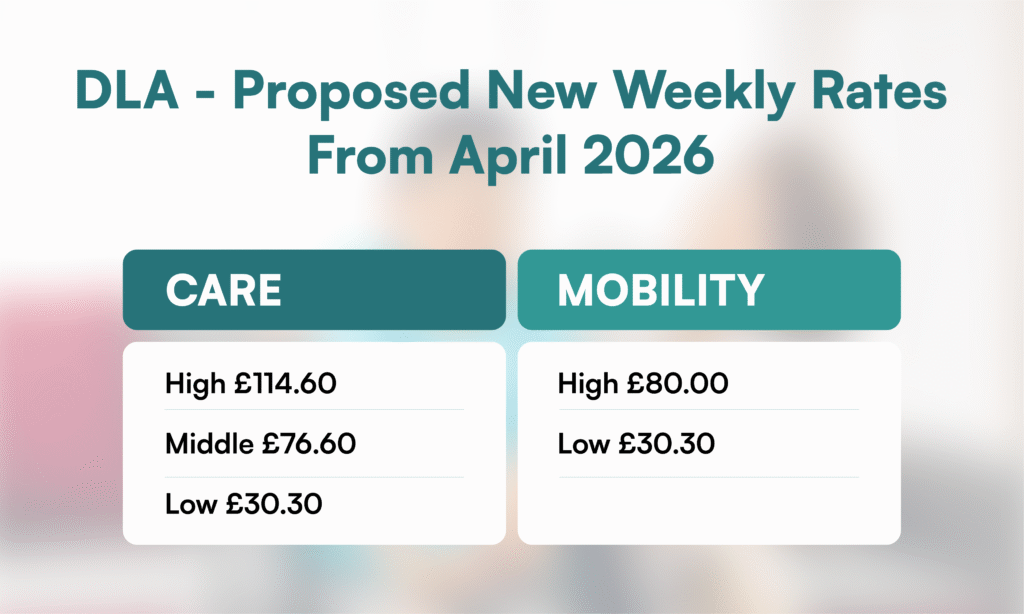
Care component (weekly payments)
| Level of care needed | Weekly amount |
| Lowest rate | £29.20 |
| Middle rate | £73.90 |
| Highest rate | £110.40 |
Parents often ask “how much is middle rate DLA for a child?” or “how much is high rate DLA for a child?”. The answer depends on how much supervision or assistance your child needs throughout the day or night.
- Lowest rate – for children who need help during part of the day.
- Middle rate – for children who need frequent help during the day or supervision at night.
- Highest rate – for children who need care or supervision both day and night, or who have a serious life-limiting condition.
Mobility component (weekly payments)
| Mobility support needed | Weekly amount |
| Low rate mobility DLA child | £29.20 |
| High rate mobility DLA | £77.05 |
The low rate mobility DLA applies when a child can walk but still needs guidance or supervision outdoors. The high rate mobility DLA applies when a child cannot walk, can only walk short distances without severe discomfort, or has a severe visual impairment.
In official terms, this lower tier is also called disability living allowance lower rate mobility.
Age rules apply to the mobility component:
- Lower rate mobility usually applies from age 5.
- Higher rate mobility can apply from age 3.
If your child qualifies for the highest mobility rate, they may also become eligible for the Motability Scheme, which can help families access adapted vehicles.
RELATED: Equality Act Protected Characteristics: 2026 Importance for Care Work
Do autism or ADHD change the DLA rate?
Many parents search for DLA rates for child with autism, DLA rates for child with ADHD, or DLA rates for child with autism and ADHD. In practice, the diagnosis itself does not determine the amount of Disability Living Allowance a child receives.
The Department for Work and Pensions looks at how much extra care, supervision, or mobility support your child needs, not the medical label attached to the condition.
For example, two children with autism may receive different DLA child rates if their daily needs differ. One child might qualify for the middle care rate because they need frequent help during the day, while another child may qualify for the highest care rate if they require supervision both day and night.
Decision-makers usually assess things such as:
- how much extra supervision your child needs compared with other children the same age
- whether your child needs help with personal care, communication, or safety
- whether your child experiences mobility difficulties or needs guidance outdoors
- whether their condition affects sleep, behaviour, or risk awareness
Children with autism, ADHD, or a combination of both often qualify for DLA when they require significantly more supervision than other children of the same age. For instance, some children may need constant supervision outside because of limited danger awareness, while others may require structured support for daily routines.
This is why DLA focuses on practical daily needs rather than diagnosis alone. When applying, it helps to describe clearly what support your child actually needs throughout the day and night, rather than only listing their medical conditions.
Who can claim DLA for a child?
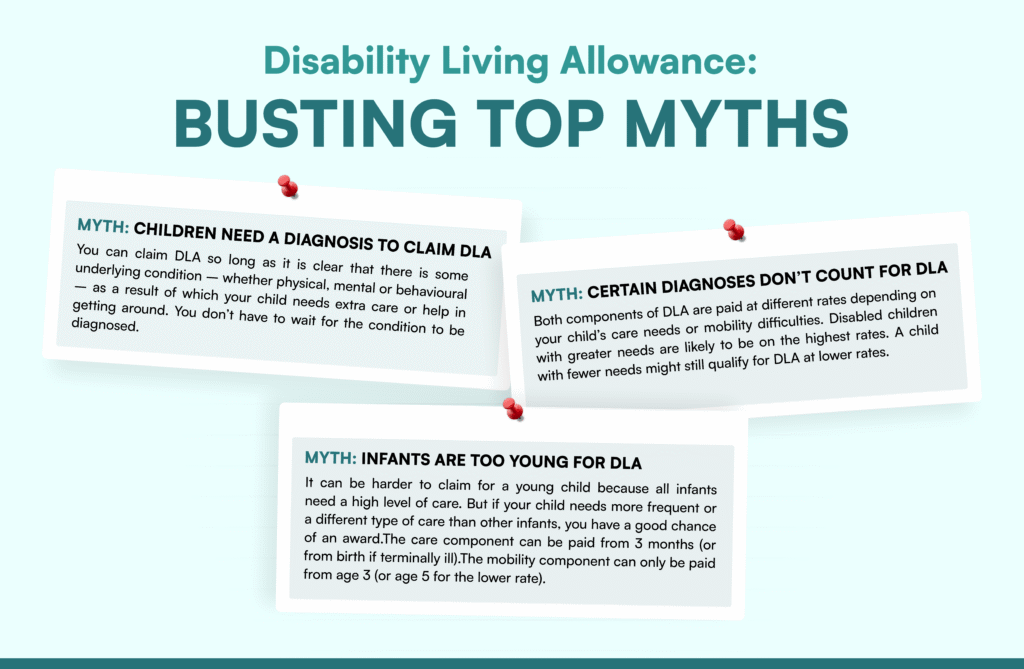
You can claim Disability Living Allowance (DLA) for a child if you look after them as a parent and they meet the eligibility rules. This includes parents, step-parents, guardians, grandparents, foster parents, or older siblings who take on the main caring role.
To qualify, your child must usually:
- be under 16 years old
- need much more care, supervision, or help moving around than other children the same age
- live in England or Wales when the claim is made
- have had these difficulties for at least 3 months and expect them to last for at least 6 months
You can claim DLA whether you work or not, and your household income does not affect the benefit. The assessment focuses entirely on your child’s care and mobility needs.
Living in different parts of the UK
Where your child lives affects which benefit you apply for:
- England and Wales: apply for Disability Living Allowance for children
- Scotland: DLA for children has been replaced by Child Disability Payment
- Northern Ireland: children still claim Disability Living Allowance, but the application process runs through the Northern Ireland system
If your child lives in Scotland, you should apply for Child Disability Payment instead of DLA. This benefit provides similar support but is managed by Social Security Scotland.
Living abroad or moving countries
In some situations, you may still be able to claim if your child lives outside the UK temporarily, such as when:
- your child receives medical treatment abroad
- a parent works in the armed forces
- your child lives in certain European countries under specific agreements
However, most families must show that the child normally lives in England or Wales when applying.
Who receives the payments?
DLA payments usually go to the parent or caregiver responsible for the child. The money helps cover the additional costs of caring for a child with a disability, such as supervision, transport, specialist equipment, or extra support services.
READ MORE: UK Cost of Living Payment Eligibility (2026): What Caregivers and Families Need to Know
Is there a DLA points scoring system for children?
Many parents search for a “DLA points scoring system child”, especially if they have heard about the points-based system used for Personal Independence Payment (PIP). However, DLA for children does not use a public points system.
Instead, decision-makers look at how your child’s condition affects their daily life compared with other children the same age. The Department for Work and Pensions reviews the information you provide in the claim form and decides whether your child qualifies for the care component, the mobility component, or both.
What the DLA decision is based on
When reviewing a claim, assessors usually focus on:
- how much extra supervision your child needs during the day
- whether your child needs help with personal care tasks, such as eating, dressing, or washing
- whether someone must watch over them for safety, especially outdoors
- whether your child needs help moving around or guidance when walking
- whether their condition affects sleep or night-time care
The key question is whether your child needs significantly more support than another child of the same age.
Evidence that can strengthen a claim
You do not need to prove your child’s condition using points. Instead, it helps to explain clearly how their needs affect everyday life. Useful evidence can include:
- reports from doctors, therapists, or specialists
- letters from schools or support workers
- care plans or therapy plans
- examples of supervision or support your child needs during the day and night
Parents often improve their chances by focusing on real daily challenges, rather than just listing the child’s diagnosis.
SEE ALSO: PIP Contact Number: Number for PIP Payment and Enquiries (2026)
My child gets DLA: what else am I entitled to?
Many parents ask “my child gets DLA, what else am I entitled to?” because Disability Living Allowance can unlock other types of support for families caring for a disabled child.
If your child receives middle or highest rate care, you may qualify for additional financial help and support services.
Carer’s Allowance
You may be able to claim Carer’s Allowance if:
- you care for your child for at least 35 hours per week
- your child receives middle or highest rate care component
- you meet the income and eligibility rules
Some families receiving Universal Credit may instead qualify for the carer element, which increases their monthly payment if they provide regular care.
Motability Scheme
If your child receives the high rate mobility DLA, you may be able to access the Motability Scheme. This allows families to lease a vehicle, scooter, or powered wheelchair using the mobility component of the benefit.
Many caregivers use this option to make transport easier for school, medical appointments, or daily activities.
Other support your family may qualify for
Depending on your situation, DLA may also help you access:
- extra Universal Credit support for disabled children
- free school meals or additional school support
- council tax reductions
- grants from charities supporting disabled children
Because every family’s situation differs, it is worth checking which additional support you can claim once your child’s DLA child rates are approved.
Child Disability Payment in Scotland and DLA in Northern Ireland
The benefit you apply for depends on where your child lives in the UK. While Disability Living Allowance (DLA) still applies to children in England, Wales, and Northern Ireland, Scotland now uses a different system.
Scotland: Child Disability Payment
If your child lives in Scotland, you cannot apply for DLA. Instead, you must apply for Child Disability Payment, which replaced disability living allowance Scotland (DLA Scotland) for children.
Child Disability Payment works in a similar way to DLA and also includes:
- a care component
- a mobility component
The amount your child receives still depends on how much help they need with daily care or mobility, rather than the specific diagnosis.
Northern Ireland: DLA for children
Children living in Northern Ireland can still claim Disability Living Allowance for children through the Northern Ireland system.
The eligibility rules and DLA child rates are broadly similar to those used in England and Wales, but the claim process and support services operate through Northern Ireland departments.
Families in Northern Ireland can contact the Disability and Carers Service for help with claims. Many parents search for the DLA Northern Ireland telephone number when starting an application or asking about their claim.
Because the application routes differ slightly across the UK, it’s important to make sure you apply through the correct system for your child’s location.
MORE: Labour Home Support Plan Pensioner Devices: 2026 Update
DLA contact information and helpline numbers
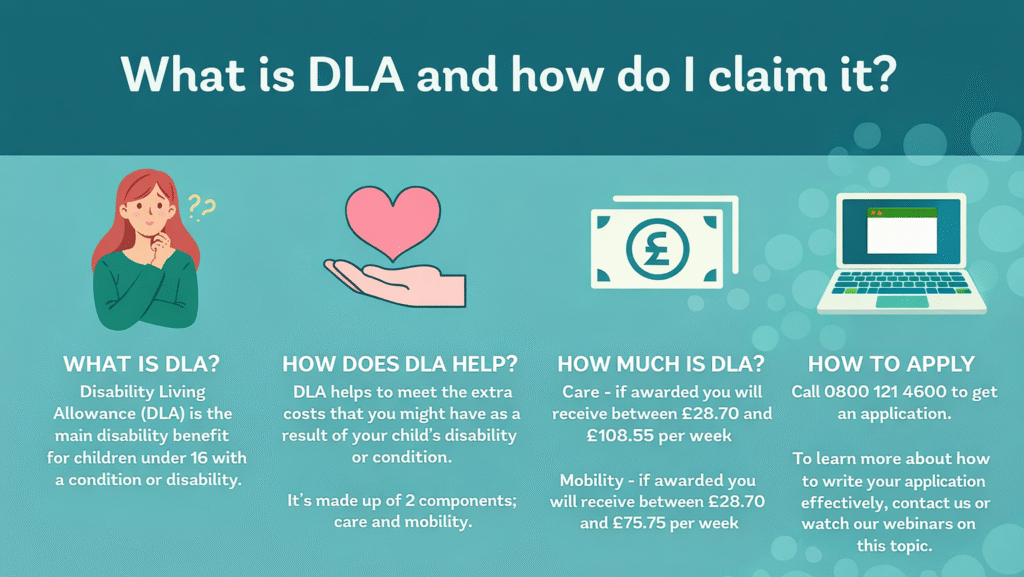
If you need help with a claim, you can contact the Disability Living Allowance helpline. Parents often search for the disability living allowance contact number, children’s DLA number, or general DLA contact information when starting an application or reporting a change.
England and Wales
You can request a claim form or ask questions about an existing claim by contacting the DLA helpline:
Disability Living Allowance helpline
Telephone: 0800 121 4600
Textphone: 0800 121 4523
Relay UK: dial 18001 then 0800 121 4600
You can ask the helpline to send you a DLA claim form by post, or download and print one from the GOV.UK website.
Northern Ireland
Families in Northern Ireland must contact the Disability and Carers Service instead of the England and Wales helpline. Parents often search for the DLA Northern Ireland telephone number when starting a claim.
Disability and Carers Service (Northern Ireland)
Telephone: 0800 587 0912
They can send you the claim pack and help answer questions about DLA child rates and eligibility.
When to contact the DLA helpline
You should contact the helpline if:
- you want to request a claim form
- you need to report a change in your child’s circumstances
- you want to check the progress of a claim
- you need help understanding your child’s DLA child rates or eligibility
Keeping the DLA office updated helps ensure your payments continue correctly.
Key takeaway…
Children’s DLA rates depend on the level of care and mobility support your child needs, not just their diagnosis. If your child qualifies, the benefit can help cover the additional costs of care and may also unlock other support, such as Carer’s Allowance or mobility schemes.
If you think your child may qualify, contacting the DLA helpline or requesting a claim form is often the first step toward accessing the support your family needs.
Need Expert Support Navigating Disability Benefits and Care Funding?
Care Sync Experts supports care providers, parents, and healthcare organisations across the UK with clear, practical guidance on disability benefits, care funding, and regulatory processes that affect children and families.
From helping families understand children’s DLA rates and eligibility to guiding care organisations through benefit-related policies, compliance requirements, and support frameworks, our specialists translate complex government guidance into straightforward, actionable advice.
Whether you need help understanding Disability Living Allowance for children, Child Disability Payment in Scotland, carers’ support options, or benefit-linked care funding, our team provides structured guidance aligned with current UK health and social care standards.
Help families access the support they deserve while strengthening compliance across your organisation.
Contact Care Sync Experts today to receive expert guidance on disability benefits, care funding, and support pathways with clarity and confidence.
FAQ
What conditions qualify a child for DLA?
There is no fixed list of medical conditions that automatically qualify a child for Disability Living Allowance (DLA). Instead, the decision depends on how the child’s condition affects their daily care or mobility needs.
A child may qualify if they need significantly more help or supervision than other children of the same age because of a long-term condition or disability.
Examples of conditions that commonly lead families to claim DLA include:
– autism spectrum disorder
– ADHD
– learning disabilities
– physical disabilities
– sensory impairments such as blindness or severe hearing loss
– long-term medical conditions that require regular supervision
The Department for Work and Pensions focuses on the level of care and support required, not just the diagnosis itself.
What evidence do I need for child DLA?
When you apply for Disability Living Allowance for a child, you should include evidence that explains how your child’s condition affects their daily life.
Helpful evidence may include:
– letters or reports from GPs, paediatricians, or specialists
– reports from speech therapists, occupational therapists, or physiotherapists
– information from schools or special educational needs coordinators (SENCOs)
– care plans or support plans
– examples of daily supervision or assistance your child needs
Strong applications usually describe real situations from everyday life, such as help needed with dressing, supervision for safety, or support required at night.
What happens after DLA is approved?
After a successful claim, the Department for Work and Pensions sends you a decision letter explaining:
– which care or mobility components your child has been awarded
– the weekly rate your child will receive
– how long the award will last
Payments usually go into your bank or building society account every four weeks.
Once your child receives DLA, you may also become eligible for other support, such as Carer’s Allowance or additional benefits depending on your circumstances.
Can a 2 year old get DLA for autism?
Yes, a 2-year-old child can qualify for Disability Living Allowance, including children with autism, if they need much more supervision or care than other children their age.
However, the mobility component usually only applies at certain ages:
– Higher mobility rate can apply from age 3
– Lower mobility rate usually applies from age 5
Even if a child is younger than these ages, they may still qualify for the care component if they require significant extra supervision or support due to their condition.
Parents applying for young children should focus on explaining how much extra care their child needs compared with other children of the same age.