CQC Mandatory Training for Care Workers:
2026 Update
Text to speech
Duration: 00:00
Font size
Published: 18 Jun, 2026
Share this on:
CQC mandatory training for care workers is not one fixed list of courses that every provider must copy. CQC expects care providers to make sure staff have the right training, skills, competence, and experience to support people safely.
Under Regulation 18, providers must deploy enough suitably qualified, competent, skilled, and experienced staff to meet people’s needs.
For a care business, that means training must match the service you deliver. A domiciliary care worker who supports people at home may need safeguarding, moving and handling, infection prevention, fire safety, basic life support, medication awareness, Mental Capacity Act training, equality and diversity, and learning disability and autism training where relevant.
But certificates alone will not protect your service during inspection. CQC wants to see that your team can apply training in real care situations. A care worker should know how to spot a safeguarding concern, move someone safely, follow a medication prompt procedure, reduce infection risks, and report changes before harm happens.
At Care Sync Experts, we help care providers approach training as part of a wider compliance system, not a tick-box exercise. The goal is simple: train staff properly, evidence competence clearly, and build a team that delivers safe, confident, person-centred care every day.

What Is the Care Quality Commission?
The Care Quality Commission, also known as CQC, regulates health and adult social care services in England. It checks whether care providers deliver support that is safe, effective, caring, responsive, and well-led. These are often called the 5 CQC standards, although CQC describes them as five key questions used to assess quality.
For a care business, CQC does more than inspect paperwork. It looks at how your service protects people, manages risks, trains staff, responds to concerns, and improves care. That means your training programme must connect directly to the care your workers provide every day.
People sometimes search “what are CQC” or “what is the quality care commission,” but the correct name is Care Quality Commission. Its role is to make sure registered care services meet legal standards and give people safe, high-quality care.
For providers, this matters because weak staff training can quickly affect safety, safeguarding, medication, infection control, moving and handling, and the overall quality of care.
RELATED: How Much Does CQC Registration Cost in 2026?
Does CQC Have a Fixed List of Mandatory Training for Care Workers?
CQC does not give care providers one fixed list of mandatory training for care workers to copy and follow. Instead, CQC expects each provider to choose training based on the service they run, the roles staff perform, and the needs of the people they support.
That means your CQC mandatory training requirements should reflect real care delivery. A domiciliary care agency may need strong training in safeguarding, moving and handling, medication support, infection prevention, lone working, dementia awareness, and emergency response. A supported living service, care home, or complex care provider may need additional specialist training.
The same principle applies to the list of mandatory training for support workers. You should not train staff only because a course appears on a generic checklist. You should train them because the topic links to a real responsibility, real risk, or real person receiving care.
This is where many providers get caught out. They collect certificates but fail to prove competence. During inspection, CQC may ask how you know a worker can apply the training safely during care visits.
A stronger approach is to build your training around three questions:
- What does this worker need to do?
- What risks could they face?
- What evidence proves they can do it safely?
That is the difference between training that looks good on paper and training that protects your service.
Core CQC Training Courses Most Care Providers Need
Most care providers build their CQC training courses around the risks staff face in real care work. The exact mix depends on your service, but a strong training programme usually covers:
- Safeguarding adults and children
- Moving and handling
- Infection prevention and control
- Health and safety
- Fire safety
- Basic life support
- Medication awareness or medication administration
- Mental Capacity Act and DoLS
- Equality, diversity, and human rights
- Food hygiene, where staff prepare or handle meals
- Dementia awareness, where staff support people living with dementia
- Learning disability and autism training
The Oliver McGowan Mandatory Training now deserves special attention. CQC explains that registered providers must make sure staff receive learning disability and autism training that matches their role, and the Oliver McGowan Code of Practice started on 6 September 2025. (Care Quality Commission)
Some providers search for free CQC training or CQC courses online to reduce costs. Online learning can help with knowledge, but it should not replace practical checks where staff perform high-risk tasks. A care worker may complete medication training online, but the provider still needs to check whether that worker can follow the medication policy correctly during real care delivery.
We recommend building training around your service risks, your staff roles, and the people you support. The best training plan does not simply ask, “Has this worker passed a course?” It asks, “Can this worker deliver safe, confident, person-centred care today?”
READ MORE: SME Spend Targets: How to Win More Public Contracts in 2026
What Is the Care Certificate?
The Care Certificate gives new care workers a strong foundation before they support people on their own. It sets out the knowledge, skills, and behaviours that health and social care workers should show in daily practice. Skills for Care explains that the Care Certificate standards define what specific care roles need to know and do, especially during induction for people who are new to care. (Skills for Care)
For a care business, the Care Certificate should not become a paperwork exercise. It should help new starters understand their role, duty of care, safeguarding, communication, privacy and dignity, infection prevention, mental health, dementia, learning disability, health and safety, and person-centred support.
People often ask what is a care certificate, how to get care certificate, or how do I get a Care Certificate. In practice, the employer usually supports the worker through training, workplace assessment, observation, and sign-off. A certificate should only mean something when the worker can show the right knowledge and safe practice.
The Care Certificate helps with induction, but it does not replace your wider CQC mandatory training for care workers. Providers still need role-specific training, refresher planning, supervision, and competency checks that match the people they support.
CQC Training Requirements for Domiciliary Care
CQC training requirements for domiciliary care must reflect the reality of working inside people’s homes. Care workers often work alone, make quick decisions, notice changes before anyone else, and support people with personal care, medication prompts, meals, mobility, dementia, safeguarding concerns, and emergency situations.
That means a domiciliary care provider needs more than a generic training folder. Your staff should understand how to enter someone’s home respectfully, protect privacy, follow the care plan, record concerns, manage infection risks, and escalate changes quickly.
A care worker may be the first person to notice that someone has stopped eating, fallen overnight, missed medication, become more confused, or lost confidence with personal care. Training should prepare staff to act early, not wait until a small concern becomes a serious incident.
For Care Sync Experts, strong domiciliary care training should cover three things:
- The worker’s role and daily responsibilities
- The risks linked to the people they support
- The evidence that proves they can work safely and confidently
This is why CQC mandatory training for care workers should always connect to real care visits. A certificate shows that learning happened. Competency checks, supervision, observations, and accurate records show that the worker can apply that learning where it matters most: in the person’s home.
SEE ALSO: What Is a Tender in Health and Social Care? 2026 Update
Training for Registered Managers and Senior Staff
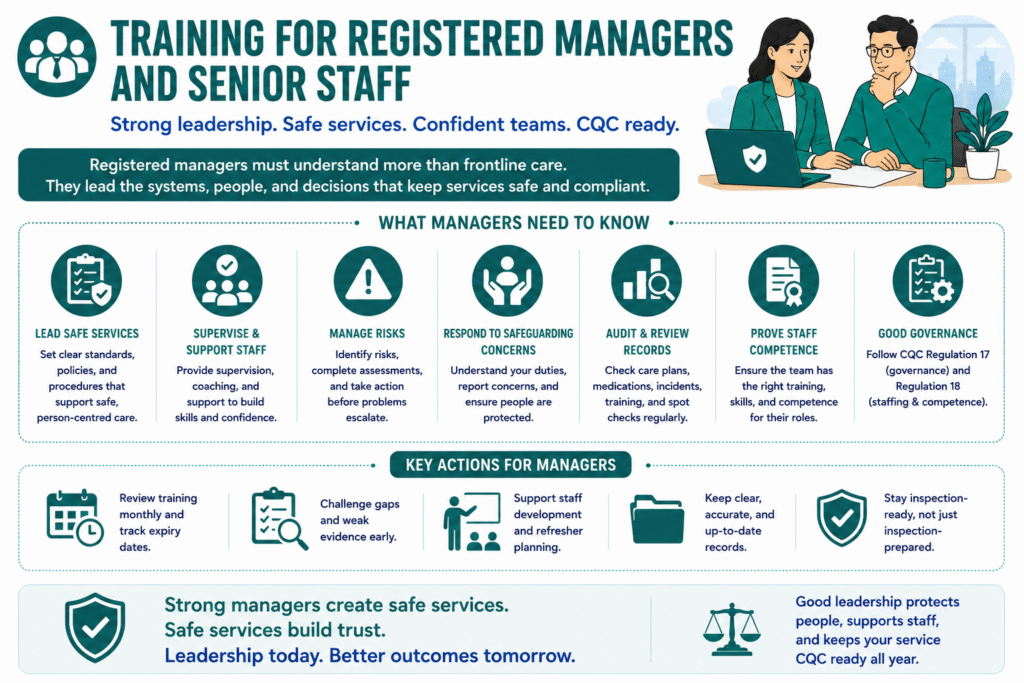
CQC training for registered managers should go beyond frontline care topics. A registered manager must know how to lead safe services, supervise staff, manage risk, respond to safeguarding concerns, audit records, investigate incidents, and prove that the team has the right skills for the people they support.
Senior staff also need strong knowledge of governance. They should understand how training links to care plans, risk assessments, complaints, medication audits, spot checks, and staff supervision. If a care worker makes a mistake, managers should be able to show what training the worker received, when they received it, how the service checked competence, and what action followed.
Many people ask how many CQC regulations are there, but care providers should focus less on memorising numbers and more on applying the regulations that affect daily care. Regulation 18 covers staffing and staff competence, while Regulation 17 covers good governance, systems, and processes. Together, they show why training records, competency checks, and management oversight matter.
For Care Sync Experts, strong managers do not wait for CQC to find gaps. They review training monthly, challenge weak evidence, support staff early, and keep the service inspection-ready all year.
How to Prove Training Compliance During Inspection
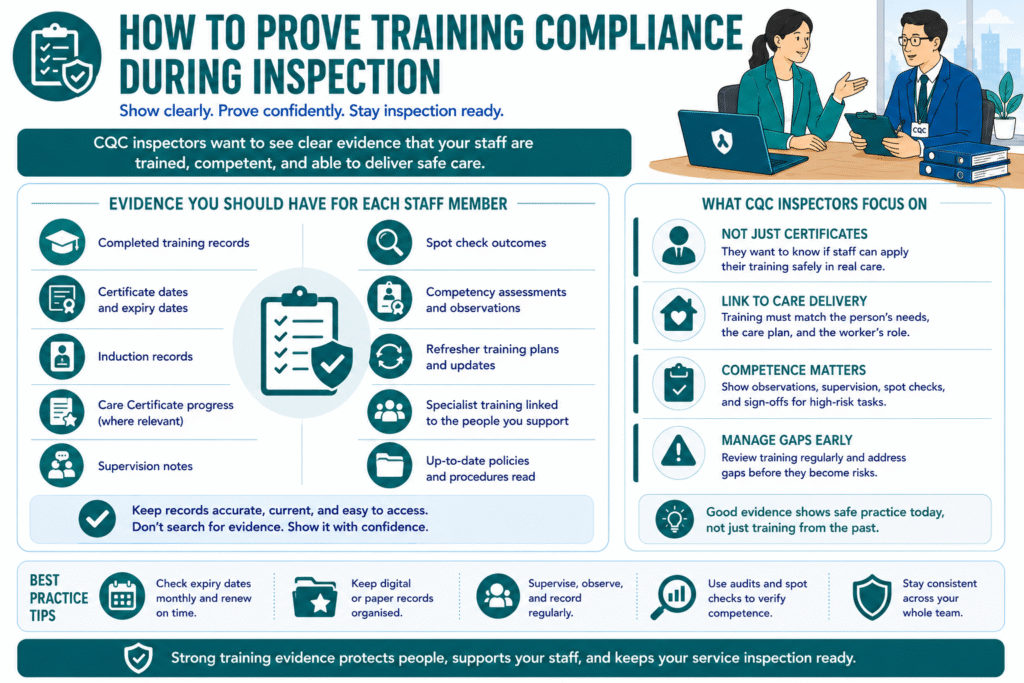
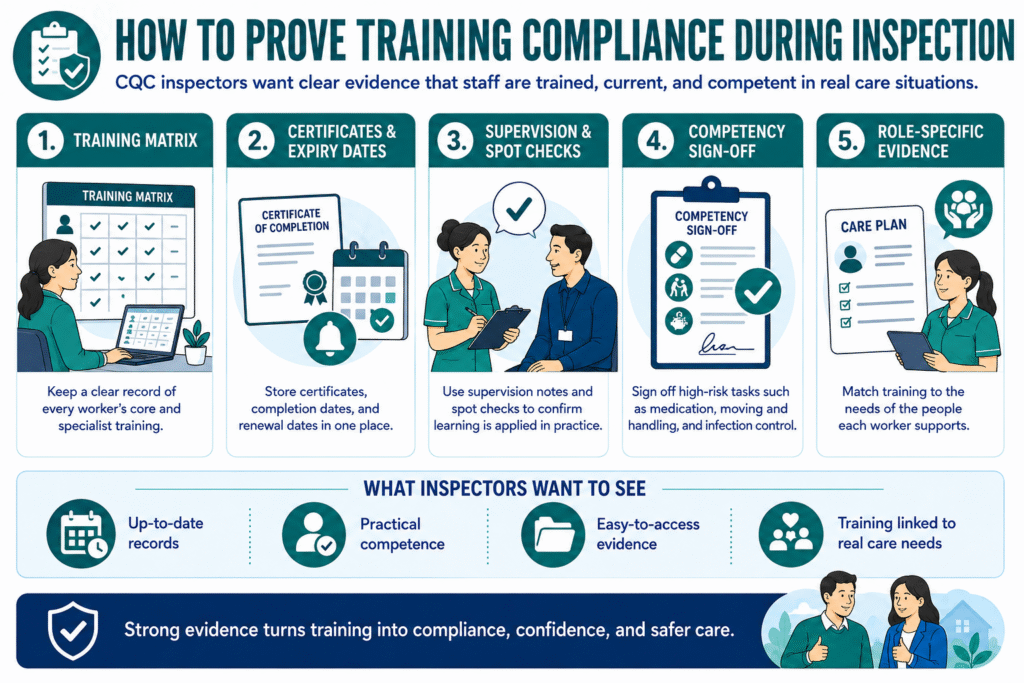
CQC inspectors do not only want to see a folder full of certificates. They want to know whether your staff can use their training safely in real care situations.
A strong provider should be able to show clear evidence for each worker, including:
- Completed training records
- Certificate dates and expiry dates
- Induction records
- Care Certificate progress where relevant
- Supervision notes
- Spot check outcomes
- Competency assessments
- Refresher training plans
- Specialist training linked to the people they support
For example, if a care worker supports medication, your records should show more than a medication course. They should also show that the worker understands your medication policy, follows the care plan, records correctly, reports errors, and has been observed as competent.
The same applies to moving and handling, infection control, safeguarding, dementia care, catheter care, or any higher-risk task. Training should link directly to the person’s needs and the worker’s responsibilities.
We encourage providers to treat training evidence as a live compliance system. Review gaps monthly, update records before certificates expire, and keep proof easy to access. When CQC asks for evidence, you should not need to search through old emails, loose papers, or outdated spreadsheets.
MORE: CQC Nominated Individual vs Registered Manager (2026): What You Need to Know?
Final Compliance Checklist for Care Providers
Before inspection, every provider should check whether their training system can prove safe practice, not just course completion. Strong CQC-mandated training for care workers should demonstrate that staff understand their duties, manage risks effectively, and support people with confidence.
Use this checklist:
- Every worker has training that matches their role
- New starters have started or completed the Care Certificate where appropriate
- Staff refresh key training before it expires
- Managers record supervision, spot checks, and observations
- High-risk tasks have practical competency sign-off
- Training links clearly to the needs of people using the service
- Records are accurate, current, and easy to access
- Managers review gaps regularly instead of waiting for inspection
Care providers should also review safeguarding knowledge often. Adult safeguarding in England follows six key principles: empowerment, prevention, proportionality, protection, partnership, and accountability.
The strongest providers do not treat training as a yearly admin task. They use it to protect people, support care workers, reduce risk, and prove that the service can deliver safe, person-centred care every day. At Care Sync Experts, that is the standard we believe every care business should aim for.
FAQ
What are the 4 types of caregivers?
The four common types of caregivers are family caregivers, professional caregivers, volunteer caregivers, and informal caregivers. A family caregiver may support a parent, spouse, child, or relative without being paid. A professional caregiver, such as a care worker or support worker, provides care as part of a paid role.
Volunteer caregivers support through charities or community groups, while informal caregivers may include friends, neighbours, or trusted people who help regularly.
What is the difference between a carer and a care worker?
A carer can be anyone who supports another person with daily living, health needs, emotional support, or personal care. This may include a family member or friend. A care worker usually means someone employed by a care provider to deliver professional support. Care workers often follow care plans, record visits, report concerns, and complete role-specific training as part of their job.
What skills do I need to be a good carer?
A good carer needs patience, kindness, communication skills, observation, reliability, respect, and confidence in following care plans. Strong carers notice small changes, protect dignity, listen carefully, and know when to report concerns.
Practical skills also matter, especially when supporting personal care, mobility, medication prompts, dementia care, safeguarding, or end-of-life support.
What is another word for mandatory training?
Another word for mandatory training is compulsory training. In care, people may also call it statutory training, required training, essential training, or core training. The best term depends on the subject. For example, some training is required by law, some is required by the employer, and some is needed because the worker’s role carries specific risks.