Domiciliary Care Business Plan:
How to Start a CQC-Ready Agency in 2026

Text to speech
Duration: 00:00
Font size
Published: 22 Jun, 2026
Share this on:
A domiciliary care business plan is the practical blueprint for starting and running a safe, sustainable home care agency. It should show who you will support, the services you will provide, how you will recruit and manage carers, how you will meet CQC requirements, how you will attract clients, and how the business will remain financially stable.
If you plan to provide personal care in England, you will usually need to register with the Care Quality Commission. Your plan must show that you can deliver safe, person-centred care with the right leadership, trained staff, clear systems, and enough financial resources to operate properly.
A strong CQC domiciliary care business plan does not focus only on profit. It shows how you will protect clients, respond when care needs change, support your carers, and maintain reliable visits every day.
Whether you want to know how to start a domiciliary care agency, how to start a home care business, or how to open a care agency, start with one question:
Can this business deliver dependable care even when staffing, client needs, or daily pressures change?
That question should shape every part of your plan.

Why Your Domiciliary Care Business Plan Must Work in Real Life
A domiciliary care business plan should do more than help you apply for registration, approach lenders, or impress potential investors. It should help you run safe care every day.
From a caregiver’s perspective, the real test starts when the rota changes at short notice, a client’s needs increase, a carer calls in sick, or traffic delays a morning visit. Your plan should already explain what your team will do, who takes responsibility, and how you will keep the client safe.
A strong domiciliary care business plan example should answer practical questions such as:
- Can you cover every visit safely and on time?
- Have you allowed for travel time between clients?
- Can your hourly rate cover wages, mileage, training, insurance, software, and management?
- Who provides emergency cover when a carer cannot attend?
- How will you communicate with families when support changes?
- Can you maintain quality while your client numbers grow?
A good CQC domiciliary care business plan turns these questions into systems. It sets out how you will plan rotas, train carers, monitor missed calls, manage risks, review care plans, and respond to incidents.
The strongest agencies do not wait for problems before they act. They build reliable systems early, so carers can focus on what matters most: delivering safe, respectful, person-centred care.
RELATED: How Much Does CQC Registration Cost in 2026?
Define Your Services, Clients, and Care Promise
When you start a domiciliary care agency, avoid saying you will provide every type of care to everyone. A clear service focus helps you recruit the right carers, set safe prices, create suitable policies, and build trust with families.
Start by deciding what your agency can deliver well. You may offer:
- Personal care, including washing, dressing, continence support, and grooming
- Companionship and social support
- Meal preparation and daily living support
- Medication prompts or support within your governance process
- Dementia care
- Respite care for family carers
- Night care or live-in care
- Support after hospital discharge
Choose services your team can provide safely and consistently, not services that only sound profitable. For example, complex care may bring higher fees, but it also demands stronger clinical oversight, specialist training, robust risk assessments, and dependable emergency cover.
You also need to define who you want to support. Your target clients may include older adults, people living with dementia, adults with physical disabilities, people recovering after hospital treatment, or people who need regular support to remain independent at home.
Your care promise should explain why families should choose you. It could focus on continuity of carers, fast response times, specialist dementia support, culturally sensitive care, flexible visit times, or stronger family communication.
A clear care promise makes it easier to answer the question, “How do I start a care agency?” You start by knowing exactly who you will help, what support you will provide, and how you will deliver it better than local alternatives.
Build a CQC-Ready Operating Model
A strong domiciliary care agency needs more than a good idea and a list of services. It needs clear systems that help carers deliver safe, consistent care every day.
Your operating model should show who leads the service, how carers work, how you record care, and how you respond when something goes wrong. For a CQC domiciliary care business plan, this means showing that your agency can manage people, risks, records, and quality from the first client onwards.
Start with leadership. Decide who will act as the registered manager, who will manage rotas, who will handle safeguarding concerns, and who will support carers outside normal working hours. Families need to know that someone takes responsibility when care changes or an emergency happens.
Then build the core care systems:
- Safe recruitment, DBS checks, references, and right-to-work checks
- Staff induction, training, supervision, and competency reviews
- Care plans and risk assessments for every client
- Safeguarding procedures and whistleblowing routes
- Medication policies and clear recording processes
- Incident reporting, complaints handling, and quality audits
- Secure client records and data protection controls
- Regular care reviews with clients and families
Your agency should also explain how carers communicate changes. A care plan only works when carers read it, follow it, and report when a client’s needs change.
When people ask how to start a domiciliary care agency in UK, this is where many plans become weak. They list policies but do not explain how the agency will use them in real life. A CQC-ready agency shows how those policies guide daily decisions, protect clients, and support carers to do their jobs well.
READ MORE: How Long Does CQC Registration Take? 2026 Update
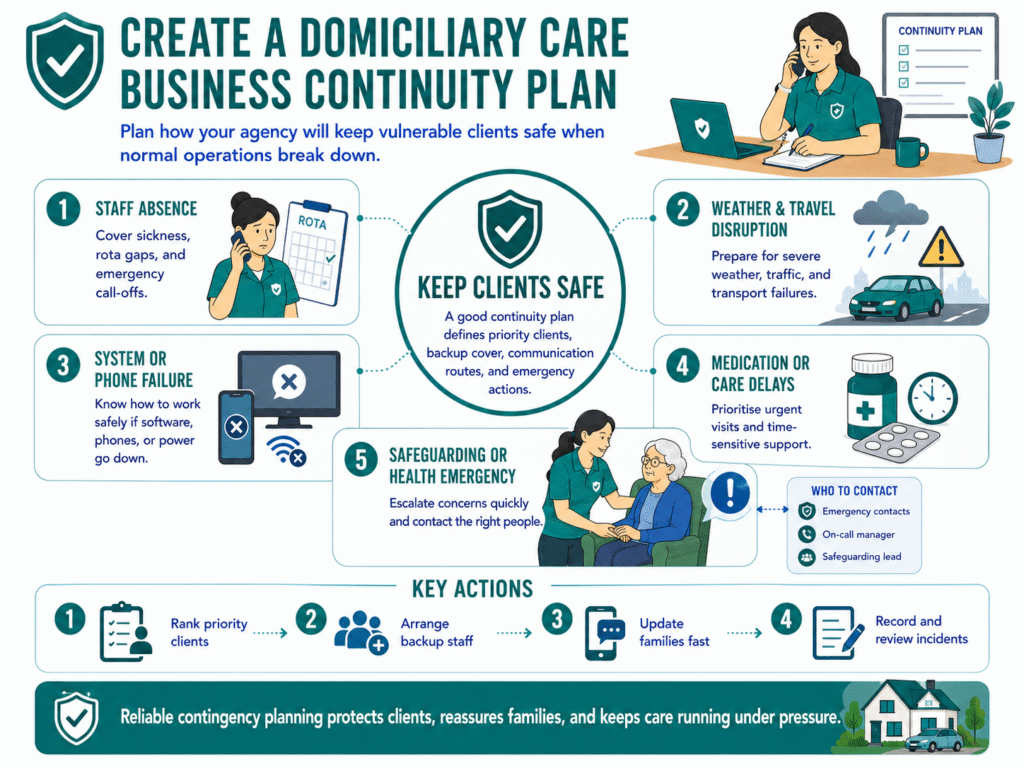
Create a Domiciliary Care Business Continuity Plan
Your domiciliary care business continuity plan explains how your agency will keep clients safe when normal operations break down. It is not just a document for a folder. It is the plan your team follows when a carer cannot attend, roads close, systems fail, or a client needs urgent support.
In home care, small disruptions can quickly become serious. A missed morning visit may mean someone does not receive medication, food, mobility support, or help getting out of bed. Your plan should make it clear who notices the problem, who contacts the client, who arranges cover, and who updates the family.
Your continuity plan should cover:
- Carer sickness, absences, and rota gaps
- Severe weather, traffic disruption, or transport failures
- Power cuts, phone outages, and care-management software issues
- Medication delays or missed deliveries
- Safeguarding concerns and emergency escalation
- Hospital admissions or sudden changes in care needs
- Family communication during disruptions
- Backup staff, on-call cover, and priority client lists
A good domiciliary care business continuity plan also ranks clients by urgency. For example, clients who need time-sensitive medication, hoisting, insulin support, or essential personal care may need priority cover before lower-risk visits.
The key question is simple: if the rota collapses at 6am, how will your agency make sure vulnerable clients still receive safe care?
A strong answer protects clients, reassures families, and shows that your agency can deliver reliable care under pressure.
Plan Your Staffing, Rotas, and Recruitment Costs
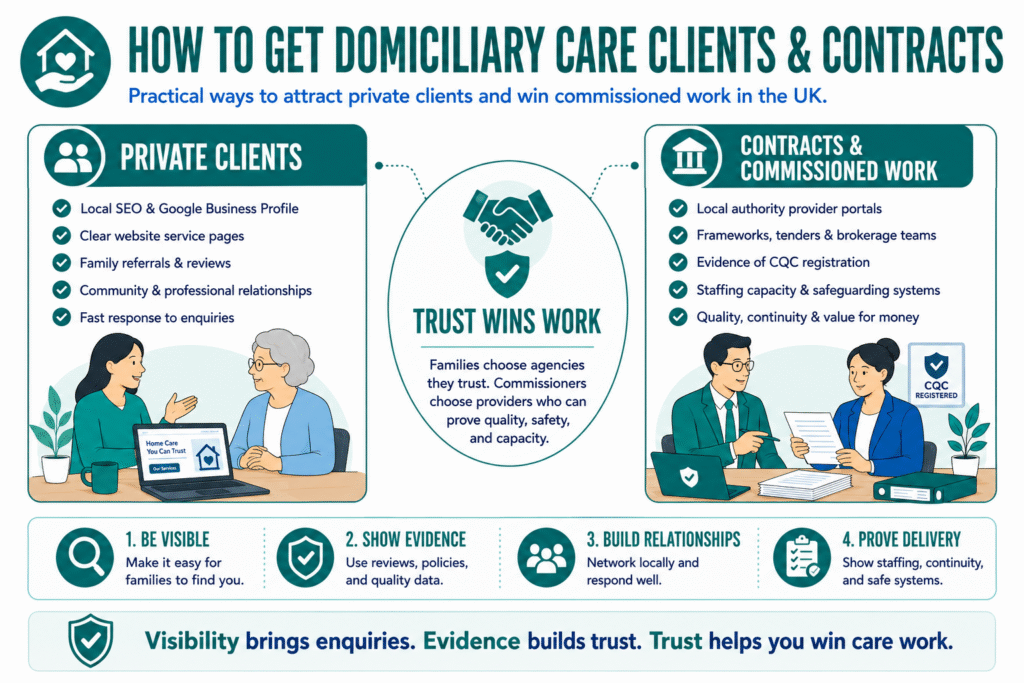
Your first major challenge is not designing a logo or launching a website. It is building a care team that shows up, delivers good care, and stays with your agency.
A domiciliary care business depends on reliable people. Families notice quickly when carers arrive late, unfamiliar faces appear too often, or visits change without clear communication. Your business plan should show how you will recruit, train, support, and retain carers from day one.
Start with your staffing model. Work out how many care hours you expect to deliver each week, how many carers you need to cover those hours, and how much time each visit requires. Include travel time, handovers, training, annual leave, sickness, supervision, and emergency cover.
Your plan should also set out:
- Your recruitment process, including DBS checks, references, right-to-work checks, and interviews
- Required training, such as safeguarding, moving and handling, medication, infection prevention, and dementia awareness
- How you will check competency before carers work alone
- How supervisors will support carers and review performance
- How you will manage on-call cover outside office hours
- How you will reduce missed calls, late visits, and rushed care
- How you will retain staff through fair pay, mileage support, recognition, and regular communication
Do not build your rota around perfect attendance. Plan for sickness, emergencies, and turnover from the start.
A strong agency gives carers enough time to travel, read care notes, and support clients properly. When carers feel rushed or unsupported, quality drops. When carers feel valued and prepared, clients receive more reliable, consistent care.
SEE ALSO: CQC Mandatory Training for Care Workers: 2026 Update
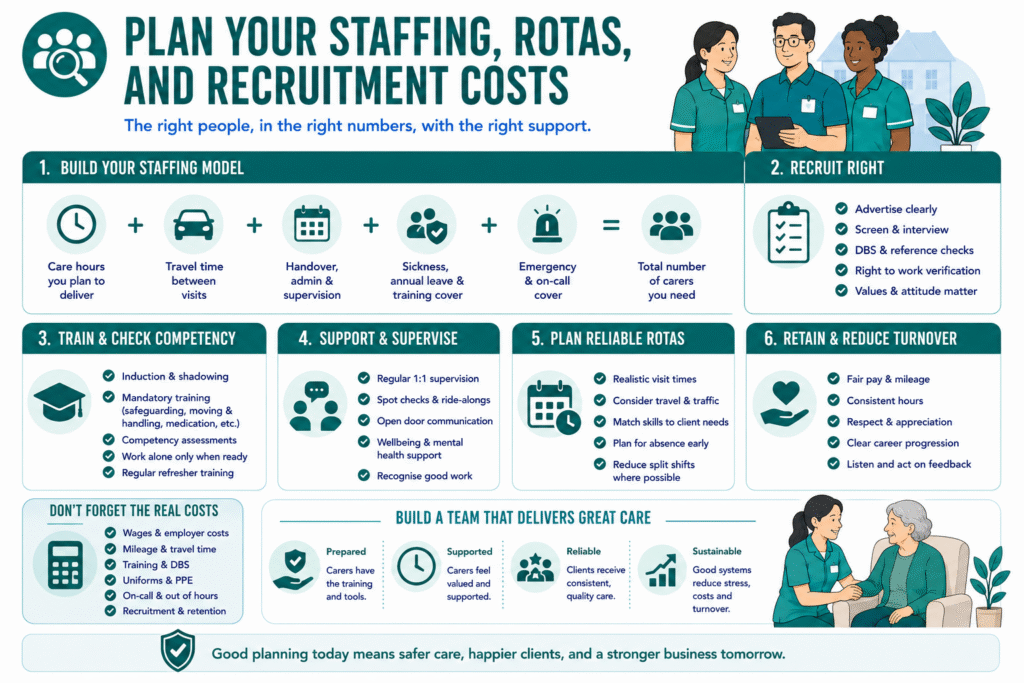
How to Get Domiciliary Care Clients and Contracts
A strong service needs clients, but new agencies should not rely on one source of work. Your business plan should explain how you will attract private-pay clients while also preparing for local authority, NHS, or commissioned opportunities where suitable.
To get domiciliary care clients, start with trust. Families often search online when care becomes urgent, so your website should clearly explain your services, locations, care approach, contact process, and availability. Build local pages for the areas you serve, keep your Google Business Profile accurate, and collect genuine reviews once you begin delivering care.
You can also build referrals through local relationships. Speak with community groups, hospitals, discharge teams, charities, pharmacies, faith groups, and professionals who support older adults and vulnerable people. Do not approach these relationships as a quick sales route. Show that your agency communicates well, responds reliably, and puts client safety first.
For private work, focus on the question families ask: “Can I trust this agency to care for my parent properly?” Make it easy for them to find answers about your carers, care plans, continuity, pricing approach, and emergency support.
To get contracts for domiciliary care, monitor local authority provider portals, tender opportunities, framework agreements, and brokerage routes. Commissioners often expect evidence of CQC registration, safeguarding systems, financial stability, staff capacity, quality assurance, and the ability to meet agreed care hours.
The best answer to how to get home care clients is not simply “run adverts.” Build a visible, credible agency that families recommend and commissioners can trust.
Build a Financial Plan Before You Launch
A domiciliary care agency can look busy and still run out of cash. Your financial plan must show how the business will pay carers, cover overheads, manage delayed payments, and remain stable while client numbers grow.
Start with your launch costs. Include CQC registration and compliance preparation, insurance, DBS checks, recruitment, training, uniforms, care management software, phones, office costs, marketing, and a payroll buffer. Do not forget mileage, unpaid travel time, employer pension contributions, holiday pay, and on-call cover.
Then build a monthly forecast around the care hours you expect to deliver. Your plan should show:
- Your average hourly care rate
- Carer wages and employment costs
- Mileage and travel time
- Management and coordination costs
- Training and recruitment spending
- Software, insurance, and office costs
- Marketing costs
- The number of weekly care hours needed to break even
A useful sample business plan for domiciliary care agency does not only show projected income. It shows whether the agency can keep paying staff before client payments arrive.
For example, a new agency may win several clients quickly, but each new client can increase recruitment pressure, rota costs, management time, and travel expenses. Growth only helps when your pricing covers the real cost of delivering safe care.
Your domiciliary care business plan example should also explain how you will fund the first few months. You may use personal savings, business loans, investors, grants, or a combination of funding sources. Whatever route you choose, keep enough working capital to protect care delivery while the business builds stable weekly hours.
MORE: SME Spend Targets: How to Win More Public Contracts in 2026
Domiciliary Care Agency vs Care Home or Supported Living Business
A domiciliary care agency supports people in their own homes. Your carers travel to clients, follow individual care plans, and help people stay safe and independent in familiar surroundings.
A care home works differently. It provides accommodation, meals, staffing, and care in one setting. If you want to know how to open a care home UK, you need to plan for a suitable property, higher staffing levels, premises safety, resident rooms, food provision, and around-the-clock care. That makes it a very different business model from domiciliary care.
Supported living also differs from both. When people ask how to set up a supported living business UK, they usually mean a service that helps people live more independently in their own tenancy or shared accommodation. The support may include daily living skills, personal care, medication, community access, and help managing a home.
Your business plan should stay focused on the model you actually want to run. Do not copy a care home plan into a domiciliary care agency application. The staffing, property needs, financial risks, and care delivery methods are different.
Choose domiciliary care when you want to provide flexible support in people’s homes. Choose a care home or supported living model only when you understand the extra property, staffing, commissioning, and compliance demands that come with it.
Final Checklist Before You Submit or Launch
Before you submit your registration documents, approach investors, or accept your first client, check that your domiciliary care business plan answers the practical questions that matter.
Use this final checklist:
- Have you defined the care services you will provide?
- Have you identified your target clients and service area?
- Do you have a clear care promise that sets you apart?
- Have you planned safe recruitment, DBS checks, training, supervision, and on-call cover?
- Do you have care planning, safeguarding, medication, complaints, and incident-reporting systems?
- Have you created a domiciliary care business continuity plan for staffing gaps and emergencies?
- Do you know how you will get private clients, referrals, or local authority contracts?
- Have you calculated your real staffing, travel, training, insurance, and management costs?
- Do you have enough cash to pay carers while the business grows?
- Can you show CQC, families, and future partners that your agency can deliver safe, reliable care?
The strongest home care agencies do not grow by chasing every client or cutting every cost. They grow by building systems that help carers deliver dependable, respectful, person-centred care every day.
Ready to Build a Stronger Care Business?
Starting a domiciliary care agency takes more than a good idea. You need clear systems, confident leadership, and a plan that protects both clients and carers.
Care Sync Experts provides practical guidance to help care providers build safer, stronger, CQC-ready services from day one.
FAQ
What is the description of domiciliary care?
Domiciliary care, also called home care, provides support to people in their own homes. It can include personal care, medication support, meal preparation, companionship, mobility assistance, dementia care, respite care, and help with daily routines. The aim is to help people live safely and independently at home for as long as possible.
How do I write a business plan sample?
Start with a simple structure: executive summary, business description, services, target market, competitor research, marketing plan, staffing plan, operations, financial forecast, and risk management. A good sample business plan uses real numbers, clear responsibilities, and practical actions rather than vague promises.
What are the 10 duties of a caregiver?
A caregiver’s duties can include:
– Supporting personal care
– Preparing meals and encouraging hydration
– Helping with mobility and transfers
– Providing companionship
– Supporting medication routines where agreed
– Keeping the home environment safe
– Following the person’s care plan
– Recording changes in health or behaviour
– Communicating with families and care managers
– Protecting dignity, privacy, and independence
What are the top 3 qualities of a caregiver?
The three most important qualities are:
Compassion: treating people with patience, kindness, and respect.
Reliability: arriving on time, following the care plan, and doing what you say you will do.
Communication: listening carefully, explaining support clearly, and reporting changes quickly.