DWP Benefit Changes 2026: Which Payments Are Ending
DWP Benefit Scrapping 2026: Latest Update
Text to speech
00:00
5sec
Duration: 00:00
Font size
Published: 22 Apr, 2026
Share this on:
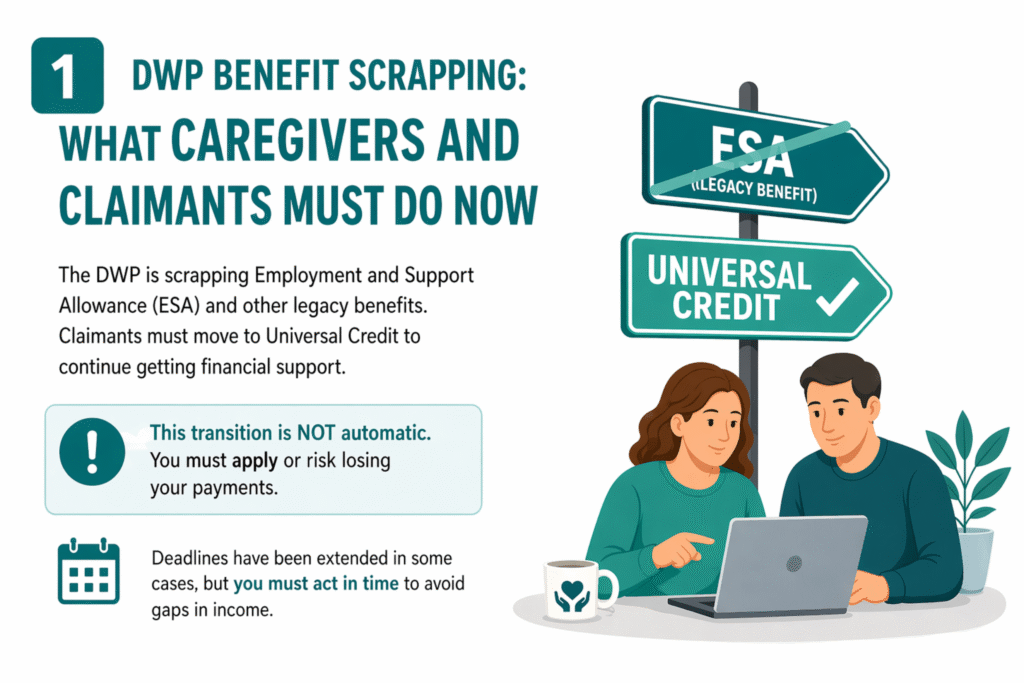
The Department for Work and Pensions (DWP) is scrapping Employment and Support Allowance (ESA) as part of a wider DWP benefit scrapping programme. Claimants must move to Universal Credit (UC) to continue receiving financial support, as the government phases out legacy benefits. This transition is not automatic; people must apply for Universal Credit or risk losing their payments.
The DWP has extended deadlines in some cases to support vulnerable claimants, but the responsibility still falls on individuals and caregivers to act in time. Care providers should identify clients receiving ESA and guide them through the transition early to avoid disruptions in income.
While this reform focuses on ESA, it also signals broader welfare changes. Many families are now asking whether other policies, such as the two child benefit cap, will also change under ongoing government reviews.
The current wave of DWP benefit scrapping is not just a policy change; it directly affects how caregivers support vulnerable people every day.
If you run a care agency or support clients on ESA, you now carry a bigger responsibility. You must identify which clients still receive legacy benefits and help them transition to Universal Credit before deadlines pass. Many clients, especially elderly or disabled individuals, do not fully understand the process or may assume payments will continue automatically.
For families, the impact can be immediate. A missed application can stop income entirely. That creates stress, increases dependency on care providers, and can even affect a person’s ability to afford basic needs like housing, food, and medication.
Care providers must also prepare for increased workload. You may need to:
Explain benefit changes in simple terms
Help clients gather documents
Support online applications
Follow up on claims and deadlines
This shift also connects to wider welfare concerns. Families already dealing with limits like the 2 child cap UK rules may face additional financial pressure as benefits change. When combined with ongoing uncertainty around policies like the two child benefit cap, the risk of financial instability grows.
In short, DWP benefit scrapping turns caregivers into frontline support for both care and financial guidance. Acting early protects your clients and reduces crisis situations later.
Why ESA and Other Legacy Benefits Are Being Scrapped
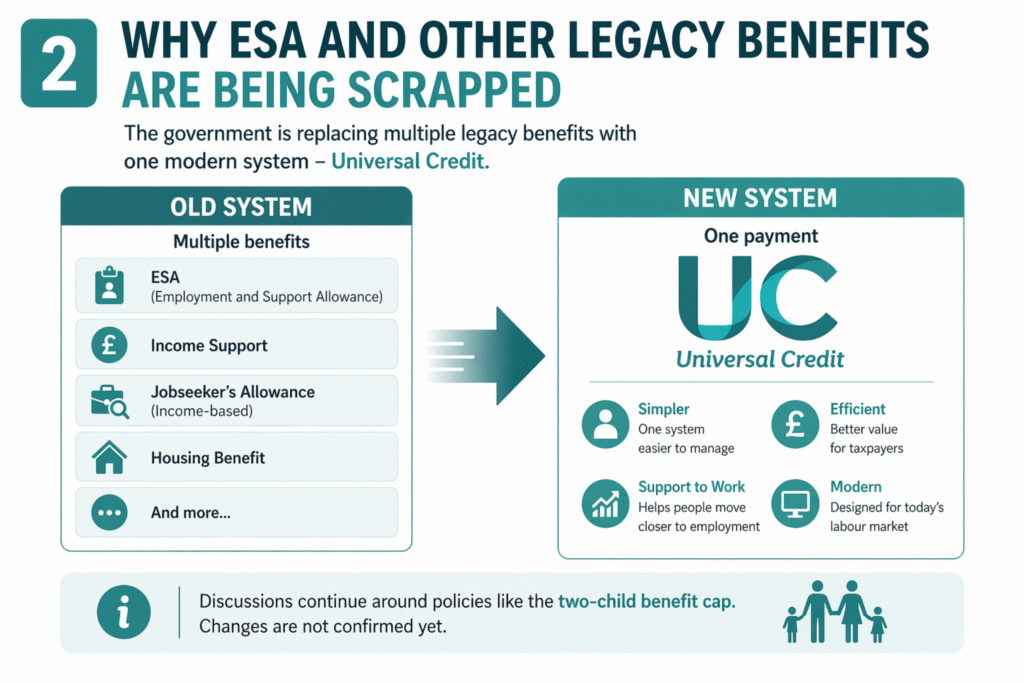
The DWP is scrapping ESA and other legacy benefits to replace them with a single system: Universal Credit. This move forms a key part of the wider DWP benefit scrapping programme aimed at simplifying welfare and encouraging people to move closer to work where possible.
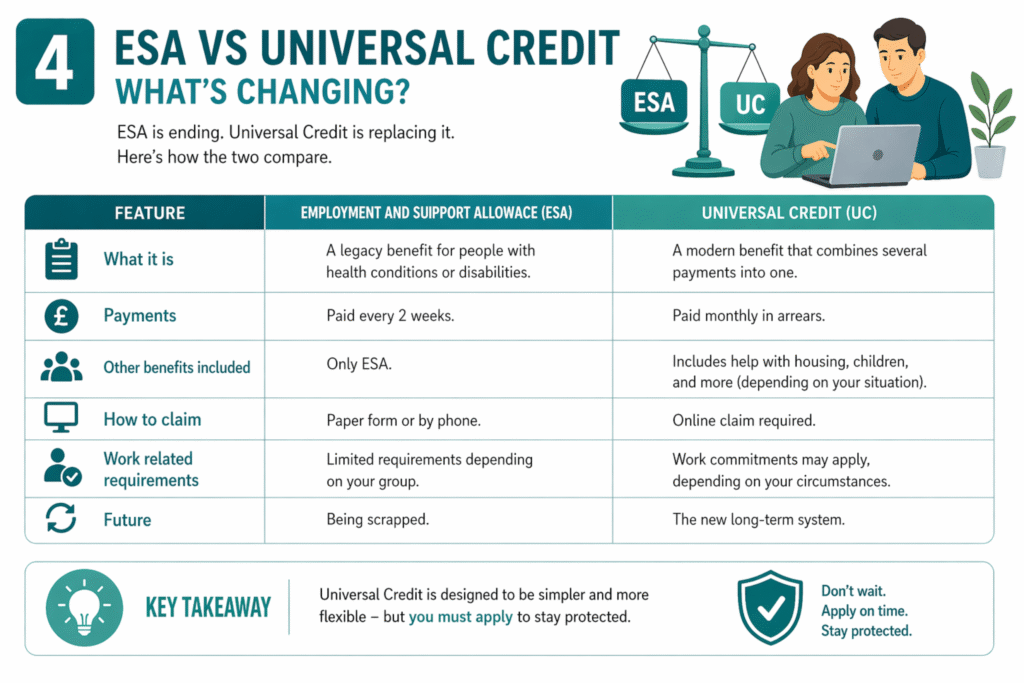
Universal Credit combines several older benefits, including ESA, Income Support, and income-based Jobseeker’s Allowance, into one monthly payment. The government argues that this system better reflects today’s labour market and provides clearer pathways into employment.
Universal Credit is designed to replace multiple legacy benefits with a single payment that adjusts based on income, employment status, and personal circumstances.
From a policy standpoint, the goal is efficiency. Instead of managing several separate benefits, the DWP wants one streamlined system that is easier to administer and monitor. However, for many claimants and caregivers, the transition creates confusion and risk, especially because the process requires action.
This change also raises broader questions about the future of welfare limits. Many families now ask whether policies like the two-child benefit cap will change alongside these reforms. While discussions continue, particularly around whether the two-child benefit cap will be lifted or adjusted under future budgets, no universal change has been confirmed yet.
For now, the priority remains clear: ESA is ending, and Universal Credit is replacing it. Care providers must treat this as an active transition, not a passive update.
What You Must Do Before ESA Is Scrapped
Checklist Before ESA transitions
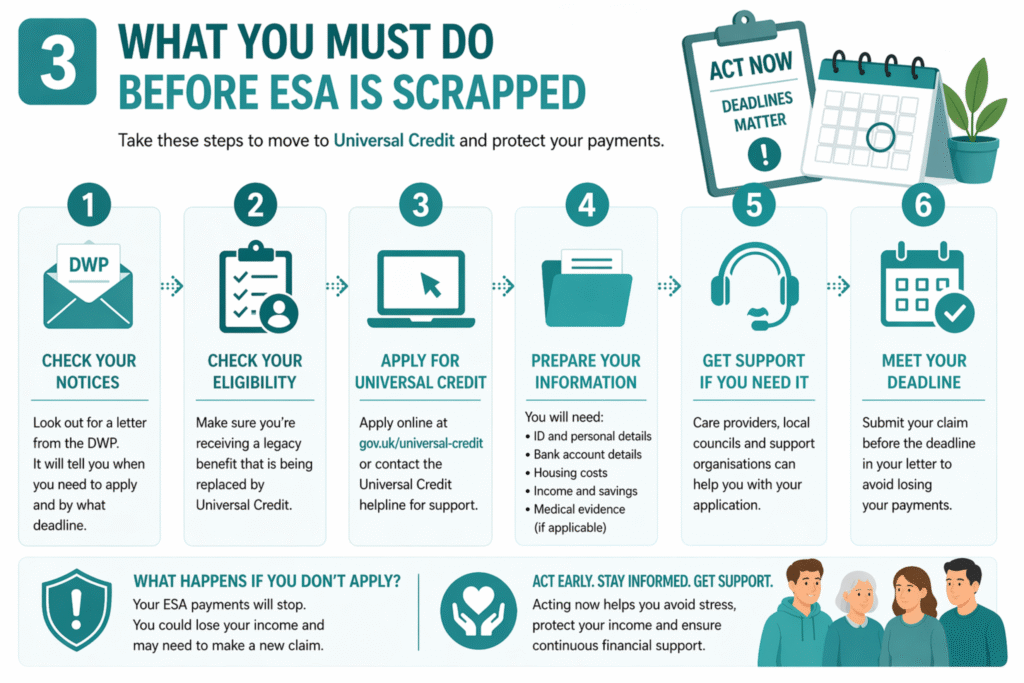
If you or someone you support still receives ESA, you must act now. The DWP will not move you automatically. You must apply for Universal Credit before your deadline to keep receiving financial support.
The move to Universal Credit is not automatic. Claimants must apply or risk losing their payments completely.
Follow these steps to stay protected:
Check eligibility immediately Confirm whether you receive income-related ESA or another legacy benefit being replaced
Watch for official DWP letters The DWP sends a migration notice with a deadline to apply
Apply for Universal Credit early Do not wait until the last minute—processing delays can affect payments
Prepare required information Gather ID, bank details, housing costs, and medical evidence if needed
Seek support if needed Care providers, local councils, and support organisations can guide you through the process
For caregivers, this step is critical. Many vulnerable clients may ignore letters, misunderstand instructions, or struggle with online applications. You should actively monitor their situation and assist with submissions to prevent missed deadlines.
This transition also connects to wider concerns about benefit limits. Families moving to Universal Credit often ask whether policies like the two child benefit cap will change or whether the benefit cap is being lifted on Universal Credit. While these questions remain under review, they do not affect the immediate requirement to apply.
Act early, stay organised, and ensure every affected claimant completes their application before the deadline.
What Happens If You Don’t Move to Universal Credit
If a claimant does not switch in time, the DWP will stop their ESA payments. The system does not transfer benefits automatically, and missing the deadline can leave people without income.
If you do not apply for Universal Credit before your deadline, your ESA payments will end and you may not receive backdated support.
This situation creates serious risks, especially for vulnerable individuals. Without a successful application:
Monthly income stops completely
Housing payments may be affected
Bills and essential costs become harder to manage
Reapplying later can cause delays and financial gaps
For caregivers, this is where proactive support matters most. You must not assume clients will act on their own. Many people miss deadlines because they:
Ignore DWP letters
Do not understand the process
Struggle with digital applications
From a wider perspective, these risks add to existing financial pressure on families already affected by limits like the 2 child cap UK rules. Questions such as “is the benefit cap being lifted for everyone?” or whether support will increase do not change the immediate reality, missing the migration deadline leads to lost payments.
Acting early prevents crisis. Waiting increases the chance of financial hardship.
Will the Two-Child Benefit Cap Be Scrapped in 2026? Latest Updates
dwp benefit changes
The current wave of DWP benefit scrapping has pushed more families to ask a bigger question: Will the two-child benefit cap be scrapped in 2026?
Right now, the policy remains in place. The two child benefit cap limits financial support to the first two children in most households claiming benefits like Universal Credit. Families with more than two children do not receive additional payments for extra children under this rule.
The two-child benefit cap restricts Universal Credit and tax credit payments to a maximum of two children in most cases.
Recent discussions, especially around the autumn budget 2025 2 child cap and political debates involving figures like Rachel Reeves child benefit cap proposals—have increased expectations that the policy could change. Some reports suggest a possible UK two-child limit abolition, but no confirmed timeline exists.
Here’s what we know so far:
The policy is still active across the UK
No official confirmation of a full removal yet
Ongoing debate continues within government and policy circles
Any change would likely come through a future budget announcement
Many families also search for:
“when will the 2 child benefit cap be scrapped”
“when does the 2 child cap end”
“two-child benefit cap scrapped”
At this stage, these remain unanswered. No confirmed date has been announced.
For caregivers, this matters because families transitioning to Universal Credit may expect increased support that does not yet exist. Managing expectations is critical. You should clearly explain that while discussions continue, the policy still applies today.
In short, while the two-child benefit cap will be lifted remains a possibility in future reforms, caregivers and claimants must plan based on current rules, not speculation.
2 Child Benefit Cap Lifted: How Much Will Families Get?
dwp benefit scrapping
Many families moving to Universal Credit ask the same question: “If the 2 child benefit cap is lifted, how much will I get?”
Right now, there is no confirmed change. The two-child benefit cap still limits payments to the first two children in most households. That means families do not receive additional Universal Credit amounts for a third or subsequent child under current rules.
If the two-child benefit cap is lifted, eligible families would receive additional Universal Credit payments for each extra child, increasing their total monthly income.
To understand the impact, here’s what would change if the policy were removed:
Families with more than two children would qualify for extra child elements under Universal Credit
Monthly payments would increase based on the number of additional children
Financial pressure on larger families would reduce significantly
For example, when people search:
“2 child benefit cap lifted how much will I get”
“2 child benefit cap lifted how much will I get universal credit”
They are trying to estimate how much extra support they could receive. While exact figures depend on individual circumstances, each additional child element in Universal Credit is worth thousands of pounds per year. Removing the cap would therefore create a meaningful increase in household income.
However, it’s important to stay grounded in current policy. There is no automatic payment or confirmed rollout yet. Questions like “will the 2 child benefit cap be automatically paid” or “will the 2 child benefit cap be backdated” remain speculative.
For caregivers and support workers, this is where clear communication matters. Many clients may expect immediate financial relief due to ongoing debates or media headlines. You must explain that:
The cap is still in place today
No confirmed payment increase has been announced
Any future change would likely require a formal policy update
Until then, families should plan based on existing Universal Credit rules, not future expectations.
Care Provider Checklist: How to Support Clients Through Benefit Changes
Why legacy benefits are being replaced
Care providers play a critical role during this period of DWP benefit scrapping. You are often the first point of support when clients feel confused, overwhelmed, or at risk of losing income.
Use this checklist to stay proactive and protect your clients:
Identify At-Risk Clients
Review your records and flag anyone receiving ESA or other legacy benefits. Prioritise clients with disabilities, limited digital skills, or no family support.
Communicate Early and Clearly
Explain the changes in simple terms. Tell clients:
ESA is ending
They must apply for Universal Credit
Missing deadlines can stop payments
Avoid assumptions, many clients do not understand official letters.
Support the Application Process
Help clients:
Create Universal Credit accounts
Upload required documents
Complete identity checks
Where possible, sit with them during the application to avoid errors.
Track Deadlines and Follow Up
Set reminders for each client’s migration deadline. Check progress regularly and confirm that applications have been submitted successfully.
Manage Expectations Around Policy Changes
Clients may ask about:
“when will the two child benefit cap be lifted”
“two-child benefit cap removed”
“is child benefit going up”
Be clear: these changes are not confirmed yet. Focus clients on what they must do now, not what might happen later.
Monitor Financial Stability
Watch for early signs of financial stress:
Missed rent
Reduced food spending
Anxiety about bills
Step in early and connect clients with additional support if needed.
Stay Updated on Policy Changes
Welfare rules continue to evolve. Follow updates on:
Universal Credit changes
Potential reforms like the 2 child cap
Budget announcements affecting benefits
By following this checklist, you move from reactive support to proactive care. You protect your clients from sudden income loss, and strengthen your role as a trusted guide during uncertain policy changes.
Conclusion
The current wave of DWP benefit scrapping is already changing how caregivers support clients across the UK. ESA is ending, Universal Credit is replacing it, and the transition requires action, not assumptions.
For care providers, this is more than a policy update. It directly affects your clients’ financial stability, well-being, and trust in your service. Acting early, guiding clearly, and staying informed will prevent avoidable crises.
At the same time, wider reforms, like ongoing debates around the two-child benefit cap, continue to shape expectations. But until confirmed, the priority remains simple: help every affected client complete their transition on time.
Care Sync Experts helps you manage applications, compliance, and updates with confidence.
FAQ
Can DWP check your bank account?
The DWP does not routinely monitor your bank account, but it can request access to financial information if it suspects fraud or needs to verify a claim. In some cases, they may work with banks or use data-sharing powers to confirm income and savings.
Can the DWP just stop my benefits?
Yes, the DWP can stop your benefits if you fail to meet eligibility rules, miss a required action (like moving to Universal Credit), or do not respond to official requests. Payments can also stop if your circumstances change and you do not report it.
What triggers a DWP bank check?
A bank check may be triggered by: Suspected fraud or incorrect claims – Unreported income or savings – Data mismatches between government systems – Random compliance reviews
Keeping your information accurate and up to date reduces the risk of checks.
Will I lose my PIP if I inherit money?
No, inheriting money does not automatically stop Personal Independence Payment (PIP). PIP is not means-tested, so it does not depend on your savings or income. However, if your condition improves or your circumstances change, the DWP may review your claim.