How to Choose Home Care Agencies in the UK (2026)
Text to speech
Duration: 00:00
Font size
Published: 23 Jan, 2026
Share this on:
You usually don’t plan to search for care agencies near me. Something happens. A fall. A hospital discharge. A slow decline you can no longer manage alone. Suddenly, you must make a decision that feels urgent, emotional, and high-stakes.
You open Google. You see star ratings. Photos. Promises of “compassionate care.” But before you trust anyone to step into your parent’s home, you need to answer one critical question:
Is this care agency legitimate, regulated, and safe?
This guide shows you what to check, quickly and confidently, before hiring a domiciliary care agency in the UK. It cuts through marketing language and focuses on facts that protect families, staff, and organisations alike.
Start Here: Confirm the Agency Operates Legally
Before reviews, prices, or availability, verify that the agency has the legal right to provide care. In the UK, home care agencies must register with a regulator before delivering regulated services. If they are not registered, you should not proceed.
Which Regulator Applies to You?
- England → Care Quality Commission (CQC)
- Wales → Care Inspectorate Wales (CIW)
- Northern Ireland → Regulation and Quality Improvement Authority (RQIA)
(Scotland uses a different framework; this guide focuses on England, Wales, and Northern Ireland.)
The 5-Minute Regulator Check
Search the agency’s exact business name on the regulator’s website and confirm:
- Registration status for the services claimed
- Registered activities (for domiciliary care, typically personal care in people’s homes)
- Inspection history, especially safety, leadership, staffing, and safeguarding
- Enforcement action, if any (not an automatic no, but it demands careful questions)
- Matching details across regulator records, invoices, and contracts
If the agency does not appear on the register, or details don’t match, stop and walk away. No review score overrides legal compliance.
Rule to remember: No regulator record = no care.
Why Google Business Profile Is Often the First Trust Test for Care Agencies
For many families searching for care, your Google Business Profile is the first real impression they form of your organisation.
Before they visit your website, they:
- scan your star rating,
- read recent reviews,
- look at photos,
- and decide, often in seconds, whether you appear safe, credible, and professional.
In a sector where decisions are emotional and time-sensitive, that first impression carries real weight.
For care agencies, this matters because Google increasingly treats your Business Profile as a public trust surface, not just a directory listing. In practice, it functions as an early credibility filter, used by families, commissioners, hospital discharge teams, and sometimes inspectors themselves.
How Local Visibility Works for Care Agencies
When someone searches for home care near me or domiciliary care in Hertfordshire, Google often displays a map with a small group of local providers before any traditional website results.
This area, commonly called the Local Pack, appears for the vast majority of local-intent searches and captures a significant share of user attention and clicks.
For homecare agencies, this means visibility arrives before explanation. People see your name, reviews, photos, and activity level before they understand your service model or values.
Your Google Business Profile is what determines:
- whether you appear at all,
- how prominently you appear,
- and whether people choose to contact you or scroll past.
In recent platform updates, Google has reinforced this by tightening verification requirements and rewarding profiles that remain accurate, active, and well-maintained.
What Google Actually Uses to Rank Local Care Providers
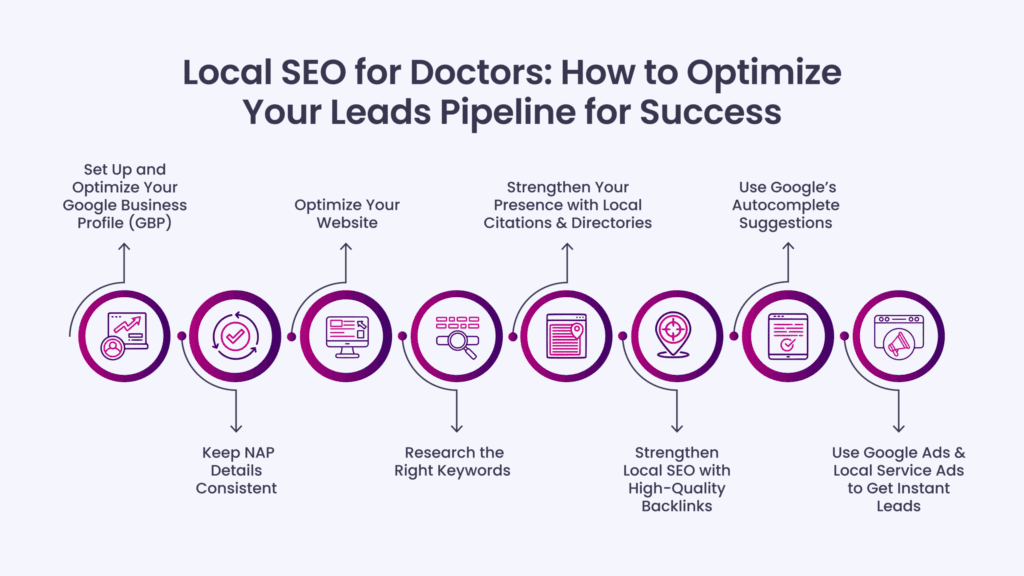
Google states that local results are primarily influenced by relevance, distance, and prominence.
- Relevance reflects how closely your profile matches the search. Detailed services, accurate categories, and clear descriptions help Google understand what you offer and when to show you.
- Distance is based on proximity to the searcher or the location specified. You can’t control where someone searches from, but you can control how accurately your service areas are defined.
- Prominence reflects how established and trustworthy your business appears online. Reviews, citations, consistent details, and engagement all feed into this signal.
Distance is fixed.
Relevance and prominence are not.
Everything that follows is about strengthening the two factors you can control, without breaching regulatory or review rules.
Step 1: Claim and Verify Your Profile Correctly
Verification is not optional. Without it, you cannot control your information, respond to reviews, publish updates, or access performance data.
Depending on eligibility, Google may require:
- postcard verification to your registered address,
- video verification showing your premises and branding,
- or phone/email verification in limited cases.
For domiciliary care agencies, video verification has become increasingly common. During this process, you may need to show:
- exterior signage,
- office space,
- branded materials,
- and evidence that you operate from the listed address.
Best practice matters here.
Use your real-world business name exactly as it appears on:
- Companies House,
- your regulator’s register,
- signage and contracts.
Adding keywords to your name, such as “Best Homecare Agency Bedford”, violates guidelines and can trigger suspension.
Avoid changing your name, address, or category while verification is in progress. Google warns that this can invalidate the process and force a restart.
Since late 2024, verified profiles have also become a prerequisite for certain advertising and local service features, making verification the foundation of wider visibility.
Step 2: Complete Every Profile Field Thoroughly
Incomplete profiles signal uncertainty, to both Google and users.
At a minimum, ensure consistency across:
- business name,
- phone number,
- website,
- opening hours.
Even small mismatches across directories can weaken trust signals.
Service Areas
You can list up to 20 service areas, such as towns or postcodes. These should accurately reflect where you operate and remain within a reasonable travel distance from your base.
Overstating coverage does not improve reach. It often reduces credibility.
Business Description
Your description should clearly explain:
- who you support,
- what services you provide,
- where you operate,
- and what distinguishes your agency.
You have limited space. Use plain language. Avoid vague promises.
Categories, Services, and Attributes
Your primary category is the strongest relevance signal on your profile. Choose the category that best reflects your core service, not every service you might offer.
Secondary categories should represent major service lines you actively deliver. Avoid categories that imply services you do not provide, as this can attract poor-fit enquiries and scrutiny.
Services and attributes help Google match you to more specific searches and help users understand your offer quickly.
Step 3: Use Services to Capture Intent Without Overpromising
The services section allows you to list both predefined and custom services, with optional descriptions.
This is one of the most underused areas of care agency profiles.
List services families actually search for, such as:
- personal care at home,
- dementia support,
- medication assistance,
- respite care,
- hospital discharge support,
- overnight or live-in care (only if genuinely offered).
Keep descriptions outcome-focused. Explain what families gain, not what you technically deliver.
Accuracy matters more than breadth.
Step 4: Photos as Trust Evidence, Not Decoration
Photos help people decide whether you feel real.
For care agencies, effective photos include:
- carers in uniform,
- training sessions,
- office exterior or interior,
- branded vehicles,
- community involvement.
Upload a solid initial set, then add new photos regularly to signal activity.
Never upload images that reveal confidential information or identifiable service users without explicit consent. This breaches both safeguarding expectations and platform policies.
Step 5: Reviews, Prominence, and Legal Reality
Reviews strongly influence prominence, but they now carry legal risk if handled incorrectly.
Recent UK enforcement has strengthened penalties around fake or incentivised reviews. For care agencies, this matters because reputational trust is non-negotiable.
Ethical review practices include:
- asking after genuinely positive moments,
- making the process simple,
- spacing requests naturally,
- and never offering incentives.
Respond to all reviews promptly and professionally. A calm, respectful response to criticism often builds more trust than a perfect rating.
Reviews that naturally mention services or locations reinforce relevance, but you should never script or pressure content.
Step 6: Posts, Q&A, and Ongoing Signals
Google Posts, Q&A, and messaging features all signal activity and responsiveness.
Use posts to:
- share availability,
- introduce staff,
- explain services,
- highlight community involvement.
Monitor Q&A regularly, especially as AI-generated answers become more common. Correct inaccuracies early and seed clear, factual responses to common questions.
A Google Business Profile is not just a visibility tool.
It is:
- a public consistency check,
- a trust proxy for families,
- and increasingly, a mirror of organisational discipline.
Agencies that manage it well tend to manage other systems well too.
Those that neglect it often struggle under scrutiny, not because Google caused problems, but because inconsistencies were already there.
Conclusion
Families search for care agencies near them because they want reassurance. Regulators test for the same reason. Care agencies answer that trust question every day, through systems, decisions, and readiness.
Care doesn’t stand still. Demand shifts. Workforces change. Expectations rise. Hoping things work out isn’t a strategy.
The strongest agencies treat regulation as a signal, not an obstacle. They build structure behind compassion so care holds steady when life doesn’t. Those answers matter long before anyone comes knocking, and they shape what happens when they do.
Need Expert Support to Strengthen Your Care Agency’s Readiness?
Running a care agency means operating under constant scrutiny. Even providers delivering good care can struggle with unclear accountability, documentation that doesn’t match practice, or growth that outpaces governance.
Care Sync Experts supports domiciliary care agencies across England, Wales, and Northern Ireland to strengthen foundations before problems escalate, covering regulatory readiness, policy and governance alignment, inspection preparation, sustainable growth planning, and ongoing compliance support.
Book a Free Readiness Consultation
If you’re unsure whether your systems would stand up to inspection, commissioning scrutiny, or expansion, a short conversation now can prevent costly disruption later.
This article reflects UK care regulation and sector practice as at 2026. Requirements may change; always refer to current guidance from the relevant regulator.
If you are thinking of opening your own agency, compare our domiciliary care start-up package with our care agency start-up package for combined home care and staffing.
FAQ
How many care agencies are there in the UK?
The UK has thousands of adult social care providers, the majority of which are small, independent organisations. This fragmentation is why regulators and commissioners focus on systems and leadership, not just outcomes.
How much does 24-hour care at home cost in the UK?
Live-in care typically costs more than hourly domiciliary visits but less than residential nursing care. Weekly costs vary by complexity, location, and rota design. Sustainable pricing accounts for fair pay, cover, supervision, and compliance, underpricing often shifts risk elsewhere.
Is HC-One an agency?
No. HC-One operates care homes (residential and nursing). It does not deliver domiciliary care in people’s homes. This distinction matters for regulation and accountability.
How should you choose a care provider?
Look beyond reassurance. Confirm registration, read inspection history for learning and leadership, assess transparency around pricing and delivery, and check that systems remain stable under pressure. Good care feels personal; safe care is structural.
Related reading
- What Qualifications Do You Need to Open a Care Home UK?
- Care Home Risk Assessment: 2026 Practical Guide to Safer, Person-Centred Care
- Individual Support Package: What It Means for Care at Home
- End of Life Care at Home: What to Expect in 2026, Costs, and Family Support
- Do Dementia Sufferers Have to Pay Care Home Fees in the UK? (2026 Guide)
- New Rules for Care Home Payments in 2026
Browse every article on CQC, Ofsted, CIW and RQIA compliance