How to Get Contracts for Domiciliary Care UK:
Complete 2026 Guide

Text to speech
Duration: 00:00
Font size
Published: 17 Jul, 2026
Share this on:
Knowing how to get contracts for domiciliary care can help your agency build a steadier pipeline of work, strengthen cash flow and reduce reliance on occasional private enquiries. However, winning the right contract requires more than registering on a tender portal or offering the lowest price.
Commissioners and private clients want evidence that your agency can recruit dependable caregivers, meet compliance requirements, manage risk and deliver consistent care.
They want evidence that your service has the leadership, staff, systems and financial stability to support people from the first day of the contract.
In England, you must register with the Care Quality Commission if your agency provides the regulated activity of personal care. You may also need a registered manager and must show that your business can meet the fundamental standards of care.
Build your tender-readiness file around:
- CQC registration and an accurate statement of purpose
- A clear service area and realistic care capacity
- Appropriate insurance and financial records
- Safe recruitment, DBS checks, training and supervision
- Safeguarding, medicines and infection-control procedures
- Business continuity and quality-assurance systems
- Evidence that you can monitor missed visits, incidents and complaints
Your domiciliary care policies and procedures must reflect how your team actually works. Do not download generic documents and leave them untouched. Train caregivers to follow them, review them when practice changes and keep evidence of audits, supervision and improvement.
CQC currently expects new providers to submit supporting documents such as safeguarding and recruitment policies, a staff training plan, insurance evidence and a statement of purpose.
If you are starting a care agency, treat compliance as the foundation of growth, not as paperwork to complete after you find a contract. Strong systems protect service users, support caregivers and give commissioners confidence that your agency can deliver what it promises.

Key Facts About Domiciliary Care Contracts
- CQC registration: In England, an agency must register with the Care Quality Commission if it provides the regulated activity of personal care.
- Supporting documents: CQC currently expects new providers to submit supporting documents such as safeguarding and recruitment policies, a staff training plan, insurance evidence and a statement of purpose.
- Where tenders appear: The UK’s Central Digital Platform, through Find a Tender, publishes regulated procurement opportunities, and many local authorities also advertise through their own portals.
- Dynamic markets: A dynamic market lets providers apply to join throughout its duration, which suits growing agencies that missed earlier procurement rounds.
- Demand for care: ONS projections indicate England’s population aged 85 and over could rise from approximately 1.1 million in 2022 to 1.5 million by 2032.
- Private hourly rates: In 2026, private domiciliary care commonly costs around £26 to £38 per hour, with some estimates placing the national average at approximately £32.
Find Domiciliary Care Tenders That Match Your Agency
Many new providers believe they need to apply for every opportunity they find. In reality, successful agencies focus on domiciliary care tenders that match their capacity, workforce and long-term growth plans.
Most publicly funded domiciliary care contracts are awarded through local authorities, NHS organisations or other public bodies. Rather than contacting councils directly, providers usually compete through regulated procurement processes published on approved procurement platforms.
Depending on the opportunity, you may come across:
| Contract Route | What It Means |
| Open Tender | Any eligible provider can submit a bid before the deadline. |
| Open Framework | Approved providers join a framework and may be invited to compete for future care packages during its lifetime. |
| Dynamic Market | Providers can apply to join throughout its duration, making it an attractive option for growing agencies that miss earlier procurement rounds. |
The UK’s Central Digital Platform (through Find a Tender) publishes regulated procurement opportunities and allows suppliers to maintain their business information for future bids. Many local authorities also advertise opportunities through their own procurement portals.
While council-funded home care often provides the largest volume of work, don’t overlook opportunities involving NHS contracts, reablement services, discharge support and specialist care packages.
Some providers also secure live in care contracts, particularly where commissioners need alternatives to residential care for people with complex or long-term needs.
Before investing time in a tender, read the specification carefully and ask yourself:
- Does the contract cover areas where we already have caregivers?
- Can we recruit enough staff before the mobilisation date?
- Does the pricing support high-quality care and sustainable growth?
- Do we already have experience delivering similar services?
- Can we meet every mandatory requirement?
Answering these questions early helps you avoid chasing contracts that look attractive on paper but place unnecessary pressure on your team. Winning the right contract is far more valuable than winning the most contracts.
RELATED: RQIA Registration for Domiciliary Care Agency in Northern Ireland (2026)
Check Whether the Contract Fits Your Agency
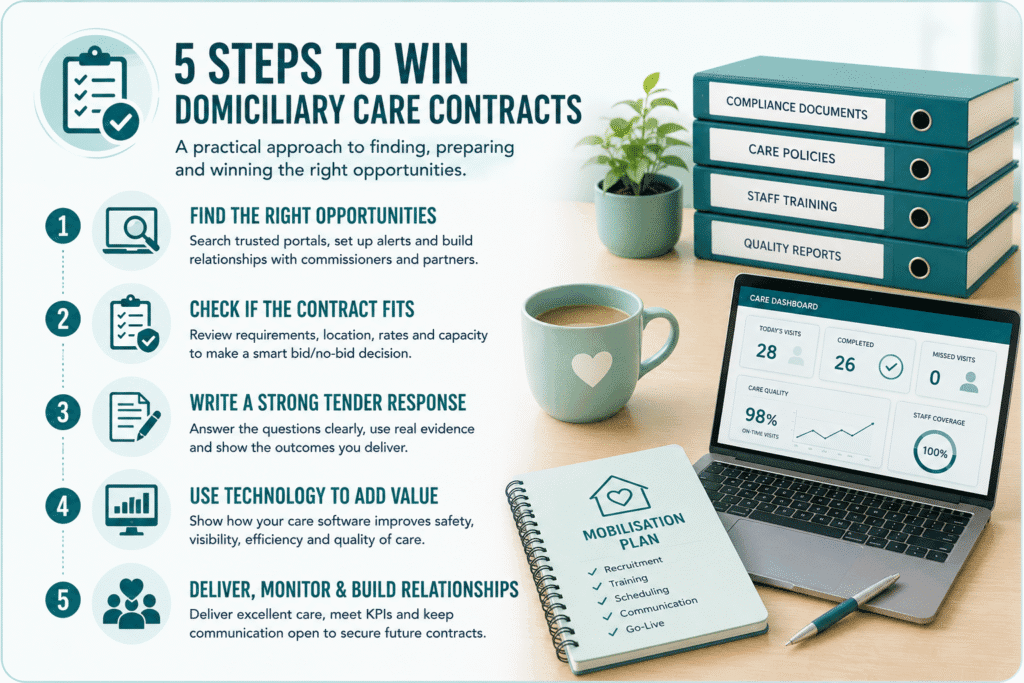
Knowing how to get contracts matters, but knowing which contracts to avoid matters just as much. A large care package may look attractive, yet it can quickly damage your service if the rate, location, or staffing demands do not match your capacity.
Before bidding, ask these five questions:
- Can we recruit and retain enough caregivers?
Review the required hours, shift patterns, skills and start date. Do not rely on staff you have not yet recruited. - Can we cover the area safely and efficiently?
Long travel distances can cause late visits, rushed care and unstable rotas. Check whether the contract supports sensible geographic scheduling. - Does the rate cover the true cost of care?
Include wages, travel time, mileage, training, supervision, insurance, software, recruitment and management overheads. - Can our systems meet the reporting requirements?
Commissioners may expect evidence on missed visits, complaints, incidents, continuity, staffing and outcomes. - Can we mobilise without disrupting existing clients?
A fast start date can place pressure on managers and caregivers if you lack a realistic mobilisation plan.
The best domiciliary care contracts support both business growth and good care. If a contract forces your team into rushed visits, excessive travel or unsustainable rotas, it may increase turnover and reduce continuity for service users.
A disciplined bid/no-bid decision protects your reputation, your caregivers and the people who depend on your service.
Write a Tender Response That Commissioners Can Trust
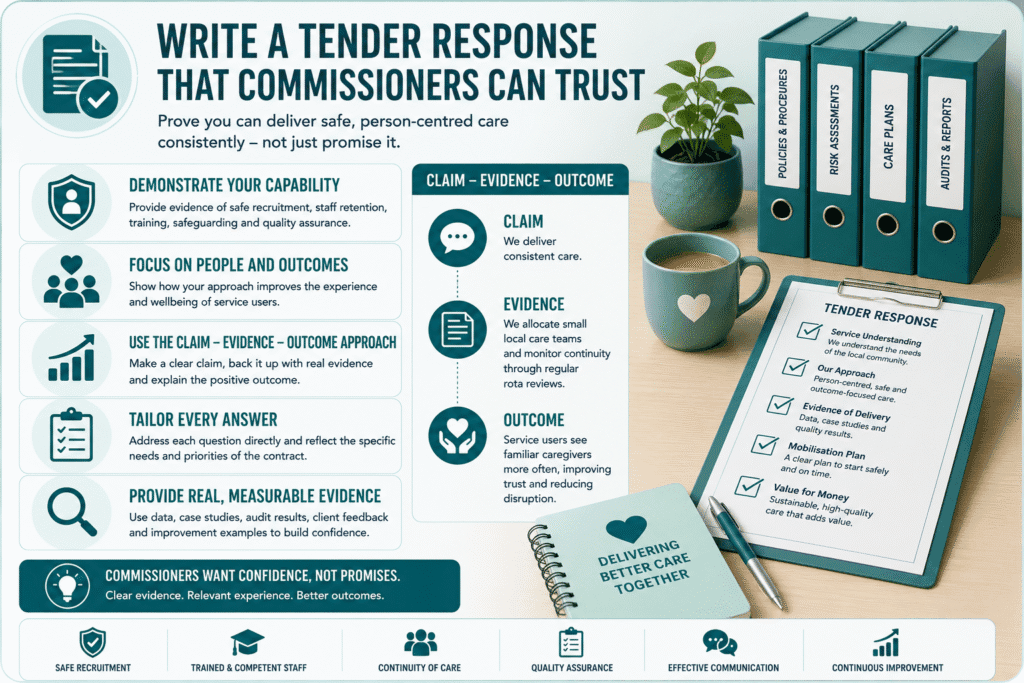
Many care agencies lose domiciliary care tenders because they describe what they intend to do instead of proving what they already do well. Commissioners want evidence that your agency can deliver safe, person-centred care consistently, not promises or marketing language.
Start by reading the service specification carefully. Every answer should address the question directly and explain how your agency will meet the contract requirements.
A strong tender usually demonstrates:
- Safe recruitment and staff retention strategies
- Person-centred care planning
- Safeguarding knowledge and reporting procedures
- Staff training, competency and supervision
- Continuity of care through consistent caregiver allocation
- Quality assurance, audits and continuous improvement
- Effective communication with families and healthcare professionals
- A realistic mobilisation plan that shows how you’ll start the service safely and on time
One of the best ways to structure your answers is to use the Claim – Evidence – Outcome approach.
| Claim | Evidence | Outcome |
| We deliver consistent care. | We allocate small local care teams and monitor continuity through regular rota reviews. | Service users see familiar caregivers more often, improving trust and reducing disruption. |
| We maintain high care standards. | Managers complete regular audits, supervisions and competency assessments. | Issues are identified early and resolved before they affect care quality. |
| We respond quickly to concerns. | Staff follow clear safeguarding and incident reporting procedures, with management oversight. | Risks are managed promptly and service users remain protected. |
Support your answers with real evidence wherever possible. This might include CQC inspection findings, quality audit results, staff retention figures, client feedback or examples of service improvements.
If your agency is new, explain the experience of your leadership team, the systems you have already established and how those systems will help you deliver safe, reliable care from the outset.
Avoid copying the same answers into every bid. Each contract has different priorities, and commissioners expect your proposal to reflect the needs of the people they serve. A tailored, evidence-based response will always carry more weight than a generic submission.
READ MORE: Registered Manager CQC Interview Questions and Answers: 2026 Guide
Use Care Software to Strengthen Your Bid
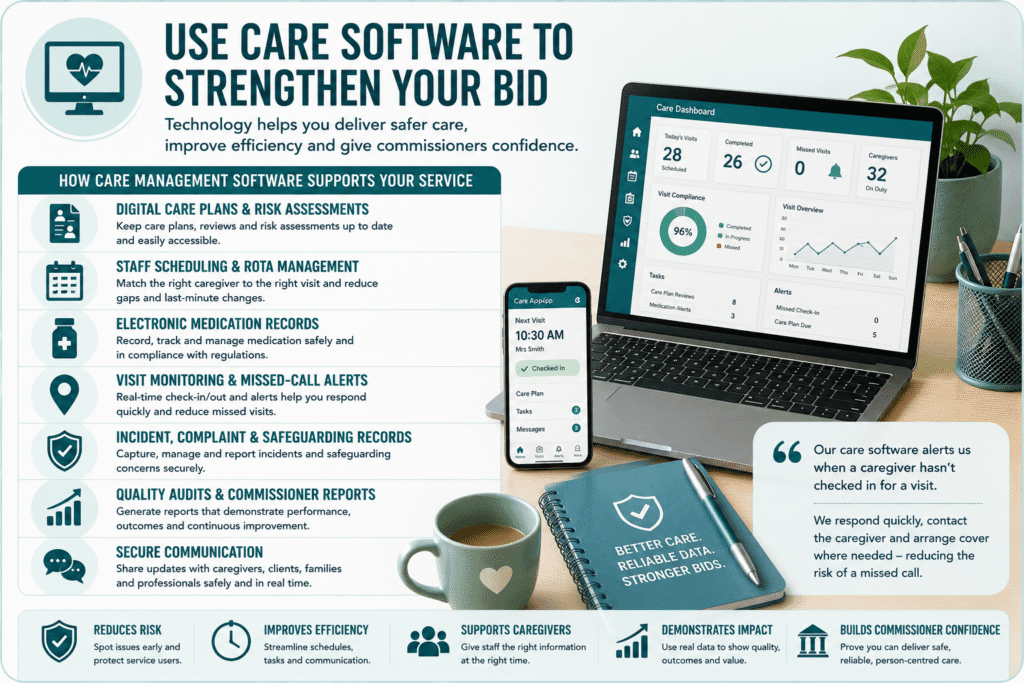
Good technology can help your agency prove that it can deliver safe, organised and transparent care at scale. Commissioners may want to know how you schedule visits, monitor missed calls, update care plans, record medication and report service performance.
A suitable domiciliary care management software system can support:
- Digital care plans and risk assessments
- Staff scheduling and rota management
- Electronic medication records
- Visit monitoring and missed-call alerts
- Incident, complaint and safeguarding records
- Quality audits and commissioner reports
- Secure communication with caregivers and families
Do not simply write, “We use modern technology.” Explain how your system improves care.
For example:
Our home care management software alerts coordinators when a caregiver has not checked in for a scheduled visit. The team can respond quickly, contact the caregiver and arrange cover where necessary, reducing the risk of a missed call.
Technology will not win a contract on its own. However, when your agency shows how it uses digital systems to reduce risk, improve accountability and support caregivers, it gives commissioners greater confidence in your ability to manage care safely.
Build Private Clients While You Pursue Public Contracts
Public-sector procurement can take time, so do not wait for a council award before growing your agency. Learning how to get private clients for domiciliary care can help you build cash flow, gather testimonials and prove that your team can deliver reliable support.
Start with a clear local presence. Your website should explain the services you provide, the areas you cover and how families can contact you. Create and maintain a Google Business Profile so people searching for home care nearby can find your agency easily.
You should also build relationships with local professionals and community groups, including:
- Hospital discharge teams
- Social workers
- GPs and district nurses
- Faith groups and community centres
- Charities supporting older people or disabled adults
- Local solicitors and financial advisers who work with families arranging care
Make referrals easy. Respond quickly, explain your assessment process clearly and give families transparent information about pricing, availability and care planning.
If you want to understand how to get private care clients in the UK, focus on trust rather than aggressive selling. Families want reassurance that your caregivers will arrive on time, communicate well and treat their relatives with dignity.
Private work can also help you develop experience in specialist support and live-in care contracts, which may strengthen future tender submissions. The strongest agencies often combine public contracts with private clients instead of depending entirely on one income source.
SEE ALSO: Safe Medication Administration Guidelines UK: Best 2026 Guide
Avoid the Mistakes That Cost Care Agencies Contracts
Many agencies lose care agency contracts before evaluators fully consider the quality of their service. The problem often comes down to poor preparation, weak evidence or unrealistic promises.
Common mistakes include:
- Applying without meeting every mandatory requirement
- Reusing generic answers from previous bids
- Making claims without policies, data or examples to support them
- Ignoring word limits or failing to answer every part of the question
- Pricing below the true cost of delivering safe care
- Promising coverage in areas where you cannot maintain reliable staffing
- Submitting policies that do not match your actual working practices
- Failing to explain how you will recruit, mobilise and monitor the service
A low price will not protect your agency if the contract creates rushed visits, high staff turnover or repeated missed calls. Commissioners need confidence that you can deliver the service safely from the agreed start date and maintain quality throughout the contract.
Before submitting, ask someone who did not write the bid to review it against the evaluation criteria. They should be able to identify your evidence, understand your delivery model and see exactly how your approach will benefit service users and caregivers.
Conclusion
Learning how to get contracts for domiciliary care involves more than finding a tender and submitting a low price. Your agency must prove that it can recruit dependable caregivers, deliver safe care, manage risks and maintain quality throughout the contract.
Prepare your compliance evidence, choose opportunities carefully and tailor every bid to the commissioner’s requirements. At the same time, continue building private referrals so your business does not depend on one source of income.
The strongest domiciliary care contracts support service users, caregivers and the long-term health of the agency. Focus on winning work that your team can deliver confidently, profitably and without compromising care quality.
Care Sync Experts can help you assess your tender readiness, develop compliant domiciliary care policies and procedures, and review your bid before submission.
Contact our team for practical support that strengthens your evidence, addresses tender requirements and improves your chances of winning the right care contracts.
If you are not registered yet, our domiciliary care start-up package takes a new home care agency through CQC registration so it is ready to bid.
FAQ
What is the demand for domiciliary care?
Demand for domiciliary care remains strong and is likely to grow as more people live longer and prefer to receive support at home. ONS projections indicate that England’s population aged 85 and over could rise from approximately 1.1 million in 2022 to 1.5 million by 2032.
Many will need personal care, medication support, companionship or help after hospital discharge. However, high demand does not guarantee business success; agencies still need reliable caregivers, competitive pricing and a strong local reputation.
How do you apply for domiciliary care?
In England or Wales, contact your local council and request a free care needs assessment. The council will assess how your needs affect daily life and determine whether you qualify for funded support.
It may then complete a financial assessment to decide how much you should contribute. You can also approach a registered home-care agency directly and pay privately without waiting for council funding.
How much do care agencies charge per hour in the UK?
In 2026, private domiciliary care commonly costs around £26 to £38 per hour, although prices vary by location, visit length and the complexity of care required. Some estimates place the national average at approximately £32 per hour.
Agencies may charge more for evenings, weekends, bank holidays, two-caregiver visits or specialist support. Families should request a written breakdown of all charges before agreeing to a service.
How do I write a simple care contract?
A simple care contract should identify both parties and clearly state the services, visit times, fees, payment terms and start date. It should also explain cancellations, access to the home, confidentiality, complaints, emergency procedures and how either party can end the agreement.
Write the terms in clear language and ensure they match your actual service. Because care agreements involve consumer rights, safeguarding and liability, ask a qualified legal professional to review the contract before using it with clients.
Related reading
Get help winning care contracts
- CQC Registration: Complete Guide for Domiciliary Care Providers
- Domiciliary Care Business Continuity Plan: A Practical 2026 Guide
- How to Get Private Care Clients UK: Best 2026 Guide
- Domiciliary Care Business Plan: How to Start a CQC-Ready Agency in 2026
- CQC Registration for Domiciliary Care Providers: Complete 2026 Guide
- How a Domiciliary Care Agency Can Prepare for 2026 and Grow Faster
Browse every article on CQC, Ofsted, CIW and RQIA compliance