Moving From ESA Support Group to Universal Credit: What You Need to Know in 2026
Text to speech
00:00
5sec
Duration: 00:00
Font size
Published: 13 May, 2026
Share this on:
If you are moving from ESA Support Group to Universal Credit after receiving a Migration Notice from the DWP, you usually have 3 months to make your Universal Credit claim and keep your financial support.
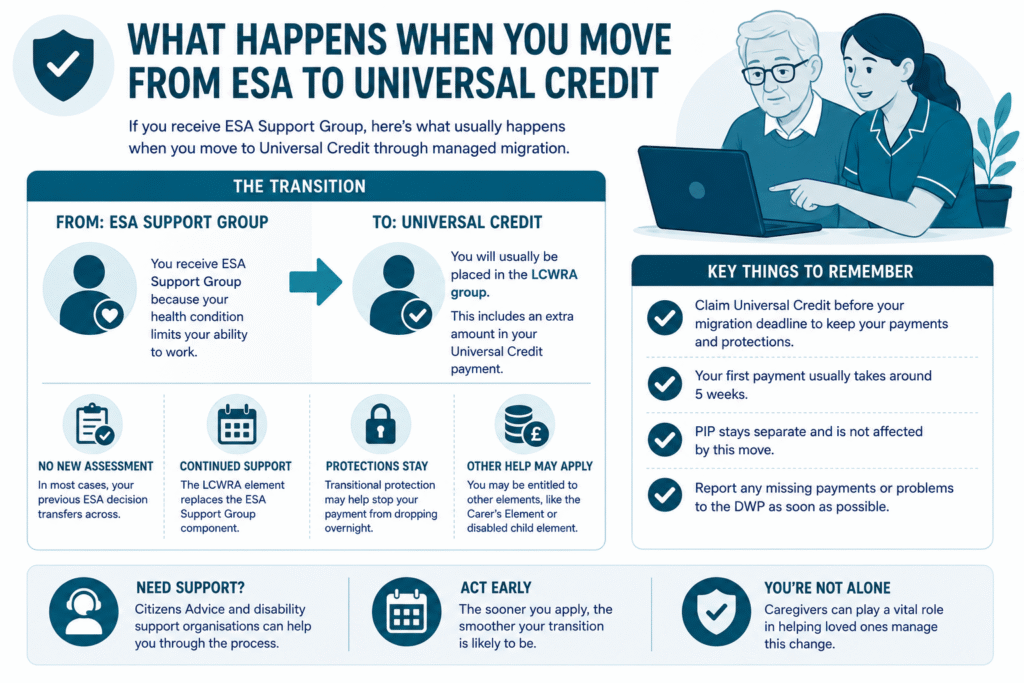
Most people in the ESA Support Group move into the Limited Capability for Work and Related Activity (LCWRA) element of Universal Credit without needing a new Work Capability Assessment immediately.
The DWP is moving benefit claimants to Universal Credit as part of the wider replacement of legacy benefits. If you claim Universal Credit before your universal credit migration deadline, you can usually receive transitional protection. Transitional protection universal credit payments help prevent a sudden drop in income when your old ESA payments stop.
For many disabled claimants and caregivers, the biggest change involves how Universal Credit gets paid. Universal Credit normally arrives as one monthly payment and uses an online journal system. However, ESA Support Group claimants placed into LCWRA usually do not have work-search requirements.
You should not ignore your Migration Notice letter. Moving from ESA Support Group to Universal Credit does not happen automatically, and missing the deadline can affect your payments and your access to universal credit transitional protection.
Moving from ESA Support Group to Universal Credit does not happen automatically after receiving a Migration Notice.
Most ESA Support Group claimants move into the LCWRA element of Universal Credit without a new assessment immediately.
You must claim Universal Credit before your universal credit migration deadline to keep your payments and qualify for transitional protection universal credit support.
Universal credit transitional protection helps prevent a sudden drop in income during managed migration.
New Style ESA differs from income-related ESA and may continue alongside Universal Credit in some cases.
PIP remains separate from Universal Credit despite ongoing discussions around pip legacy benefits changes dwp updates.
Caregivers can reduce stress and avoid delays by helping claimants prepare documents, monitor payments, and contact the DWP early if problems appear.
Why the DWP Is Moving Benefit Claimants to Universal Credit
The DWP is moving benefit claimants to Universal Credit because the government wants to replace older “legacy benefits” with a single monthly payment system. This process, often called managed migration, affects people receiving income-related ESA, Housing Benefit, Tax Credits, and several other older benefits.
Many claimants describe these changes as the DWP axing legacy benefits, but the transition will happen gradually through the universal credit migration timetable. The government originally planned to complete the move sooner, but migration has continued into later years due to concerns about vulnerable claimants and ongoing DWP Universal Credit migration struggles.
If you receive income-related ESA, you will usually get a Migration Notice letter before your benefits stop. The letter explains your universal credit migration deadline and tells you how to apply. You must make a new Universal Credit claim because the DWP will not transfer you automatically.
Some people still ask, “Is ESA to Universal Credit delayed to 2028?” While timelines have shifted several times, the DWP continues to move claimants across in stages. Most ESA claimants should expect migration activity to continue throughout 2026 and beyond as the government completes the transition away from legacy benefits.
These ESA changes do not affect all benefits equally. Personal Independence Payment (PIP) remains separate from Universal Credit, although many people searching for dwp pip legacy benefits changes or pip legacy benefits migration universal credit confusion often mix the two systems together.
What ESA Support Group Claimants Keep Under Universal Credit
Many people worry that moving from ESA Support Group to Universal Credit means losing their health-related support, but most claimants keep important protections when they move correctly through managed migration.
If you currently receive ESA Support Group payments, Universal Credit should place you into the Limited Capability for Work and Related Activity (LCWRA) group. This extra amount replaces the ESA Support Group component and gives continued support to people whose condition limits their ability to work.
In most cases, the DWP will not ask you to complete a new Work Capability Assessment immediately. Your previous ESA decision usually transfers across as long as you move to Universal Credit without a break in your claim.
Many caregivers also ask, “Is ESA means tested?” The answer depends on the type of ESA you receive. Income-related ESA forms part of the legacy benefits system and will move to Universal Credit. However, new style ESA and Universal Credit can exist together in some situations because New Style ESA depends on National Insurance contributions rather than household income.
Some families may also qualify for extra Universal Credit support, including the disabled child element UC payment for children with qualifying disabilities or health conditions.
Claimants who work limited hours often worry about earned income disallowance rules when moving benefits. Universal Credit handles this differently from ESA. Instead of permitted work rules, Universal Credit uses a work allowance system, which lets some LCWRA claimants earn a certain amount before deductions reduce their payment.
Although many discussions around PIP legacy benefits DWP changes create confusion online, PIP itself does not move into Universal Credit. The DWP still pays PIP separately from UC.
How Universal Credit Transitional Protection Works
Moving From ESA Support Group to Universal Credit
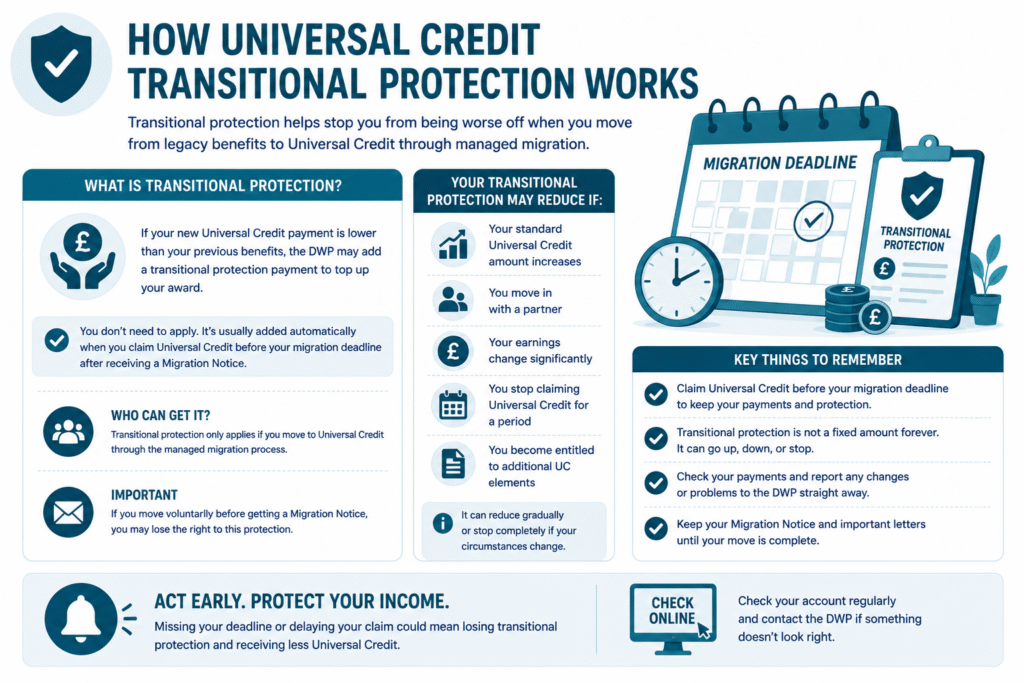
Universal credit transitional protection helps prevent a sudden drop in income when you move from legacy benefits to Universal Credit through managed migration. If your new Universal Credit payment comes out lower than your previous benefits, the DWP may add a transitional protection universal credit payment to help bridge the gap.
You do not need to apply separately for this support. The DWP usually adds it automatically if you claim Universal Credit before your universal credit migration deadline after receiving a Migration Notice.
Many claimants ask, “How long does transitional protection last Universal Credit?” The answer depends on your circumstances. Transitional protection does not stay fixed forever. The amount can reduce gradually over time if your Universal Credit award increases or your situation changes.
For example, your transitional payment may reduce if:
your standard Universal Credit amount increases
you move in with a partner
your earnings change significantly
you stop claiming Universal Credit for a period
you become entitled to additional UC elements
Some people lose transitional protection completely after major claim changes or missed deadlines. That is why caregivers and claimants should act quickly after receiving a Migration Notice letter.
Universal credit transitional protection only applies to people who move through the managed migration process. If you move voluntarily before receiving a notice, you may lose access to this financial protection.
How transitional protection works in Universal Credit
Many disabled claimants and caregivers struggle with the move from ESA to Universal Credit, especially during the first few weeks after making a claim. Although the DWP says the process should feel straightforward, many families still report universal credit managed migration issues linked to payments, deadlines, and online account problems.
One of the biggest DWP Universal Credit migration struggles involves delayed first payments. Universal Credit usually takes around five weeks to arrive, which can place pressure on households already managing disability-related costs, rent, and caregiving responsibilities.
Some claimants also experience problems with:
missing Migration Notice letters
incorrect LCWRA decisions after transfer
difficulties verifying identity online
confusion about housing payments
problems linking joint claims
missing journal messages or appointments
Caregivers often need to step in and help vulnerable family members complete online forms, upload evidence, or contact the DWP when issues appear.
If you need to report missing payment May 2025 concerns or similar Universal Credit payment issues, contact the DWP as soon as possible through your online journal or the Universal Credit helpline. Delays become harder to fix when claimants wait too long to report them.
You should also contact the DWP immediately if:
your ESA payments stop unexpectedly
your LCWRA element does not appear
your transitional protection payment looks incorrect
your migration deadline passes before you complete your claim
Many problems get resolved quickly once claimants provide the correct information early.
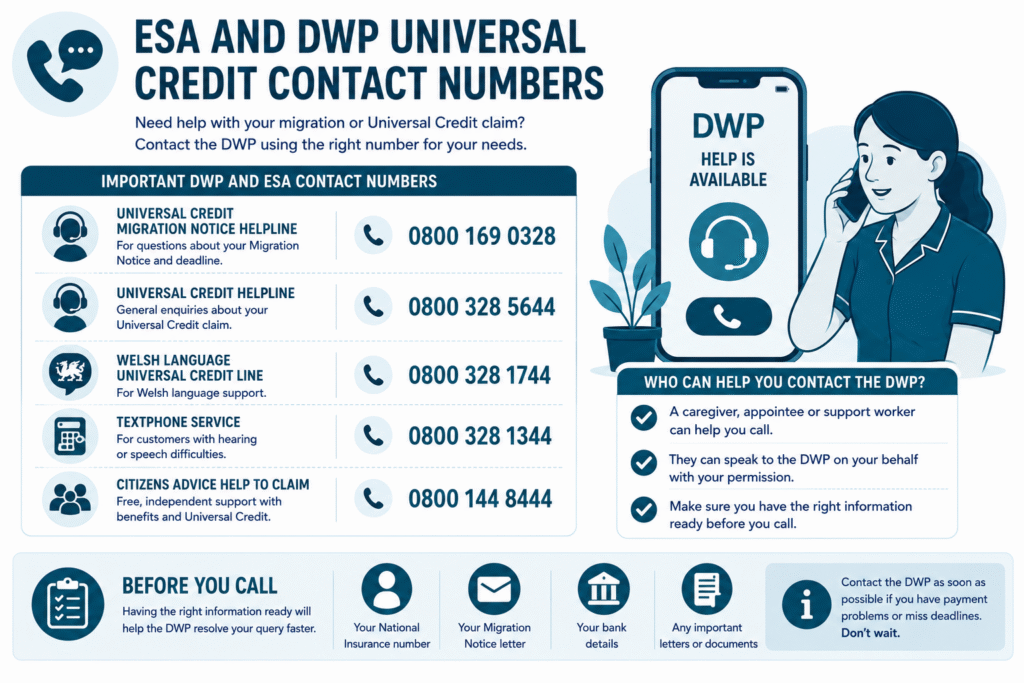
If you need help during managed migration, contact the DWP as early as possible. Many ESA Support Group claimants and caregivers solve issues faster when they speak to the correct department immediately after receiving a Migration Notice.
Welsh Language Universal Credit Line: 0800 328 1744
Textphone Service: 0800 328 1344
Citizens Advice Help to Claim: 0800 144 8444
Many people search online for terms like DWP 0800 contact number, ESA number 0800, or e s a contact number when payments stop, or migration letters arrive unexpectedly. Before calling, keep your National Insurance number, Migration Notice letter, and bank details nearby to speed up the process.
If you struggle to manage phone calls yourself, a caregiver, appointee, or support worker may help you communicate with the DWP during your Universal Credit claim.
What Caregivers and Families Should Do Before the Universal Credit Migration Deadline
DWP contact guide for Universal Credit
Caregivers can make the move from ESA Support Group to Universal Credit much less stressful by preparing early instead of waiting until the last week before the universal credit migration deadline.
Start by reading the entire Migration Notice letter carefully. Check the deadline date, gather important documents, and create a plan for completing the claim. Many people lose valuable transitional protection universal credit support simply because they miss deadlines or misunderstand the instructions.
Before starting the application, caregivers should help claimants collect:
bank account details
identification documents
tenancy or rent information
recent benefit letters
medical or disability information if needed
Families should also prepare for the five-week wait before the first Universal Credit payment arrives. Budgeting early can reduce pressure during the transition period, especially for households already dealing with disability-related expenses.
If the claimant receives Housing Benefit or Council Tax support, contact the local council to check whether payments will change after migration. Many people wrongly assume Universal Credit covers everything automatically.
Caregivers supporting people affected by DWP PIP legacy benefits changes or wider DWP PIP legacy benefits reforms should remember that PIP remains separate from Universal Credit. However, changes to income-related ESA still affect many disabled households financially and emotionally.
You do not have to handle the process alone. Citizens Advice and disability support organisations can guide claimants through managed migration, explain complicated forms, and help resolve problems before they affect payments.
Conclusion
Moving from ESA Support Group to Universal Credit can feel overwhelming, especially for disabled claimants and caregivers already managing health conditions, financial pressure, and changing DWP rules. However, understanding your migration notice, acting before the deadline, and knowing what support continues under Universal Credit can make the process far more manageable.
The most important step is to avoid delays. Claimants who respond early, prepare documents in advance, and seek support when problems appear usually experience a smoother transition and protect important payments like LCWRA and transitional protection.
At Care Sync Experts, we help caregivers and vulnerable families understand complex care and benefits changes with clear, practical guidance.
Whether you need support understanding ESA changes, Universal Credit migration, or wider UK care-related updates, our team continues to provide trusted information designed to help families make confident decisions during difficult transitions.
FAQ
What is Carer’s Element in Universal Credit?
Carer’s Element is an extra amount added to Universal Credit for people who regularly care for someone with a disability or health condition. To qualify, you usually need to provide at least 35 hours of care each week for a person receiving a qualifying disability benefit, such as PIP daily living or Attendance Allowance.
How Much Is the Carer’s Element of Universal Credit?
The Carer’s Element adds extra monthly financial support to a Universal Credit claim. The amount changes slightly each year following government benefit updates. Eligible carers receive this payment in addition to the standard Universal Credit allowance, although it can affect other benefits in some situations.
What Is the Difference Between Income-Related ESA and Contribution-Based ESA?
Income-related ESA depends on household income, savings, and other financial circumstances. This type of ESA forms part of the legacy benefits system and is moving to Universal Credit.
Contribution-based ESA, now called New Style ESA, depends mainly on National Insurance contributions rather than savings or household income. Many people can still receive New Style ESA alongside Universal Credit if they meet the eligibility rules.
Is Contribution-Based ESA Changing to Universal Credit?
Most contribution-based ESA claimants do not move fully to Universal Credit in the same way as people receiving income-related ESA. New Style ESA can continue separately because it is not part of the main legacy benefits system being replaced.
However, some claimants receive both income-related ESA and contribution-based ESA together. In those situations, only the income-related part usually moves into Universal Credit during managed migration.
Moving From ESA Support Group to Universal Credit: What You Need to Know in 2026 | Care Sync Experts Blog | Care Sync Experts