Safe Medication Administration Guidelines UK:
Best 2026 Guide

Text to speech
Duration: 00:00
Font size
Published: 15 Jul, 2026
Share this on:
Safe medication administration is one of the most important responsibilities in adult social care. When a care worker supports someone with medicines, they do more than complete a routine task. They protect the person’s health, dignity, independence and trust in the service.
For care providers, medication safety also affects CQC ratings, safeguarding outcomes, complaints, staff confidence and business reputation. One missed dose, unclear MAR chart, poor handover or untrained staff member can quickly become a serious incident.
This guide explains the safe medication administration guidelines UK care providers should follow, including the key medication “rights,” NICE guidance, CQC expectations, relevant legislation, staff competence and practical steps for safer day-to-day care.

What Are the Key Safe Medication Administration Guidelines in the UK?
The key safe medication administration guidelines UK care providers follow start with the “rights” of medication. Most teams know the 5 rights of medication: the right person, right medicine, right dose, right route and right time.
Many services expand this into the 6 rights of medication administration by adding the right documentation. Others use the 7 rights of medication by adding the person’s right to refuse, or go further by including the right reason, right response and informed consent.
These rights matter, but care providers should not treat them as a memory test. Staff need a safe system around them. That means clear care plans, accurate MAR charts, allergy checks, consent, safe storage, staff training, competency checks, incident reporting and regular audits.
In practice, safe medication administration works best when staff pause, check, record and escalate concerns instead of relying on habit.
RELATED: Setting Up Supported Living Business UK in 2026
Current Legislation, NICE Guidance and Professional Standards
Care providers must understand the current legislation relevant to administration of medication UK services depend on. The Human Medicines Regulations 2012 set important rules for medicinal products, while controlled drugs also sit under separate legal requirements. Providers must turn these duties into clear workplace policies that staff can follow during real visits and shifts.
The NICE guidelines medication administration advice also matters. NICE SC1 covers managing medicines in care homes, while NICE NG67 covers medicines support for adults receiving social care in the community. Together, these guidelines help providers assess what support each person needs, record that support clearly, and reduce avoidable medicine-related harm.
Many people still search for NMC standards of medicines management, but the old standalone NMC medicines management standards have been withdrawn. Nurses should now follow the NMC Code, their employer’s medicines policy, current professional guidance and their own scope of competence.
For care businesses, the lesson is simple: do not rely on memory, custom or “how we have always done it.” Build medication policies around current law, NICE guidance, professional standards and the needs of each person receiving care.
CQC Medication Administration Guidelines for Care Providers
CQC does not only look at whether staff gave a medicine. Inspectors look at the whole medication system. They want to see that the provider assesses people’s needs, trains staff properly, keeps accurate records, stores medicines safely, learns from incidents and checks practice through regular audits.
Strong CQC medication administration guidelines in a care service should cover ordering, receiving, storing, administering, recording, returning and disposing of medicines. They should also explain what staff must do when someone refuses medicine, misses a dose, reports side effects or comes home from hospital with medication changes.
Managers should never allow new staff to support or administer medicines until they have completed training and passed a competency assessment. Annual refreshers also help staff stay confident and reduce bad habits.
For care providers, medication governance protects everyone. It protects clients from avoidable harm, protects staff from unclear expectations, and protects the business from poor inspection outcomes.
READ MORE: Reg 44 Children’s Homes: 2026 Guide for Providers, Managers and Independent Visitors
A Practical Medication Safety Process for Care Teams
Safe medication administration needs a simple process that staff can follow under pressure. Start by assessing how much support the person needs. Some people only need a reminder, while others need full support with ordering, storing, preparing and taking medicines.
Next, record the support clearly in the care plan and MAR chart. Staff should check allergies, preferences, consent, capacity and any instructions for PRN medicines before they assist. They should never give medicine from memory or guess when instructions look unclear.
A monitored dosage system can help some people manage regular medicines, but it does not remove the provider’s duty to check changes, missed doses, discontinued items or medicines kept outside the pack.
Staff should record medicines immediately after support or administration. If a person refuses medicine, misses a dose, vomits after taking it, shows side effects or has a medication error, staff should escalate the concern and document what happened.
Good managers then audit MAR charts, review errors and retrain staff before small mistakes become repeated risks.
Repeat Prescriptions, Pharmacists and Reliable Medicines Information

Care providers need a clear process for ordering, checking and receiving medicines. Poor NHS repeat prescription ordering can lead to missed doses, duplicate medicines, stock shortages or confusion after hospital discharge. Managers should make sure staff check current prescriptions, discontinued medicines, quantities, delivery dates and MAR chart updates.
Pharmacists also play an important safety role. They can explain medicine instructions, support reviews and help providers understand changes. People often ask, “Can a pharmacist prescribe antibiotics UK?” A pharmacist independent prescriber can prescribe within their scope and competence, but care workers must still follow the authorised prescription, care plan and MAR chart.
Staff should use reliable medicines information, such as the BNF or Medicines Complete BNF, and escalate clinical questions instead of guessing. Specialist resources such as The Renal Drug Handbook or drug calculations for nurses belong with trained clinicians, not unqualified care staff working beyond their role.
SEE ALSO: How to Get Private Care Clients UK: Best 2026 Guide
Common Medication Administration Mistakes to Prevent
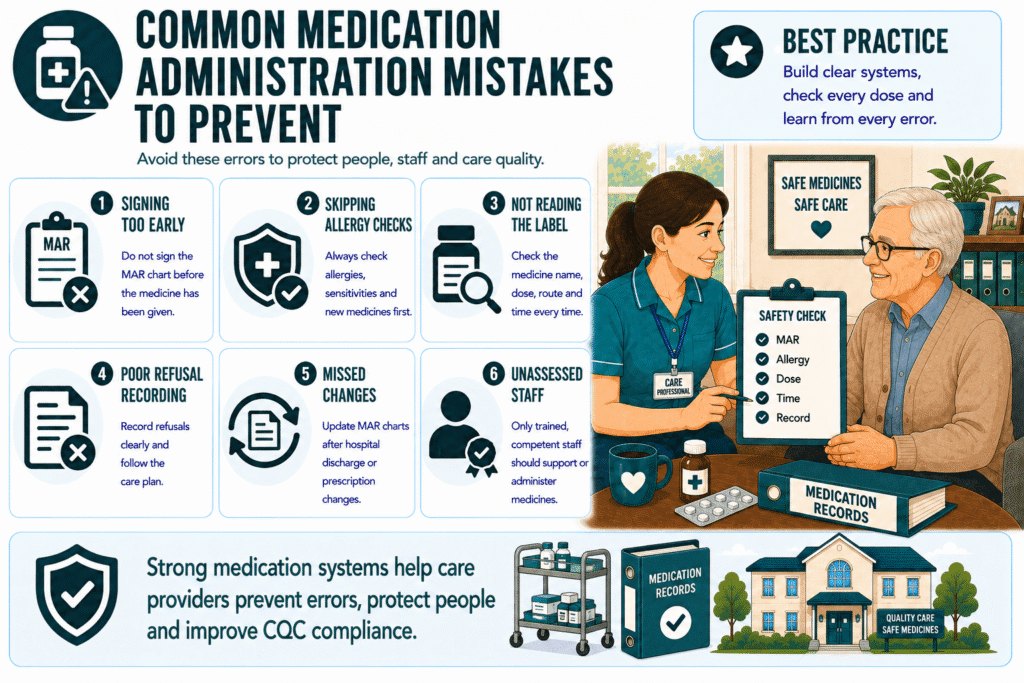
Most medication errors do not happen because staff do not care. They happen when systems feel rushed, unclear, or too dependent on memory.
Care providers should watch for common risks such as staff signing the MAR chart before giving medicine, missing allergy checks, giving medicine without reading the instructions, failing to record refusals, or treating PRN medicines as routine medication.
Problems also happen when teams miss hospital discharge changes, rely too heavily on a monitored dosage system, ignore low stock, skip MAR audits, or allow unassessed staff to support medicines.
Managers should treat every medication error as a learning opportunity, not just a blame issue. A strong service investigates what happened, updates the care plan where needed, supports the staff member, reports concerns properly and prevents the same mistake from happening again.
Final Checklist for Safer Medication Administration
Before supporting someone with medicines, staff should pause and check the basics. Confirm the right person, right medicine, right dose, right route and right time. Then check the MAR chart, allergies, consent, capacity, storage instructions and any special notes.
Staff should also respect the person’s right to refuse. If someone refuses medicine, staff should not force or hide it unless a lawful covert administration process has been agreed. They should record the refusal clearly and escalate the concern according to the care plan and medication policy.
After giving support, staff should record the medicine immediately, report concerns quickly, and ask for guidance when instructions look unclear. These checks turn safe medication administration from a routine task into a reliable safety habit.
Conclusion
Medication safety does not depend on one careful staff member. It depends on a clear system that helps every care worker make safe decisions during real visits, busy shifts, and changing circumstances.
The strongest care providers train staff properly, assess competence, keep accurate records, audit MAR charts, learn from medication errors and act quickly when risks appear. They do not leave safe medication administration to memory or guesswork.
By following safe medication administration guidelines UK care providers can protect clients, support staff confidence and strengthen CQC compliance. Care Sync Experts can help care businesses review medication policies, improve audit systems, assess staff competence and prepare stronger evidence for inspection.
FAQ
What are the 12 rights of safe medication administration?
The 12 rights of safe medication administration usually expand the basic medication checks into a fuller safety process. They often include the right person, right medicine, right dose, right route, right time, right documentation, right reason, right response, right education, right to refuse, right assessment and right evaluation.
Different organisations may use slightly different wording, so care providers should follow their own medication policy, MAR process, training and local guidance. The key point is not to memorise a number. Staff must check the medicine properly, record accurately, respect the person’s rights and escalate concerns quickly.
What are the 7 main drug categories?
Drug categories can vary depending on the system used, but common broad categories include antibiotics, pain medicines, cardiovascular medicines, respiratory medicines, gastrointestinal medicines, mental health medicines and endocrine medicines such as diabetes or thyroid treatments.
Care workers do not need to memorise every drug category to support medication safely. They need to read the MAR chart carefully, follow the care plan, check instructions, understand their role and ask a nurse, pharmacist, GP or manager when anything looks unclear.
What are 5 drugs to avoid in the elderly?
No medicine should be stopped just because someone is elderly, but some medicines need extra caution because older people may have a higher risk of side effects, falls, confusion, bleeding or kidney-related problems.
Five medicine groups that often need careful review in older adults include benzodiazepines, strong opioids, non-steroidal anti-inflammatory drugs such as ibuprofen or naproxen, medicines with strong anticholinergic effects, and some sedating antihistamines or sleeping tablets.
Care providers should never tell someone to stop these medicines. Instead, they should report concerns, monitor changes, document side effects and encourage a medication review by a GP, pharmacist or relevant prescriber.
What are high-risk medications?
High-risk medications are medicines that can cause serious harm if staff give them incorrectly, monitor them poorly or miss important warning signs. Common examples include insulin, anticoagulants such as warfarin, strong opioids, sedatives, some injectable medicines and controlled drugs.
Care providers should give high-risk medicines extra attention. Staff should follow the MAR chart exactly, check the person’s care plan, store medicines safely, record administration immediately and escalate missed doses, side effects, refusals or unclear instructions.
Managers should also audit high-risk medicines more closely and make sure only competent staff support or administer them.
Related reading
- HPFT Social Care in the Community Tender: £36m Framework Bid Guide 2026
- CQC Registration: Complete Guide for Domiciliary Care Providers
- Manager Application Evidence: 9 Essential Home Care Checks
- How to Apply for CQC Registration in 2026: Forms, Evidence and Assessment
- CQC Personal Care Form: 7 Essential Application Checks
- Service User Feedback in Health and Social Care: How to Build Better CQC Evidence
Browse every article on CQC, Ofsted, CIW and RQIA compliance