How to Start a Supported Living Business in the UK (2026 Guide)
Text to speech
Duration: 00:00
Font size
Published: 15 Jul, 2026
Share this on:
Setting up supported living business UK can give you the chance to build a meaningful care business while helping vulnerable adults live with more independence, choice and dignity. But this is not a simple “rent a house and place people in it” model.
Before you spend money on property, staff or policies, you need to understand what you want to provide. Will your service only offer housing-related support, such as budgeting, tenancy support, emotional support and help with community access? Or will your team deliver personal care, such as help with washing, dressing, eating, toileting or medication?
That decision shapes almost everything: your CQC position, staffing needs, policies, property setup, funding route and business plan. If you want to know how to start a supported living business properly, start by choosing the right care model before choosing the house.

Key Facts About Setting Up a Supported Living Business
- Housing and care separate: In supported living, the person usually has a tenancy or occupancy agreement, while their care or support sits under a separate arrangement.
- When CQC registration applies: In England, supported living accommodation only needs CQC registration if the provider carries out a regulated activity, such as personal care.
- What personal care means: Personal care means hands-on support with tasks such as washing, dressing, toileting, eating, drinking, skin care or certain types of medication support.
- Provider and registered manager: A supported living business delivering personal care will usually need to register with the CQC as the provider and may also need a registered manager.
- HMO licensing: Some shared supported living properties may need a House in Multiple Occupation licence, depending on the number of unrelated people living there and local council rules.
- Council funding rates: There is no fixed amount that every council pays for supported living in England, as funding depends on assessed needs, support hours, risk level and local rates.
What Is Supported Living?
Supported living is a care and housing model that helps people live as independently as possible in their own home or shared supported living accommodation. The person usually has a tenancy or occupancy agreement, while the care or support sits under a separate arrangement.
In simple terms, supported living gives vulnerable adults the right level of help without removing their independence. Support may include help with budgeting, cooking, cleaning, attending appointments, managing bills, building daily routines, accessing the community and staying safe at home.
Some providers also deliver personal care. This can include help with washing, dressing, eating, toileting or medication support. If your service provides personal care in England, you will usually need to register with the CQC.
Supported living for vulnerable adults can support people with learning disabilities, autism, mental health needs, physical disabilities, sensory needs or complex support needs. The best services do more than provide accommodation. They help people build confidence, make choices and live with dignity.
RELATED: What Is Supported Living? 2026 Update for Businesses
Supported Living vs Care Home: Know the Difference Before You Start
Before setting up supported living accommodation, you must understand the difference between supported living and a care home. Many new providers confuse the two, but they are not the same business model.
A care home provides accommodation and care together in one registered residential setting. People usually live on-site as residents, and the provider manages both the home and the care. Residential care homes for disabled adults may suit people who need a higher level of daily support in a more structured environment.
Supported living works differently. The person usually has their own tenancy or occupancy agreement, and the care or support is arranged separately. This gives people more choice over their home, routines, visitors, meals, bills and daily decisions.
This difference matters because it affects your property setup, contracts, CQC registration, staffing model and funding route. If you want to build a genuine supported living service, do not design it like a care home with a different name.
How to Start a Supported Living Business: Step-by-Step
If you want to know how to start a supported living business, follow the right order. Many new providers make costly mistakes because they secure a property before they understand the care model, local demand or regulatory route.
Start with these steps:
- Choose the client group you want to support.
- Decide whether your service will provide personal care.
- Register your company, CIC or chosen business structure.
- Research local demand and council commissioning priorities.
- Create a supported living business plan with clear costs, staffing and referral routes.
- Agree the need with commissioners and a housing partner. The person’s tenancy is with the landlord, so avoid buying or leasing property before referrals are agreed.
- Check HMO licensing, planning, fire safety, tenancy and landlord requirements.
- Prepare policies, risk assessments, safeguarding systems and quality monitoring tools.
- Recruit a registered manager if CQC registration applies.
- Apply for CQC registration if your service provides regulated personal care.
- Join local authority frameworks, approved provider lists and tender portals.
- Prepare your team, property and records before accepting your first placement.
Setting up supported living business UK requires planning before action. The stronger your model, evidence and systems are at the start, the easier it becomes to win trust from commissioners, families and the people you support.
READ MORE: CQC Supported Living Registration in 2026: The Complete Guide
How Much Does It Cost to Start a Supported Living Business?
The official costs of starting a supported living business are small. Incorporating a company online costs £100, CQC charges nothing to apply, and the CQC annual fee for a small service is a few hundred pounds a year. Most of your money goes on people, insurance, an office, policies and the cash you need to pay wages before your first invoice is paid.
You may see claims online that CQC charges an application fee of £1,000 or more. It does not. CQC fees are annual and cover registration.
You usually do not need to buy property. In supported living, the person holds their own tenancy with a landlord or housing association, and your company provides the care and support under a separate agreement. Buying or leasing a property before a commissioner has agreed to refer people is one of the most expensive mistakes a new provider can make. Agree the need with commissioners and a housing partner first.
| Cost line | Cost | Notes |
|---|---|---|
| Company incorporation (Companies House, online) | £100 one-off | Then £50 a year to file the confirmation statement online. |
| CQC registration application | £0 | No application fee. Only needed if you provide personal care. |
| CQC annual fee (community social care) | £239 per location plus £54.305 per person supported | Example: 6 people is £564.83 a year; 10 people is £782.05 a year. |
| DBS checks (from 5 October 2026) | Enhanced £41, standard £20 per check | DBS Update Service £15 a year per person, if used. |
| ICO data protection fee | £52 a year (tier 1) | £5 less by direct debit. |
| Employers’ liability insurance | Costs vary, get quotes | A legal requirement from your first employee (with limited exemptions), with at least £5 million cover. |
| Public liability, professional indemnity and abuse cover | Costs vary | Check the minimum cover your commissioners ask for. |
| Policies, procedures and business plan | Costs vary | Must match the service you actually provide. CQC rejects incomplete or inaccurate applications. |
| Office | Costs vary | You need somewhere secure to manage the service and keep records. |
| Registered manager and staff recruitment | Costs vary | Hiring a full team before referrals are confirmed is a major cash risk. |
| Property purchase or lease | Usually £0 for the care provider | The tenancy is between the person and a landlord, housing association or registered provider. |
| HMO licence (only if your company is the landlord or manager) | Set by each council | Check your local council’s licensing pages. |
| Working capital | Costs vary | You pay wages before councils pay you, and Housing Benefit is not paid until the council decides the claim. |
Choose the Right Supported Living Model
The best supported living businesses do not try to support everyone. They choose a clear model, understand the people they want to serve, and build the service around those needs.
Your service may support adults with learning disabilities, autism, mental health needs, physical disabilities, sensory needs, older adults, care leavers or people with complex support needs. You can also choose between shared supported accommodation, self-contained flats, step-down support from hospital, long-term support or community-based outreach.
Some people search for setting up assisted living business or how to set up assisted living business UK, but in the UK care sector, “supported living” is usually the more accurate term when people live in their own home with separate support arrangements.
When choosing options for supported living, look at four things: local demand, your team’s skills, the type of property available, and what local authorities actually commission. A focused model helps you write better policies, recruit the right staff, price your service properly and deliver safer assisted living for vulnerable adults.
Do You Need CQC Registration?
You need to check your CQC position before you launch, not after you accept your first client. In England, supported living accommodation only needs CQC registration if the provider carries out a regulated activity, such as personal care.
Personal care means hands-on support with tasks such as washing, dressing, toileting, eating, drinking, skin care or certain types of medication support. If your team delivers actual care services like these, you will usually need to register with the CQC as the provider. You may also need a registered manager.
If your business only provides housing-related support, emotional support, tenancy support, budgeting help, community access or general daily living support without personal care, CQC registration may not apply. However, you still need strong safeguarding, risk assessment, staffing, housing and quality systems.
Do not guess. Define your service clearly, check whether your activities fall under CQC-regulated personal care, and build your policies around the support you actually provide.
ALSO SEE: Reg 44 Children’s Homes: 2026 Guide for Providers, Managers and Independent Visitors
Property, HMO and Supported Accommodation Rules
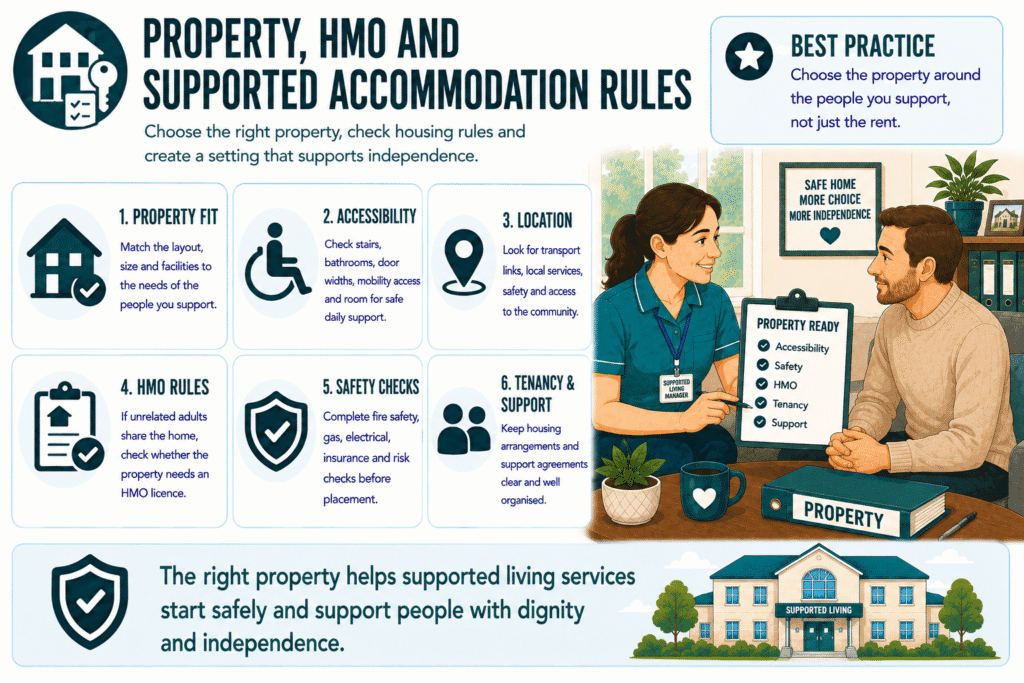
When setting up supported living accommodation, choose the property around the people you want to support, not just around rent, location or availability. The wrong property can create daily risks, staffing problems and poor outcomes.
A good supported accommodation setting should support independence. Check bedroom sizes, bathrooms, accessibility, transport links, local amenities, safety, noise levels, staff access, fire safety and space for private conversations. If you support people with mobility needs, stairs, narrow corridors or inaccessible bathrooms can quickly become a problem.
You also need to check housing rules before you sign a lease. Some shared properties may need a House in Multiple Occupation licence, depending on the number of unrelated people living there and the local council’s rules. You should also check planning requirements, landlord permissions, tenancy agreements, fire risk assessments, gas safety, electrical safety and insurance.
What is supported accommodation in practice? It is not just a house with support attached. It is accommodation that helps vulnerable people live safely, make choices and build independence.
Who Pays for Supported Living, and How Much Can You Charge?
Supported living is usually paid for in two separate parts. The care and support is funded by the council, the NHS or the person, and the rent and service charges are usually paid through Housing Benefit.
Who pays for the care and support
- The local council, after a care needs assessment. The council sets a personal budget for the person’s eligible needs.
- Direct payments, where the personal budget is paid to the person so they can choose and pay their provider.
- NHS continuing healthcare, for adults with complex health needs. This care is arranged and funded by the NHS and can be provided in the person’s own home.
- Self-funders, who pay for their own care.
Who pays the rent and service charges
The landlord charges rent and eligible service charges. Housing costs in supported (specified) accommodation are not paid through Universal Credit, so tenants claim Housing Benefit for them, even if they receive Universal Credit. Charges for care, support or supervision are not eligible for Housing Benefit, so they must be funded separately.
Where the landlord is a not-for-profit body, such as a housing association, registered charity or voluntary organisation, and the landlord or someone on its behalf provides care, support or supervision, the home can count as exempt accommodation. Rent is then assessed under older rules, often called enhanced Housing Benefit.
What changes from 2027
The Supported Housing (Regulatory Oversight) Act 2023 will bring local licensing of supported exempt accommodation in England. The government plans to consult on draft regulations in late 2026, and sector bodies expect licensing to start in 2027. Councils are expected to publish Local Supported Housing Strategies by 31 March 2027. The government plans to link Housing Benefit entitlement to holding a licence, and licence holders will need to meet the National Supported Housing Standards, although services commissioned by a council are exempt from that condition. The licence usually sits with whoever manages the accommodation, often the landlord or managing agent, so check your housing partner’s plans before you sign anything.
How much can you charge?
For council-funded work you rarely set the price yourself. Rates are set by each council’s framework, dynamic purchasing system (DPS) or published fee rates, and they vary by area and level of need. Two published 2026/27 examples:
- Oxfordshire County Council ceiling rates for supported living and outreach: £25.05 an hour for general support needs, rising to £29.67 an hour for enhanced specialist behavioural and forensic needs; sleep-in £84.97 a night.
- Solihull Council: supported living sleep-in £103.22 a night per carer.
These are examples, not national rates. Check your own council’s published rates before you build a pricing model. Sources: Housing Benefit guidance for supported housing claims, government response on supported housing regulation (16 April 2026), Oxfordshire fees and reviews, Solihull fee rates.
How Supported Living Businesses Get Clients and Funding
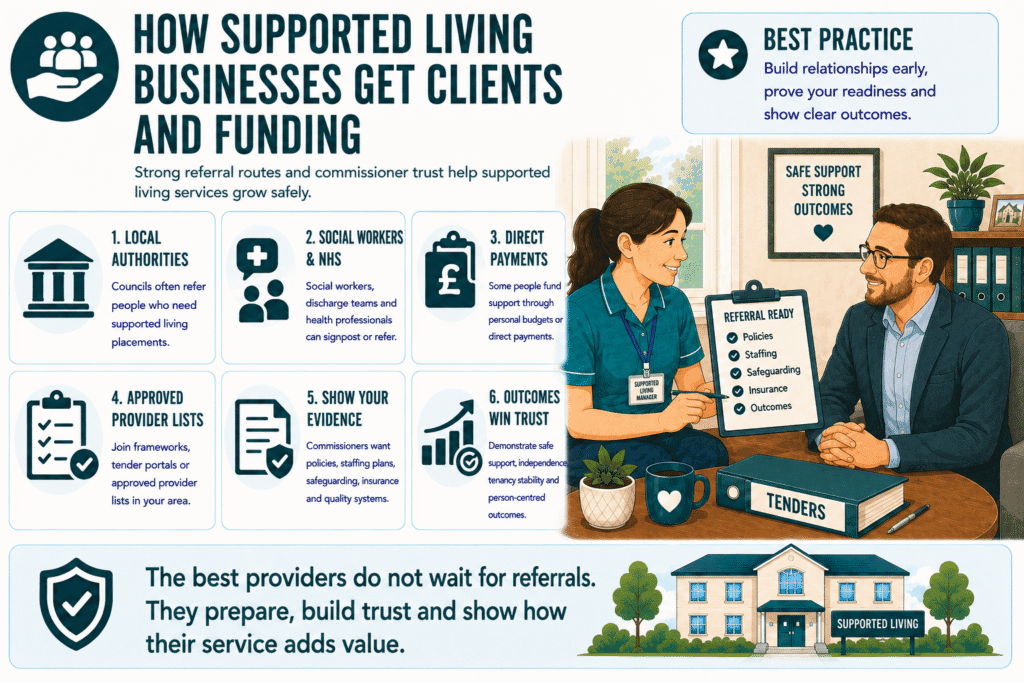
Most supported living businesses get clients through local authority referrals, social workers, NHS discharge teams, commissioning teams, direct payments, personal budgets or family-led enquiries. To grow, you need more than a nice property. You need commissioners to trust your service.
Start by researching your local council’s adult social care priorities. Find out what type of supported living for vulnerable adults they need most. Some areas need learning disability placements. Others need mental health step-down support, autism services, complex care support or accommodation for people moving out of residential settings.
You may need to join an approved provider list, apply to a local authority framework, register on tender portals or respond to spot-purchase opportunities. Councils will usually want evidence of your safeguarding systems, staffing plan, policies, insurance, financial stability, property suitability and quality monitoring.
Strong providers do not wait for referrals to appear. They build relationships, prove their readiness and show how their supported living accommodation can deliver safe, person-centred outcomes.
MORE: How to Get Private Care Clients UK: Best 2026 Guide
Staffing, Training and Quality Systems
Your staff will shape the quality of your supported living business. Do not recruit people just to fill shifts. Recruit around the needs of the people you want to support.
If your service supports people with autism, mental health needs, learning disabilities or complex behaviours, your team needs the right skills from day one. Training may include safeguarding, medication awareness, mental capacity, positive behaviour support, autism awareness, mental health support, infection control, fire safety, record keeping and person-centred care planning.
You also need strong quality systems before your first placement starts. Set up supervision, incident reporting, risk assessments, care reviews, audits, complaints handling, staff files, training records and safeguarding logs early. These systems protect the people you support and help you prove that your service runs safely.
A shared lives scheme works differently because an approved shared lives carer supports someone in a family-style setting. Supported living usually needs a wider staffing and governance structure. You can use tools such as rota software, care planning systems or a flexible benefits platform to improve organisation and retention, but technology will not fix poor leadership. A strong culture must come first.
Supported Living, Shared Lives Scheme or Care Home: Which Route Fits You?
Supported living, shared lives and care homes all support vulnerable adults, but they work in different ways. Choose the route that matches your skills, funding, property plans and appetite for regulation.
Supported living suits providers who want to help people live with more independence in their own home or shared accommodation. A shared lives scheme works differently. It matches a person with an approved shared lives carer who supports them in a family-style home. A care home provides accommodation and care together in one registered residential setting.
If you want to build a property-based service with separate tenancy and support arrangements, supported living may fit your goals. If you want to offer family-style support, shared lives may suit you better. If people need accommodation and higher levels of care in one place, residential care may be the better model.
ALSO READ: Housing for Autistic Adults: What Care Businesses Need to Know in 2026
Common Mistakes When Setting Up a Supported Living Business
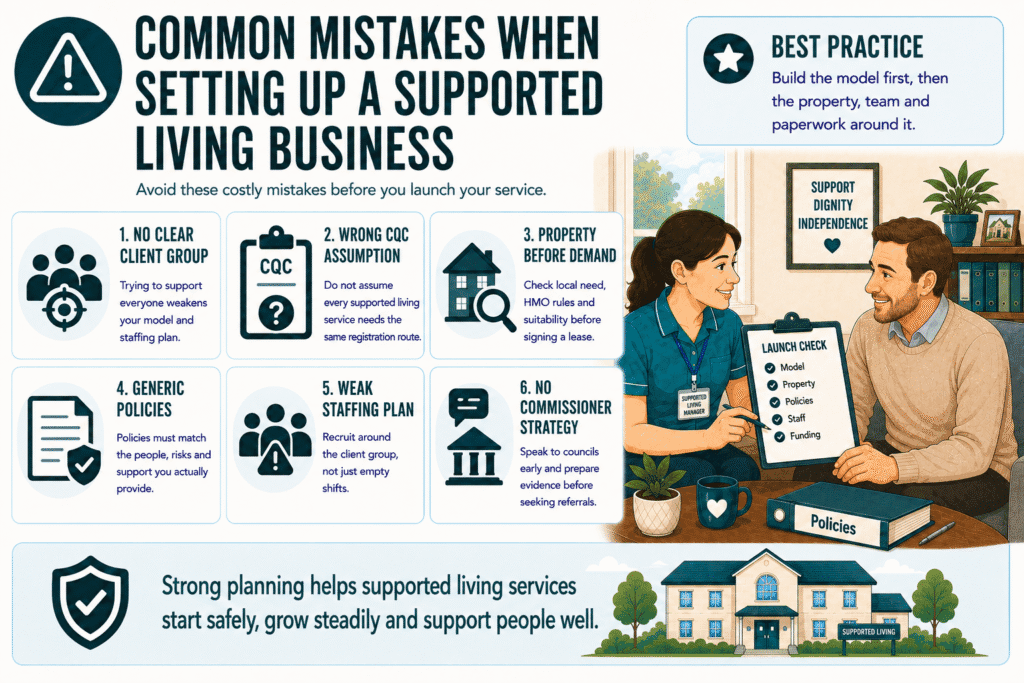
Many new providers struggle because they rush the setup stage. Avoid these common mistakes before you launch:
- Taking on a property before checking local demand.
- Assuming every supported living model needs CQC registration.
- Confusing supported living with a care home.
- Ignoring HMO, planning, fire safety and landlord requirements.
- Using generic policies that do not match the service.
- Hiring staff before defining the client group.
- Underpricing support hours and sleep-in arrangements.
- Waiting too long to speak with local commissioners.
- Forgetting to build evidence, audits and governance systems.
- Accepting a placement before the property and staff are ready.
Setting up supported living accommodation takes more than ambition. You need a clear model, safe property, trained staff, accurate pricing and strong quality systems before you support your first person.
Final Checklist Before You Launch
Before you launch, check that the main parts of your supported living business are ready:
- You have chosen your client group.
- You have confirmed your care and support model.
- You have checked whether CQC registration applies.
- You have registered your company, CIC or chosen business structure.
- You have completed your business plan and pricing model.
- You have checked local demand and council commissioning routes.
- You have secured suitable property.
- You have checked HMO, planning, fire safety and tenancy requirements.
- You have prepared policies, risk assessments and safeguarding systems.
- You have recruited the right manager and staff.
- You have identified local authority frameworks, tender portals or referral routes.
- You have set up quality monitoring, audits and record keeping.
If you want to know how to start a supported living business safely, treat this checklist as your launch gate. Do not accept your first placement until your property, people, paperwork and funding route are ready.
Conclusion
Setting up a supported living business in the UK takes more than finding a property and hiring staff. You need the right care model, clear CQC position, suitable accommodation, trained workers, strong policies and a realistic route into local authority referrals.
The providers who succeed usually plan before they spend. They understand the people they want to support, build safe systems early and prove to commissioners that they can deliver reliable, person-centred care.
If you need help with supported living setup, CQC registration, policies, compliance systems, tender readiness or local authority frameworks, Care Sync Experts can support you from idea to launch.
FAQ
Who qualifies for supported living in the UK?
People may qualify for supported living in the UK if they have care or support needs that make it harder to live safely and independently without help.
This can include adults with learning disabilities, autism, mental health needs, physical disabilities, sensory needs, complex needs, or older adults who need support with daily living.
A local council usually decides eligibility through a care needs assessment. If the person has eligible needs, the council may recommend supported living as one option.
How much does the council pay for supported living in England?
There is no fixed amount that every council pays for supported living in England. The amount depends on the person’s assessed needs, support hours, risk level, housing arrangement, local rates, and whether the person contributes towards their care.
If the council agrees that someone has eligible care needs, it may create a personal budget. This budget can pay for some or all of the agreed care and support, depending on the financial assessment.
How long can you live in supported living?
Some people live in supported living for a short period, while others stay for many years. The length of stay depends on the type of scheme, the tenancy or occupancy agreement, the person’s needs, and the purpose of the placement.
Some supported accommodation helps people move on to more independent housing after a few months or years. Other supported living arrangements provide long-term support for people who need ongoing help to live safely.
How do you get supported living in the UK?
To get supported living in the UK, contact your local council’s adult social care team and ask for a care needs assessment. The council will look at the person’s needs, risks, daily living skills, housing situation and support network.
If supported living appears suitable, social services may explain local options and help create a care and support plan. Some people also access supported living through NHS teams, hospital discharge teams, direct payments, personal budgets, family referrals or specialist providers.
How much does it cost to start a supported living business?
The official fees are low: £100 to incorporate a company online, no CQC application fee, and a CQC annual fee of £239 per location plus £54.305 per person supported if you provide personal care. Most of your budget goes on staff, insurance, an office, policies and working capital. You usually do not need to buy property, because the person rents from a landlord or housing association.
How much can you charge for supported living?
For council-funded packages, the council usually sets the rate through its framework, dynamic purchasing system or published fee rates, and rates vary by area and need. For example, Oxfordshire’s 2026/27 ceiling rates for supported living run from £25.05 to £29.67 an hour depending on need. Self-funders agree a price with you directly. Rent is charged separately by the landlord.
How do you become a supported accommodation provider?
It depends on who you support. For adults, you usually work with a not-for-profit landlord, such as a housing association or charity, so tenants can claim Housing Benefit, and once licensing starts, expected from 2027, many schemes will need a council licence. If you provide personal care, you also need CQC registration. Supported accommodation for looked-after children and care leavers aged 16 and 17 must be registered with Ofsted.
Related reading
Get help registering a supported living service
- What Is Supported Living? 2026 Update for Businesses
- CQC Supported Living Registration in 2026: The Complete Guide
- Domiciliary Care Business Continuity Plan: A Practical 2026 Guide
- Supported Accommodation Regulations: 2026 Practical Ofsted Compliance Guide
- Domiciliary Care Business Plan: How to Start a CQC-Ready Agency in 2026
- Living Wage UK 2026: What Care Providers Need to Know
Browse every article on CQC, Ofsted, CIW and RQIA compliance