SME Spend Targets:
How to Win More Public Contracts in 2026

Text to speech
Duration: 00:00
Font size
Published: 16 Jun, 2026
Share this on:
The new SME spend targets could create the biggest public procurement opportunity UK care providers have seen in years.
Under the latest plans from the government of the United Kingdom, central government departments must increase the amount they spend directly with small and medium-sized enterprises (SMEs).
The ambition is significant: government departments are expected to spend more than £7.4 billion annually with SMEs by 2027/28, creating a stronger pipeline of public sector contracts for smaller organisations.
For many care providers, this announcement arrives at the perfect time. Rising operating costs, workforce pressures and increasing competition have left many care businesses searching for sustainable growth opportunities.
While much of the recent news on SMEs has focused on economic challenges, these new procurement reforms offer a practical route to expansion through public sector contracts.
The opportunity extends far beyond traditional government suppliers. Domiciliary care agencies, supported living providers, specialist care organisations and other CQC-regulated businesses could all benefit from a procurement environment that actively encourages greater SME participation.
Most importantly, the new policy does not stand alone. The SME spend targets sit alongside the Procurement Act 2023, the Central Digital Platform and wider reforms designed to make bidding for contracts simpler and more accessible. Together, these changes create a more favourable landscape for care businesses that are ready to compete.
The providers that act now, strengthen their bid readiness and position themselves for upcoming opportunities will place themselves in the strongest position to win the next generation of local authority care tenders, NHS care contracts and other publicly funded services.

What Are SME Spend Targets?
SME spend targets are government procurement goals that require public sector departments to spend a specific percentage of their budget directly with small and medium-sized enterprises (SMEs). Under the UK government’s Plan for Small Business, departments must increase direct SME spending, with annual SME procurement expected to exceed £7.4 billion by 2027/28.
For care providers, the significance goes far beyond a headline figure. The new SME spend targets signal a clear shift in procurement policy towards creating more opportunities for smaller organisations to compete for public sector contracts.
Historically, many care businesses struggled to access larger procurement opportunities because contracts often favoured national providers with dedicated bid teams and extensive resources. The new approach aims to level the playing field by encouraging buyers to increase direct engagement with SMEs and reduce barriers that have traditionally limited participation.
The SME spend targets also work alongside the Procurement Act 2023, which introduces measures designed to make public procurement more transparent, accessible and competitive. These reforms encourage contracting authorities to engage more actively with SMEs and create procurement routes that support a wider range of suppliers.
For domiciliary care agencies, supported living providers and other care businesses, this means more opportunities to compete for local authority care tenders, NHS care contracts and other publicly funded services that may previously have been difficult to access.
In simple terms, SME spend targets for care providers create a larger pool of potential contract opportunities while making it easier for smaller care organisations to participate in the procurement process. The providers that prepare early will be best placed to benefit from these changes.
RELATED: How to Report Benefit Fraud in the UK (2026)
What Changed Under the Government’s SME Procurement Plan?
The government’s new SME procurement plan goes far beyond setting spending targets. It introduces a framework designed to make public procurement more accessible, transparent and accountable for smaller businesses.
At the centre of the reforms are department-specific SME spend targets. For the first time, individual departments must increase the percentage of their budget spent directly with SMEs rather than relying on broad government-wide ambitions.
Some of the headline targets include:
- Cabinet Office: 30%
- Department for Science, Innovation and Technology: 40%
- Department for Energy Security and Net Zero: 29%
- Ministry of Housing, Communities and Local Government: 27.5%
- HM Treasury: 22%
- Department for Health and Social Care: 15%
Collectively, these targets support the government’s ambition to exceed £7.4 billion annually in direct SME spending by 2027/28.
The reforms also introduce greater accountability. Departments must publish annual progress reports and explain how they plan to meet their targets. Where performance falls short, departments must produce improvement plans that outline specific actions to increase SME participation.
For care providers, this accountability matters. Procurement teams now have stronger incentives to engage with capable SMEs and demonstrate that they are creating opportunities for smaller suppliers.
The wider reforms also support this objective.
The Procurement Act 2023
The Procurement Act 2023 introduces significant changes aimed at simplifying public procurement and improving access for SMEs.
Key reforms include:
- Greater procurement transparency.
- Earlier supplier engagement opportunities.
- Simpler supplier registration processes.
- Faster payment requirements.
- Improved visibility of future procurement opportunities.
Together, these changes reduce many of the administrative barriers that have historically discouraged smaller care businesses from bidding.
The Central Digital Platform and SME Hub
Another major change is the rollout of the Central Digital Platform, which acts as the central registration system for public procurement suppliers.
Instead of repeatedly entering the same information across multiple procurement systems, suppliers can maintain a single profile and use a share code when bidding for opportunities.
Alongside this, the government has expanded resources through the SME Hub, helping businesses understand procurement requirements, departmental action plans and upcoming opportunities.
For any small business UK owner considering public sector contracts, these tools significantly reduce the administrative burden associated with tendering.
The message from the government is clear: SMEs should play a larger role in public procurement, and departments must actively support that objective. For care providers, that creates a more favourable environment for securing local authority care tenders, NHS care contracts and other publicly funded opportunities over the coming years.
READ MORE: What Is a Tender in Health and Social Care? 2026 Update
What This Means for Domiciliary Care and Supported Living Tenders
The real value of the new SME spend targets lies in what happens next. Care providers do not win contracts because government departments announce new targets. They win contracts because procurement teams change how they buy services.
That shift has already started.
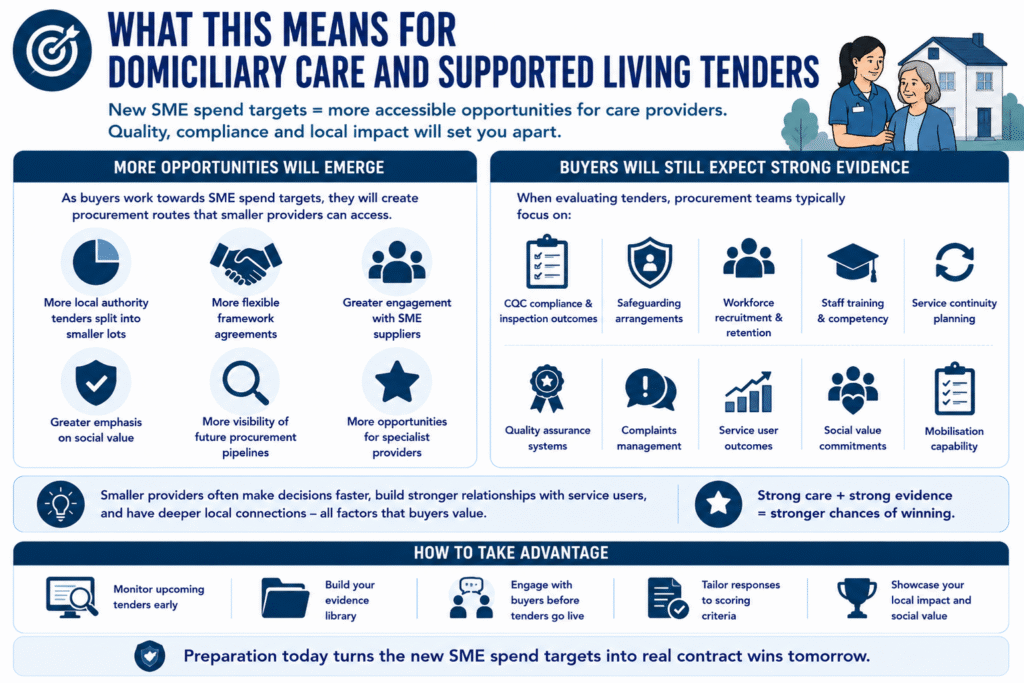
As buyers work towards their SME spend targets, many contracting authorities will need to create procurement routes that smaller providers can realistically access. This is particularly important in adult social care, where local delivery, community knowledge and workforce stability often matter more than corporate size.
For domiciliary care providers, this could mean more opportunities to bid for local authority care tenders that previously favoured larger regional or national providers. Buyers increasingly recognise that smaller providers often deliver more responsive services and maintain stronger relationships with service users and families.
Supported living providers may see similar opportunities emerge. Many councils and commissioners now prefer specialist providers that understand local needs, specific client groups and community integration rather than large-scale one-size-fits-all delivery models.
The Department of Health and Social Care’s SME target may appear lower than some other departments at 15%, but its influence reaches far beyond direct departmental procurement. NHS organisations, integrated care boards and local authorities frequently align procurement practices with wider central government priorities.
As a result, care providers should expect to see:
- More local authority care tenders divided into smaller lots.
- More flexible framework agreements.
- Greater emphasis on social value.
- Increased engagement with SME suppliers.
- More opportunities for specialist providers.
- Better visibility of future procurement pipelines.
However, buyers will still expect strong evidence.
When evaluating domiciliary care tenders, supported living tenders and NHS care contracts, procurement teams typically focus on:
- CQC compliance and inspection outcomes.
- Safeguarding arrangements.
- Workforce recruitment and retention.
- Staff training and competency.
- Service continuity planning.
- Quality assurance systems.
- Complaints management.
- Social value commitments.
- Mobilisation capability.
This is where many care businesses gain a competitive advantage. Unlike larger organisations, SMEs can often demonstrate direct leadership involvement, local partnerships and stronger community connections. These factors increasingly influence procurement scoring models.
The providers most likely to benefit from the SME spend targets are not simply those that submit more bids. They are the organisations that understand what buyers want to see and can present clear evidence that they deliver safe, effective and person-centred care.
In practical terms, the SME spend targets create opportunity. Strong preparation turns that opportunity into contract awards.
SEE ALSO: CQC Registered Manager: Requirements, Interview Tips for 2026
How Care Providers Can Prepare Now
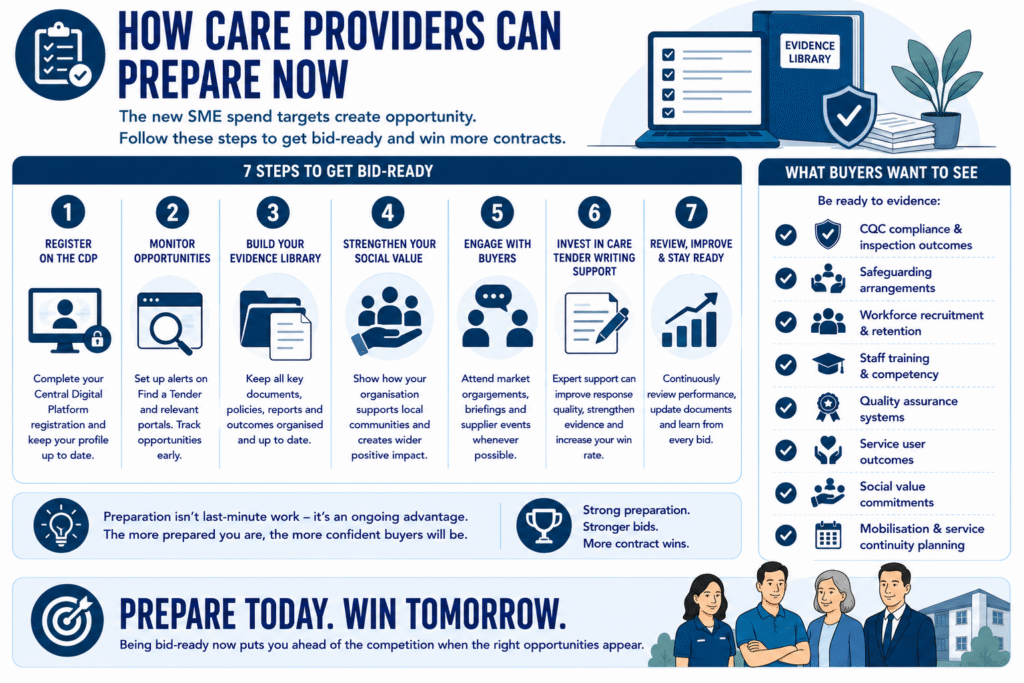
The SME spend targets create opportunity, but opportunity alone does not win contracts. Buyers will still expect providers to demonstrate compliance, quality and delivery capability.
The care providers that start preparing now will have a significant advantage when new procurement opportunities reach the market.
Register on the Central Digital Platform
The Central Digital Platform should be one of your first priorities.
The Procurement Act 2023 introduced the platform to simplify supplier registration and reduce repetitive administration. Instead of entering the same information for every opportunity, suppliers can maintain a central profile and use a share code when bidding.
Complete your registration, verify your details and ensure key documents remain up to date. A fully completed supplier profile can save valuable time when responding to tenders.
Monitor Opportunities Through Find a Tender
Many providers only start searching when they need work. Successful bidders take the opposite approach.
Set up alerts on Find a Tender and relevant procurement portals long before you need to submit a bid. Monitor keywords such as:
- domiciliary care
- supported living
- home care
- complex care
- adult social care
- care at home
- extra care housing
- community support
Early visibility gives you more time to assess opportunities and prepare stronger responses.
Build a Bid-Ready Evidence Library
One of the biggest mistakes care businesses make is gathering evidence after a tender is published.
Instead, create a central evidence library containing:
- Latest CQC inspection report
- Statement of Purpose
- Employer liability insurance
- Public liability insurance
- Training matrix
- Staff qualification records
- Safeguarding procedures
- Quality assurance audits
- Complaints and compliments data
- Service user outcomes
- Case studies and testimonials
A well-maintained evidence library can reduce tender preparation time dramatically.
Strengthen Your Social Value Offer
Social value continues to influence procurement scoring across the public sector.
Buyers increasingly want to know how providers support local communities beyond direct service delivery.
Strong examples include:
- Recruiting locally
- Supporting apprenticeships
- Partnering with colleges
- Working with carers’ organisations
- Supporting disadvantaged job seekers
- Delivering community initiatives
- Paying the Real Living Wage
These commitments often help SMEs compete effectively against larger providers.
Engage With Buyers Before Tenders Go Live
Many procurement teams now run:
- Market engagement events
- Supplier briefings
- Soft market testing exercises
- Provider forums
Attend these sessions whenever possible.
Early engagement helps you understand buyer priorities, identify upcoming opportunities and build credibility before formal procurement begins.
Invest in Care Tender Writing Support
Even excellent care providers lose contracts because they fail to communicate their strengths effectively.
Tender responses must address scoring criteria, demonstrate compliance and present evidence clearly. Strong operational performance does not automatically translate into strong bid responses.
Professional care tender writing support can help providers:
- Improve response quality
- Strengthen win themes
- Identify evidence gaps
- Increase compliance scores
- Improve overall bid success rates
As competition increases, the ability to present your service effectively becomes just as important as the service itself.
The providers that combine strong care delivery with strong bid preparation will be best positioned to benefit from the new SME spend targets for care providers.
MORE: Bid Writing Service: Top 5 Mistakes Care Providers Make in 2026
The Biggest Mistake Care Businesses Should Avoid
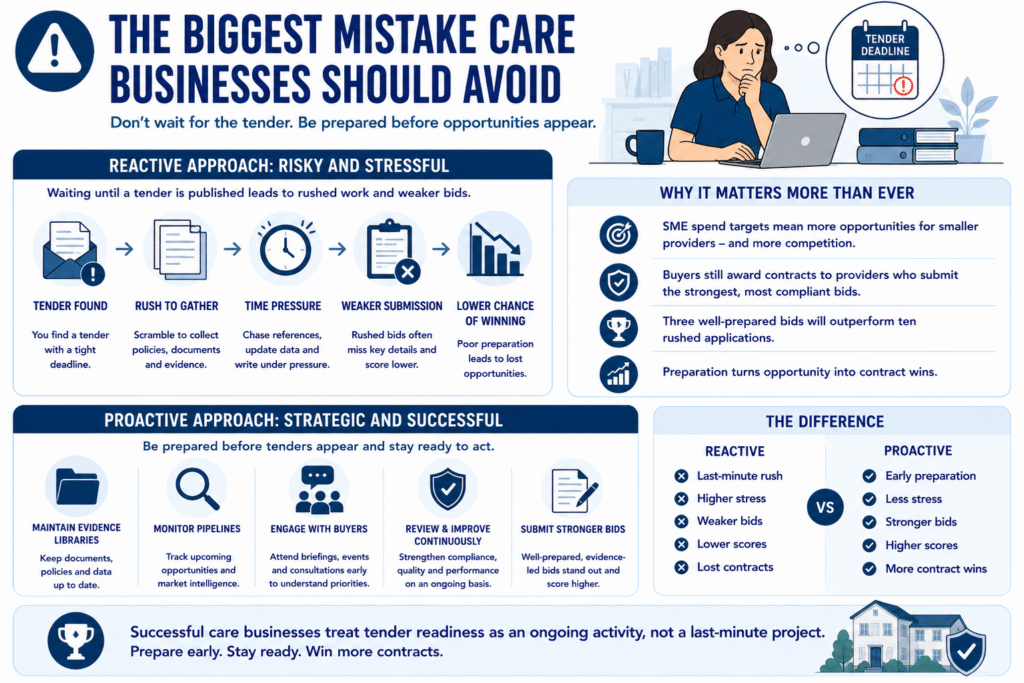
The biggest mistake care providers make is waiting for a tender to appear before they start preparing.
By the time a local authority care tender or NHS care contract reaches the market, the strongest bidders have often been preparing for months. They already have their evidence library organised, their case studies updated and their bid processes in place.
Many care businesses take the opposite approach.
They discover a tender with a tight deadline, scramble to gather documents, chase references, update policies and pull together operational data at the last minute. The result is often a rushed submission that fails to showcase the quality of the service.
This reactive approach becomes even more dangerous under the new SME spend targets.
As more procurement opportunities become available to SMEs, competition among care providers will increase. Buyers may create more accessible routes to market, but they will still award contracts to the providers that submit the strongest responses.
Successful care businesses treat tender readiness as an ongoing activity, not a last-minute project.
They maintain up-to-date evidence libraries. They track procurement pipelines. They attend supplier engagement events. They regularly review their policies, workforce data and quality metrics. Most importantly, they make bid or no-bid decisions based on strategy rather than urgency.
A provider that submits three well-prepared bids will often outperform a provider that submits ten rushed applications.
The new SME spend targets for care providers create a valuable opening, but they do not guarantee success. Care businesses still need to demonstrate why they are the right choice for the contract.
The providers that prepare before opportunities appear will have a clear advantage over those that start preparing after the deadline clock starts ticking.
That is the difference between participating in the procurement market and consistently winning public sector contracts.
How Care Sync Experts Helps Care Providers Win SME-Targeted Contracts
The new SME spend targets create a bigger opportunity pipeline, but opportunity alone does not secure contract awards. Care providers still need a structured approach to procurement, compliance and bid quality.
That is where Care Sync Experts helps.
We work with domiciliary care agencies, supported living providers, complex care organisations and other regulated care businesses that want to compete more effectively for public sector contracts.
Our support starts long before a tender reaches your inbox.
We help providers become genuinely bid-ready by strengthening the foundations that procurement teams assess during every evaluation. This includes reviewing compliance documentation, building evidence libraries, identifying gaps in tender readiness and ensuring key organisational information remains current and accessible.
For providers actively pursuing opportunities, we offer practical support across the entire tender lifecycle, including:
- Care tender writing
- Bid review and quality assurance
- Tender compliance checks
- Evidence library development
- Social value response support
- Bid or no-bid assessments
- Red team reviews
- Local authority care tender support
- NHS care contract submissions
- Supported living tender responses
Because we specialise in health and social care, we understand the areas that matter most to evaluators. We know how to present evidence around safeguarding, workforce development, quality assurance, service user outcomes, governance and CQC compliance in a way that aligns with procurement scoring criteria.
This sector-specific knowledge helps providers avoid generic responses and build submissions that clearly demonstrate value, quality and capability.
As the SME spend targets continue to reshape procurement across the public sector, prepared providers will have the strongest chance of securing new opportunities. Our role is to help care businesses move from being interested in tendering to becoming confident, competitive bidders.
Whether you are preparing for your first public sector contract or looking to improve your existing win rate, Care Sync Experts can help you position your organisation to take advantage of the growing opportunities created by the SME spend targets for care providers.
FAQ
Can a newly registered care provider bid for public sector contracts?
Yes. A newly registered care provider can bid for public sector contracts if it meets the eligibility requirements set by the contracting authority.
While some tenders require previous contract experience, many local authorities and framework providers allow newer organisations to compete by demonstrating strong governance, financial stability, workforce capability and a clear service delivery model.
Which government departments have the highest SME spending targets?
The Department for Science, Innovation and Technology currently has one of the highest direct SME spending targets at 40%. Other departments with significant targets include the Cabinet Office (30%), the Department for Energy Security and Net Zero (29%) and the Ministry of Housing, Communities and Local Government (27.5%). These targets are designed to increase direct procurement opportunities for SMEs across government.
Do SME spending targets guarantee more contracts for small care providers?
No. SME spending targets create more opportunities for smaller suppliers, but they do not guarantee contract awards. Care providers must still meet procurement requirements, demonstrate quality and compliance, and submit competitive tender responses that satisfy the evaluation criteria.
What is the difference between direct and indirect SME spend?
Direct SME spend occurs when a government department awards a contract directly to a small or medium-sized enterprise. Indirect SME spend occurs when a larger contractor uses SMEs within its supply chain to deliver part of a contract. The new departmental targets focus primarily on increasing direct spend with SMEs.