Temporary Occupation Permit UK: A Guide for Care Providers
Temporary Occupation Permit in the UK (2026): What Care Businesses Must Know
Text to speech
00:00
5sec
Duration: 00:00
Font size
Published: 10 Apr, 2026
Share this on:
A temporary work permit UK (often referred to as a temporary occupation permit) allows foreign workers to take up short-term roles in the UK through specific visa routes that typically last between 6 and 24 months.
To qualify, applicants must meet UK temporary work visa requirements, including securing a licensed sponsor, obtaining a Certificate of Sponsorship (CoS), and meeting basic financial and eligibility criteria.
For caregiver businesses, these permits offer limited use, as most care roles require longer-term staffing solutions through the Skilled Worker route rather than short-term temporary visas.
A temporary work permit UK (also called a temporary occupation permit) allows foreign nationals to work in the UK for a fixed, short-term period under specific visa routes approved by the government.
These permits are not a single visa type, instead, they cover a group of temporary work visas such as the Creative Worker, Charity Worker, Government Authorised Exchange, and Seasonal Worker routes.
A temporary work permit in the UK allows individuals to work for a licensed sponsor for a limited time under a specific visa route.
Each route has its own rules, duration, and restrictions, but they all share one key requirement: you must have a licensed sponsor in the UK who issues a Certificate of Sponsorship (CoS) before applying.
From a caregiver business perspective, this distinction matters.
Temporary permits are designed for:
Short-term or project-based roles
Exchange programmes or training placements
Seasonal or voluntary work
They are not built for long-term workforce needs, which is what most care providers require when hiring carers, support workers, or nurses.
For example:
A Charity Worker visa allows unpaid voluntary roles but cannot be used for paid care staff
A Seasonal Worker visa focuses on agriculture, not healthcare
A Government Authorised Exchange visa supports training—not permanent employment
This means that while a temporary occupation license may sound like a flexible hiring option, it rarely fits the operational needs of care agencies or care homes.
Caregiver businesses must therefore understand the limits of temporary work permits before using them, especially when planning recruitment strategies in 2026.
To apply for a temporary work permit UK, applicants must meet a clear set of UK temporary work visa requirements. These requirements apply across most temporary routes and form the foundation of any successful application.
A temporary work visa in the UK requires sponsorship from a licensed employer and a valid Certificate of Sponsorship (CoS).
1. Sponsorship from a Licensed Employer
The most important requirement is temporary work visa sponsorship UK.
Applicants must:
Have a confirmed job offer from a UK employer
Work for an organisation that holds a valid sponsor licence
Receive a Certificate of Sponsorship (CoS) from that employer
The CoS is a unique reference number that confirms:
Job role
Salary (where applicable)
Start date
Without sponsorship, applicants cannot apply.
2. Financial Requirement
Applicants must prove they can support themselves in the UK.
Typically, this means:
Having at least £1,270 in savings
Holding the funds for 28 consecutive days
In some cases, the sponsor can certify maintenance and cover this requirement.
3. Application Process
Understanding how to get temporary work visa in UK starts with the application process:
Apply online (usually from outside the UK)
Submit application up to 3 months before job start date
Provide supporting documents (passport, CoS, financial proof)
Complete biometrics (fingerprints and photo)
4. Processing Time
Standard decision time: around 3 weeks (outside the UK)
Faster decisions may be available for an additional fee
5. Duration of Stay
The length of stay depends on the visa route:
Most temporary visas last 6 to 12 months
Some routes extend up to 24 months
6. Dependants
Some temporary work visas allow applicants to bring:
A partner
Children
However, this depends on the specific visa route, and not all temporary visas permit dependants.
What This Means for Caregiver Businesses
For care providers, these requirements highlight a key limitation:
You must become a licensed sponsor before hiring any international worker—even on a temporary basis.
However, most temporary visas:
Do not support long-term employment
Restrict job types
Do not align with care sector workforce needs
This is why most care providers move beyond temporary permits and rely on more sustainable visa routes (covered later).
Key Temporary Work Visa Routes (And Why They Rarely Fit Care Providers)
The UK offers several temporary work visa routes under what many refer to as a temporary work permit UK system. Each route serves a specific purpose, but most do not align with the hiring needs of caregiver businesses.
Understanding these routes helps you avoid choosing the wrong pathway when planning international recruitment.
Creative Worker Visa
This visa allows individuals to work in the UK’s creative sector for short-term, project-based roles.
Duration: up to 12 months (extendable in some cases)
Requirement: sponsorship from a licensed creative organisation
Why it doesn’t fit care providers:
This route targets actors, musicians, and production professionals—not healthcare or social care staff.
Charity Worker Visa
This visa supports unpaid voluntary work for registered UK charities.
Duration: up to 12 months
Requirement: sponsorship from a licensed charity
Why it doesn’t fit care providers:
Care roles are paid positions, and this visa strictly prohibits paid employment. It cannot be used to hire carers or support workers.
Government Authorised Exchange (GAE)
This route supports training, research, or work experience programmes.
Duration: 12 to 24 months
Requirement: sponsorship through an approved scheme
Why it doesn’t fit care providers:
This visa focuses on temporary placements, not long-term employment. Care businesses need stable staff, not short-term trainees.
Seasonal Worker Visa
This visa allows temporary work in specific seasonal industries.
Duration: up to 6 months
Sector: agriculture and horticulture
Why it doesn’t fit care providers:
This route is strictly limited to farming-related roles and has no application in the care sector.
What This Means for Caregiver Businesses
At first glance, these routes may seem like flexible hiring options under a temporary occupation license model. However, in practice:
They are highly restricted by industry
They focus on short-term or unpaid roles
They do not support long-term workforce planning
This makes them unsuitable for most care providers, who need:
Consistent staffing
Skilled workers
Long-term employment solutions
For this reason, understanding how to get temporary work visa in UK is useful, but knowing when not to use it is even more important.
Temporary Work Visa vs Skilled Worker Visa (What Care Providers Should Use)
temporary occupation permit
Caregiver businesses often explore a temporary work permit UK when hiring internationally. However, most quickly realise that temporary visas do not support long-term staffing needs.
The real solution for care providers is the Temporary Skilled Worker visa UK pathway (Skilled Worker visa).
Care providers in the UK typically use the Skilled Worker visa, not temporary work visas, to hire international care staff.
Key Difference: Temporary vs Skilled Worker
Feature
Temporary Work Visa
Skilled Worker Visa
Duration
6–24 months
Up to 5 years (renewable)
Purpose
Short-term roles
Long-term employment
Sectors
Limited (creative, charity, agriculture)
Includes healthcare and care roles
Dependants
Limited
Allowed
Career progression
Restricted
Pathway to settlement
Why Temporary Work Visas Don’t Work for Care Providers
Temporary visas under a temporary occupation permit framework are designed for:
Short-term assignments
Exchange programmes
Seasonal or voluntary work
Care businesses need:
Stable workforce
Ongoing care delivery
Long-term employment contracts
Temporary routes simply cannot support this.
Why the Skilled Worker Visa Is the Right Route
The Temporary Skilled Worker visa UK pathway allows care providers to legally hire international staff for roles such as:
Care workers
Senior care workers
Support workers
Benefits include:
Longer stay (up to 5 years)
Ability to extend or settle
Permission to bring dependants
More flexibility for employers
New Entrant Skilled Worker Advantage
Some applicants may qualify as a new entrant skilled worker, which allows:
Lower salary thresholds
Easier entry into the workforce
This can help care providers manage recruitment costs while still meeting visa requirements.
What This Means for Caregiver Businesses
If your goal is to hire and retain care staff, do not rely on temporary visas.
Instead:
Apply for a sponsor licence
Use the Skilled Worker route
Build a sustainable workforce strategy
Understanding this difference is critical. Many providers waste time exploring temporary routes when the Skilled Worker pathway offers the only realistic solution for long-term care recruitment in the UK.
Temporary Shortage Occupation List UK (2026 Explained)
Many employers searching for a temporary work permit UK come across the Temporary Shortage Occupation List UK, but this is where confusion often starts.
The Temporary Shortage Occupation List UK applies to Skilled Worker visas, not temporary work visas.
What Is the Temporary Shortage Occupation List?
The shortage occupation list UK (also referred to as the temporary shortage list UK or employment shortage list UK) is a government-approved list of jobs where the UK lacks enough local workers.
This list helps employers:
Hire international workers more easily
Fill critical workforce gaps
Access more flexible salary rules
You may also see it called:
United Kingdom shortage occupation list
National occupation shortage list UK
Job shortage list UK
List of shortage occupations in UK
All refer to the same concept.
Is This a Temporary Work Visa?
No.
The Temporary Shortage Occupation List UK 2026 does not create a temporary visa route.
Instead, it works within the Skilled Worker visa system.
This is a critical distinction:
Temporary work visas = short-term, restricted
Shortage occupation list = supports long-term hiring
Many care roles already appear on the list of shortage occupations, especially:
Care workers
Senior care workers
This makes it easier for caregiver businesses to:
Recruit internationally
Fill urgent staffing gaps
Meet workforce demand
Key Benefits of the Shortage Occupation List
For employers using the UK shortage occupation list, benefits include:
Faster recruitment decisions
Reduced barriers to hiring
Access to wider talent pools
This is why the temporary shortage list is often misunderstood, it feels like a shortcut, but it still sits under the Skilled Worker route.
What This Means for Caregiver Businesses
If you are trying to:
Hire carers
Expand your workforce
Solve staffing shortages
Focus on:
The shortage occupation list for the UK
The Skilled Worker visa route
Not temporary visas.
Understanding this difference helps you avoid costly mistakes and build a hiring strategy that actually works in 2026.
Salary Requirements and Shortage Occupation List UK Salary
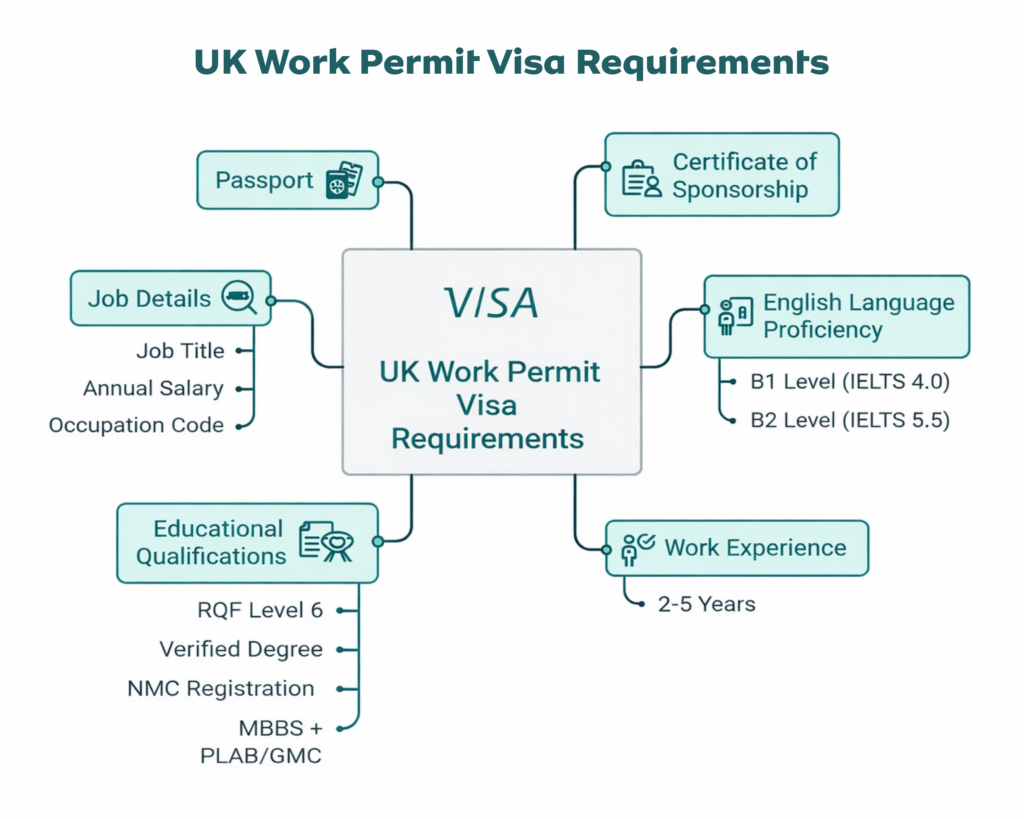
UK Work Permit Visa Requirements
Understanding salary rules is critical when hiring under the UK shortage occupation list, especially for caregiver businesses planning international recruitment.
The Shortage Occupation List UK salary rules allow some roles to be paid below standard thresholds, but employers must still meet minimum requirements.
How Salary Requirements Work
Under the Skilled Worker route, salaries depend on:
Job type
Occupation code
Experience level
Most roles follow a standard salary threshold. However, jobs on the shortage occupation list UK 2026 may qualify for reduced salary requirements.
Shortage Occupation List UK Salary Advantage
If a role appears on the list of shortage occupations, employers can:
Pay a lower salary than the standard Skilled Worker rate
Still meet visa eligibility requirements
This is particularly useful for care providers, where margins can be tight.
For example:
Care worker roles often fall under lower salary thresholds compared to high-skilled roles
Employers must still meet minimum hourly or annual pay rules
RQF Levels and Skilled Worker Eligibility
To qualify for the Skilled Worker route, jobs must meet certain skill levels.
This is where RQF level 6 skilled worker visa confusion comes in.
Not all roles require RQF Level 6 (degree level)
Many care roles fall below this but are still eligible due to labour shortages
This allows caregiver businesses to:
Recruit internationally
Fill essential roles
Stay compliant with visa rules
New Entrant Skilled Worker Salary Option
Some applicants qualify as a new entrant skilled worker, which allows:
Lower salary thresholds
Easier entry into the UK workforce
This option is useful for:
Younger applicants
Early-career workers
Certain training or progression roles
What About “Unskilled” Roles?
You may see terms like:
Unskilled shortage occupation list UK
“Low-skilled visa routes”
In reality:
The UK does not offer a general visa for unskilled workers
All roles must meet Skilled Worker eligibility criteria
The UK does not provide a visa route for unskilled care workers; roles must meet Skilled Worker requirements even when listed as shortages.
What This Means for Caregiver Businesses
For care providers, salary planning is not optional, it is strategic.
You must:
Align job roles with the shortage occupation list for the UK
Meet minimum salary thresholds
Structure offers carefully to remain compliant
The opportunity:
Use shortage roles to reduce salary pressure
Hire internationally without exceeding budget
Understanding Shortage Occupation List UK salary rules helps you build a sustainable recruitment model while staying fully compliant in 2026.
How Caregiver Businesses Should Approach Hiring in 2026
Care providers often start by exploring a temporary work permit UK, but the most successful businesses take a more strategic approach.
Caregiver businesses in the UK should prioritise the Skilled Worker route over temporary work permits to build a stable and compliant workforce.
When (and When Not) to Use a Temporary Work Permit
A temporary occupation permit can be useful in very limited situations:
Use it when:
You need short-term support for a specific project
You are running a training or exchange programme
The role fits one of the approved temporary visa routes
Do not use it when:
You need permanent or long-term staff
You are hiring care workers or support staff
You want workforce stability
For most care providers, temporary visas create more limitations than value.
The Right Approach: Skilled Worker Strategy
Instead of relying on a temporary occupation license, care providers should:
Apply for a sponsor licence
Identify roles on the uk shortage occupation list
Structure salaries to meet visa requirements
Build long-term recruitment pipelines
This approach allows you to:
Hire internationally with confidence
Retain staff over multiple years
Scale your care services sustainably
Step-by-Step Hiring Strategy for Care Providers
If you want to understand how to get temporary work visa in UK and apply it correctly, follow this process:
Get a Sponsor Licence Register your organisation as a licensed sponsor with the UK Home Office
Define Eligible Roles Align job roles with the list of shortage occupations in uk
Set Compliant Salaries Ensure pay meets Skilled Worker thresholds
Issue Certificate of Sponsorship (CoS) Assign CoS to selected candidates
Support the Visa Process Guide applicants through documentation and timelines
With ongoing workforce shortages, the UK continues to rely on international recruitment—especially in the care sector.
The temporary shortage list uk and broader immigration system are designed to:
Fill critical roles
Support essential services
Maintain care quality across the country
However, only businesses that understand the system will benefit.
Final Advice for Care Providers
Focus on:
Long-term workforce planning
Compliance with visa rules
Strategic use of sponsorship
Avoid:
Misusing temporary permits
Hiring without proper eligibility
Relying on outdated assumptions about “unskilled” recruitment
By aligning your hiring strategy with the shortage occupation list for the uk, you position your business for growth, stability, and long-term success in 2026.
Key Takeaway for Care Providers
If you take one thing from this guide, let it be this: Temporary work permits in the UK are not designed for hiring care workers; care providers should use the Skilled Worker route supported by the shortage occupation list.
What You Should Focus On
A temporary occupation permit is only suitable for short-term, restricted roles
Most care roles do not qualify under temporary work visa routes
The Temporary Shortage Occupation List UK supports hiring—but only under the Skilled Worker system
You must meet UK temporary work visa requirements if using temporary routes, but they rarely apply to care
The uk shortage occupation list offers a practical pathway for hiring international care staff
What You Should Avoid
Relying on a temporary work permit UK for long-term staffing
Confusing the temporary shortage list with temporary visas
Assuming there is an unskilled shortage occupation list UK (this does not exist officially)
Caregiver businesses that succeed in 2026 do not chase short-term fixes.
They:
Secure a sponsor licence
Use the Skilled Worker route
Align hiring with the list of shortage occupations
They avoid:
Misusing temporary visa routes
Building unstable staffing models
Understanding the difference between temporary permits and long-term visa strategies allows you to:
Hire correctly
Stay compliant
Grow sustainably
And most importantly, deliver consistent, high-quality care.
Need Support Hiring International Care Staff the Right Way in 2026?
Understanding UK temporary work permits, sponsorship rules, and the shortage occupation list can be confusing, and choosing the wrong route can lead to visa refusals, delays, and staffing gaps.
Care Sync Experts helps you:
Choose the right visa pathway for your care business (avoid costly mistakes)
Secure and manage your sponsor licence with confidence
Hire qualified international care staff using the Skilled Worker route
Align roles with the UK shortage occupation list for faster approvals
Structure salaries and contracts to meet compliance requirements
Get clear, expert guidance to hire the right staff, stay compliant, and grow your care service without disruption.
FAQ
Is ILR increasing to 10 years?
Not across the board. As of April 2026, 10 years is still one of the existing routes to indefinite leave to remain under long residence, rather than a new universal rule for everyone. Many other routes, such as Skilled Worker settlement, still operate on their own settlement timelines and residence conditions.
What are the new rules for British citizenship in 2026?
The safest way to phrase this is: British citizenship rules in 2026 still depend on route and personal circumstances. In general, applicants must be 18 or over, meet the residence rules, show good character, prove English where required, and usually have held ILR or settled status first.
GOV.UK’s March 2026 naturalisation guidance also notes that lawful residence is now easier to demonstrate in some cases under changes linked to the Nationality and Borders Act 2022.
How long can I stay outside the UK with indefinite leave to remain?
In most cases, you can lose ILR if you stay outside the UK for more than 2 continuous years. If that happens, you may need to apply for a Returning Resident visa before coming back, although there are limited exceptions, including some armed forces cases.
Is IELTS compulsory for UK work permits?
Not always. For work visas that have an English-language requirement, you usually need to prove English, but that does not always mean IELTS specifically.
GOV.UK accepts Secure English Language Tests from approved providers, and some applicants can meet the requirement through a degree taught in English or another accepted qualification or exemption.
For Skilled Worker, the required level is generally B1 or B2 depending on the route and evidence used, and GOV.UK now publishes route-by-route English requirements separately.