Where Care Excellence Meets Business Success. Transform your operations today - 0333 577 0877
We are here to help 24/7.



UK Two-Child Limit Abolition:
What the 2026 Changes Mean
Text to speech
Duration: 00:00
Font size
Published: 15 May, 2026
Share this on:
The UK two-child limit abolition officially takes effect from 6 April 2026 under the Universal Credit (Removal of Two Child Limit) Act 2026. From this date, families claiming Universal Credit or Child Tax Credit can receive the child element for all eligible children in their household, including third and subsequent children born after April 2017.
Before this change, the policy restricted support to the first two children in most households. The removal means many larger families will now receive additional monthly support automatically through their existing Universal Credit claim. Most claimants do not need to submit a new application, although payment increases may appear at different times depending on their assessment period.
The 2026 reform marks one of the biggest UK two-child benefit cap changes in recent years and aims to reduce financial pressure on low-income households, including families already receiving support from caregivers, support workers, and community care services.

What Is the Two Child Benefit Cap?
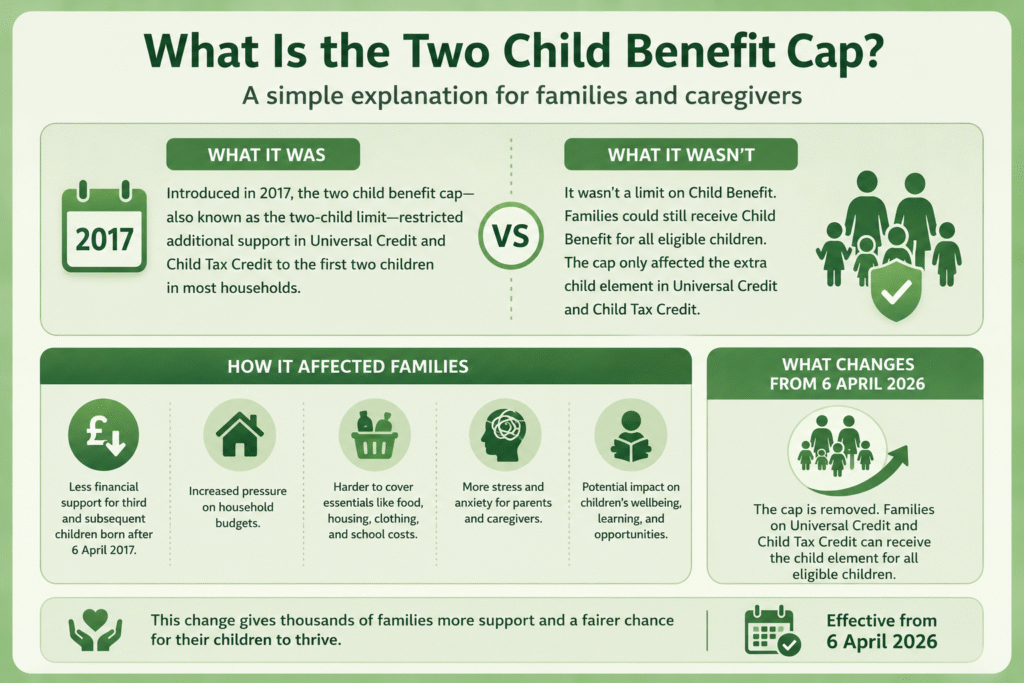
The two child benefit cap, often called the two-child limit, restricted additional financial support in Universal Credit and Child Tax Credit to the first two children in a household. The government introduced the policy in 2017 to reduce welfare spending and encourage families receiving benefits to make the same financial decisions as working households not receiving support.
Under the old rules, parents usually could not claim the Universal Credit child element for a third or subsequent child born after 6 April 2017, although some exceptions applied, including multiple births and certain safeguarding-related circumstances.
Many people confuse the policy with Child Benefit, but they are different. Child Benefit still applied to all eligible children, while the two-child limit only affected the additional child element within Universal Credit and Child Tax Credit.
For caregivers and family support workers, the policy often increased financial hardship among larger households. Many families struggled with rising food costs, housing pressures, school expenses, and emotional stress while caring for multiple children on limited incomes. The removal of the policy now changes what lifting the two child benefit cap means for thousands of vulnerable families across the UK.
RELATED: HICBC Child Benefit Rule Change UK: What Care Workers Need to Know in 2026
2 Child Benefit Cap Lifted: How Much Will Families Get?
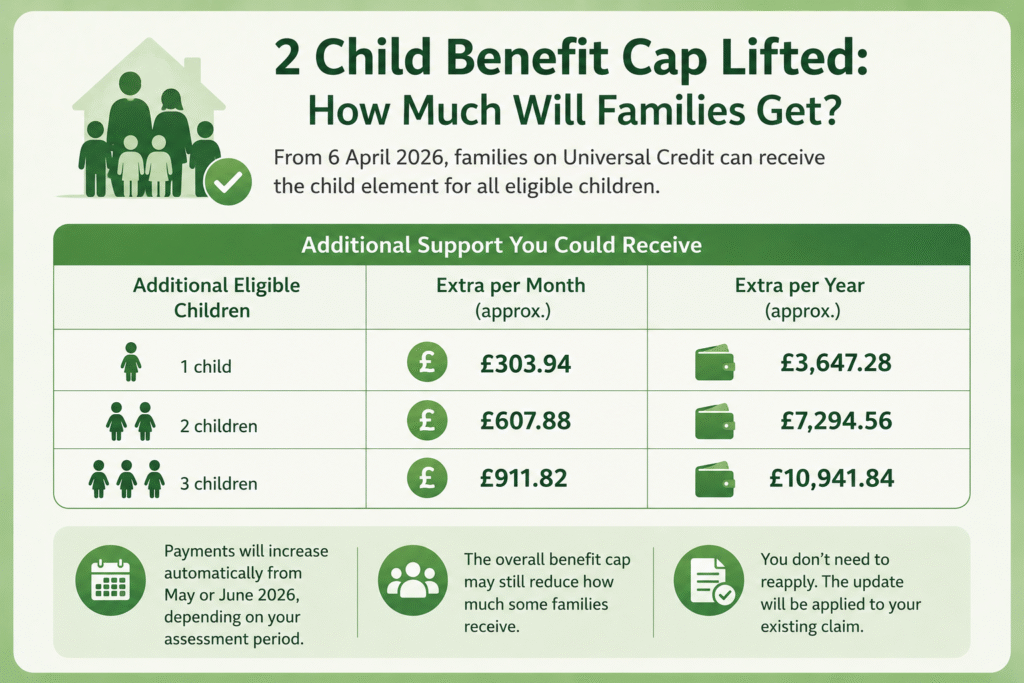
Families affected by the UK two-child limit abolition can now receive the Universal Credit child element for all eligible children in their household. In 2026, the standard child element stands at approximately £303.94 per month per additional child, although the exact amount may vary depending on the child’s date of birth and the family’s circumstances.
For many larger households, the change could increase monthly income significantly.
| Additional eligible children | Estimated monthly increase |
| 1 child | £303.94 |
| 2 children | £607.88 |
| 3 children | £911.82 |
This means some families could receive thousands of pounds more each year after the 2 child benefit cap lifted changes take effect.
Existing Universal Credit claimants usually do not need to reapply. The Department for Work and Pensions (DWP) plans to apply the increase automatically, although payment timing may depend on each household’s assessment cycle. Some families may see changes from May 2026 onwards.
However, the overall household benefit cap may still reduce how much certain households receive. Families already close to the maximum benefit threshold may not gain the full increase.
Many parents also ask whether child benefit will increase in 2026. While the removal of the two-child limit increases support through Universal Credit, Child Benefit rates follow separate annual government reviews and remain different from the Universal Credit child element.
SEE ALSO: Moving From ESA Support Group to Universal Credit: What You Need to Know in 2026
Is the 2 Child Cap Being Scrapped for Everyone?
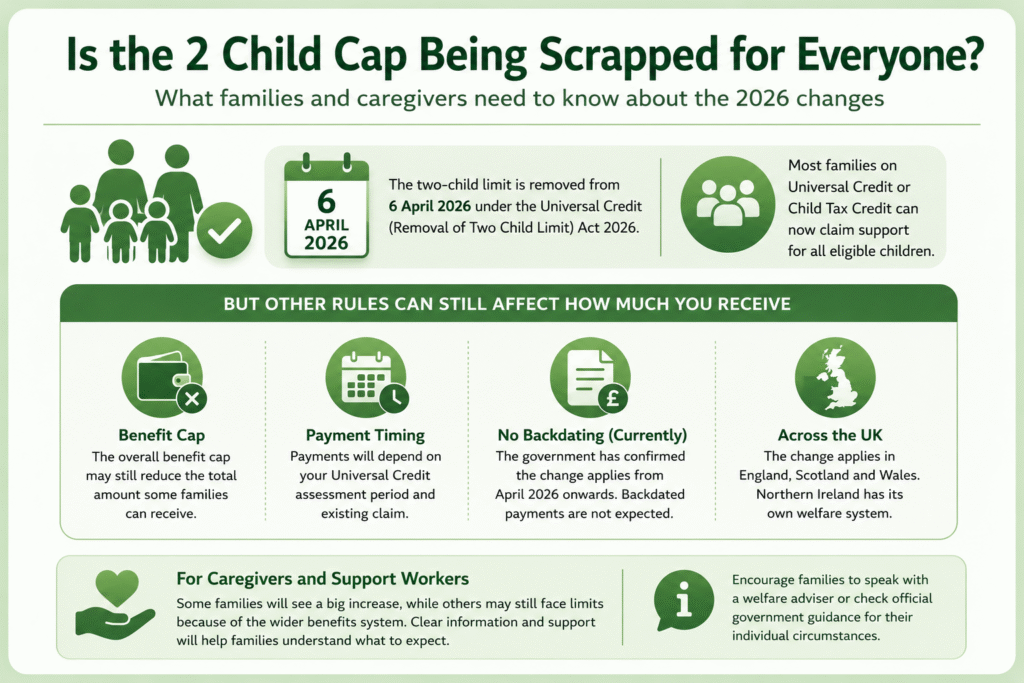
The removal of the two-child limit applies to most families receiving Universal Credit or Child Tax Credit, but not every household will benefit in the same way. While the restriction on third and subsequent children ends from 6 April 2026, other welfare rules can still reduce total payments.
The biggest limitation comes from the overall household benefit cap. Some larger families may still receive reduced payments if their total benefits exceed the government’s maximum allowance. This means a household could technically qualify for additional child elements but still not receive the full amount.
Many parents also ask whether the 2 child benefit cap will be backdated. At present, the government has confirmed the change starts from April 2026 moving forward. Families generally should not expect automatic backdated payments for periods before the law changed unless future guidance states otherwise.
The UK two-child benefit cap changes mainly affect families already claiming benefits, but payment timing may differ depending on:
- Universal Credit assessment periods
- existing claims
- changes in household circumstances
- interaction with other benefit rules
For caregivers, social workers, and support providers, this distinction matters. Some families may expect large increases immediately, while others may still face financial pressure because of the wider benefits system. Clear guidance and benefit support will remain important throughout 2026.
READ MORE: What Are Rachel Reeves Disability Benefits? 2026 Update
What the UK Two-Child Limit Abolition Means for Caregivers and Support Workers
Caregivers, family support workers, and domiciliary care providers often support families living under intense financial pressure. The removal of the two-child limit could ease some of that strain, especially for larger households already struggling with food costs, rent, school uniforms, transport, and childcare expenses.
Many caregivers regularly see how financial hardship affects family wellbeing. Parents under constant money stress often experience anxiety, burnout, and mental health challenges, while children may face poorer nutrition, unstable housing, and lower school attendance. When families receive more consistent financial support, caregivers may see improvements in stability, engagement, and overall wellbeing.
The change also matters for care organisations and community support services. Families will likely ask more questions about eligibility, payment increases, and how the new rules interact with Universal Credit. Support workers should understand what lifting the two child cap means so they can signpost families to accurate guidance and local welfare support where needed.
Although the reform will not solve every financial challenge facing vulnerable households, many caregivers across the UK may notice reduced crisis support needs over time as larger families gain access to additional monthly income under the new system.
Final Thoughts…
The UK two-child limit abolition marks a major shift in how the welfare system supports larger families. For many households, the change means more than extra monthly income; it means improved stability, reduced financial pressure, and a better chance to meet everyday needs without constant crisis management.
For caregivers and support professionals, the impact could reach far beyond benefit payments. Financial hardship often sits at the centre of wider safeguarding concerns, emotional stress, housing instability, and family burnout. As more families gain access to additional support, care providers may begin to see stronger outcomes across health, wellbeing, and community support services.
However, many families still struggle to understand how welfare changes affect their situation. Questions around eligibility, benefit caps, assessment periods, and payment increases continue to create confusion across the UK.
Need Support Understanding the 2026 Universal Credit Changes?
Care Sync Experts helps caregivers, care providers, and support organisations stay informed about major UK care, compliance, and welfare changes affecting vulnerable families.
From regulatory guidance to practical care insights, our team provides clear, people-focused information designed for the real challenges facing the care sector today.
FAQ
Do you get Child Benefit for 3 children in the UK?
Yes. Child Benefit applies to all eligible children in a household, including a third or subsequent child. The previous two-child limit only affected the additional child element within Universal Credit and Child Tax Credit, not Child Benefit itself.
At What Age Does Child Benefit Stop in the UK?
Child Benefit usually stops when a child turns 16. However, parents can continue receiving payments until the child turns 20 if they stay in approved education or training, such as A-levels or certain vocational courses.
Do All Parents in the UK Get Child Benefit?
Most parents or guardians responsible for a child can claim Child Benefit, regardless of income. However, households with a higher earner above the government’s income threshold may need to repay some or all of the benefit through the High Income Child Benefit Charge.
How Much Is the Child Benefit in the UK?
Child Benefit rates can change each tax year following government reviews. In 2026, parents typically receive a higher weekly amount for their eldest or only child and a slightly lower amount for each additional child. The exact amount depends on current HMRC rates and household circumstances.

Would you like to receive update from CareSync Experts?
All rights reserved. Copyright © - Care Sync Experts.


