What Are the CQC Fundamental Standards? 2026 Update
Text to speech
Duration: 00:00
Font size
Published: 26 Jun, 2026
Share this on:
The CQC Fundamental Standards are the legal minimum requirements that every registered health and social care provider in England must meet.
They set the level below which care must never fall, covering areas such as person-centred care, consent, safety, staffing, safeguarding, complaints and good governance.
For a caregiver business, these standards should guide everyday decisions, not just inspection preparation. They affect how your team writes care plans, responds to a fall, records consent, handles a complaint, recruits staff and raises concerns about unsafe care.
The standards sit within the Health and Social Care Act 2008 (Regulated Activities) Regulations 2014. CQC can take enforcement action where it finds a breach of those regulations or a risk to people using the service.
Strong compliance starts when managers treat the standards as part of the service’s daily operating system. When care plans reflect the person, staff understand risks, leaders act on concerns and teams learn from mistakes, providers build safer care and place themselves in a stronger position for a CQC inspection.

The CQC Fundamental Standards at a Glance
For care providers, the Care Quality Commission standards are not simply inspection topics. They shape how your team plans care, manages risks, recruits staff, responds to concerns and improves the service.
People often search for “what are the 12 fundamentals of care.” However, CQC’s current public guidance covers the following 13 Fundamental Standards. These reflect the wider CQC regulations that registered providers must meet when delivering regulated activities.
| CQC Fundamental Standard | What it means in practice for a care provider |
| Person-centred care | Build care plans around the person’s needs, choices, routines and goals. |
| Visiting and accompanying | Support people to maintain important relationships and access visits where the regulation applies. |
| Dignity and respect | Protect privacy, independence, equality and respectful communication. |
| Consent | Seek, record and review valid consent before providing care or treatment. |
| Safe care and treatment | Assess risks, act on concerns and reduce avoidable harm. |
| Safeguarding from abuse | Help staff identify, report and respond to abuse, neglect and improper treatment. |
| Food and drink | Make sure people receive enough suitable nutrition and hydration where your service provides it. |
| Premises and equipment | Keep environments and equipment clean, safe, suitable and properly maintained. |
| Complaints | Give people an accessible way to complain, investigate concerns and show what changed afterwards. |
| Good governance | Use audits, oversight and action plans to spot risks and improve quality. |
| Staffing | Deploy enough suitably skilled staff and provide training, supervision and support. |
| Fit and proper staff | Recruit safely, complete appropriate checks and confirm people can carry out their role. |
| Duty of candour | Be open, honest and supportive when something goes wrong. |
| Display of ratings | Display your current CQC rating where required and make your report available. |
These relevant standards in health and social care give providers a practical baseline for safe, respectful and accountable care. CQC’s detailed regulations sit mainly within Regulations 9 to 20A of the Health and Social Care Act 2008 (Regulated Activities) Regulations 2014.
What Do the Standards Look Like in Day-to-Day Care?
The CQC Fundamental Standards show up in everyday decisions, not only during a CQC inspection.
A care coordinator puts person-centred care into practice when they update a care plan after a fall, hospital discharge or change in mobility. A senior carer protects dignity when they ask before entering a person’s room, explain each task and respect personal routines.
Managers support safe care when they review incident records, investigate missed calls, check medicines and act quickly on staffing concerns. They do not wait for an audit or inspection to uncover repeated issues.
Consent also needs active attention. Staff should explain care clearly, check that the person understands and record the decision. Where capacity changes or a person refuses support, the team must respond appropriately rather than relying on an old care plan.
Good governance means leaders use evidence to improve. For example, a registered manager may spot repeated falls in monthly audits, review risk assessments, arrange refresher training and check whether the changes reduce harm.
A strong provider also treats complaints as useful feedback. Instead of simply closing a complaint, managers should investigate it, communicate openly with the person or family and show what the service changed as a result.
These daily actions give a provider the evidence needed for a CQC inspection. More importantly, they help teams deliver safer, more reliable care before an inspector ever visits.
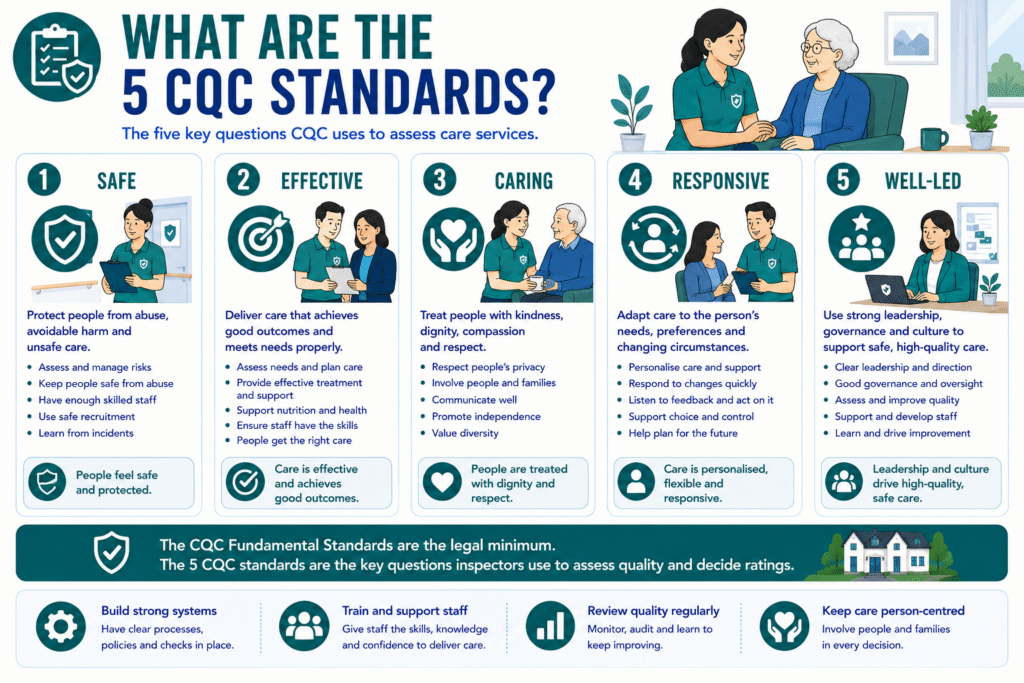
What Are the 5 CQC Standards?
People often ask, “What are the 5 CQC standards?” CQC formally describes them as its five key questions:
- Is the service Safe?
- Is it Effective?
- Is it Caring?
- Is it Responsive to people’s needs?
- Is it Well-led?
These are not the same as the CQC Fundamental Standards. The Fundamental Standards set the legal minimum that providers must meet. The five key questions help CQC assess the quality of a service and make CQC ratings decisions.
For a caregiver business, the connection is practical. Strong person-centred care supports responsive and caring services. Safe recruitment, risk assessments and staffing systems support safe care. Audits, incident reviews and open leadership support well-led care.
In 2026, CQC still uses these five questions as the core structure for its assessments. Its updated approach is expected to use supporting key lines of enquiry and rating characteristics to show what good, inadequate or outstanding care looks like in each sector.
Common CQC Compliance Mistakes Care Providers Should Avoid
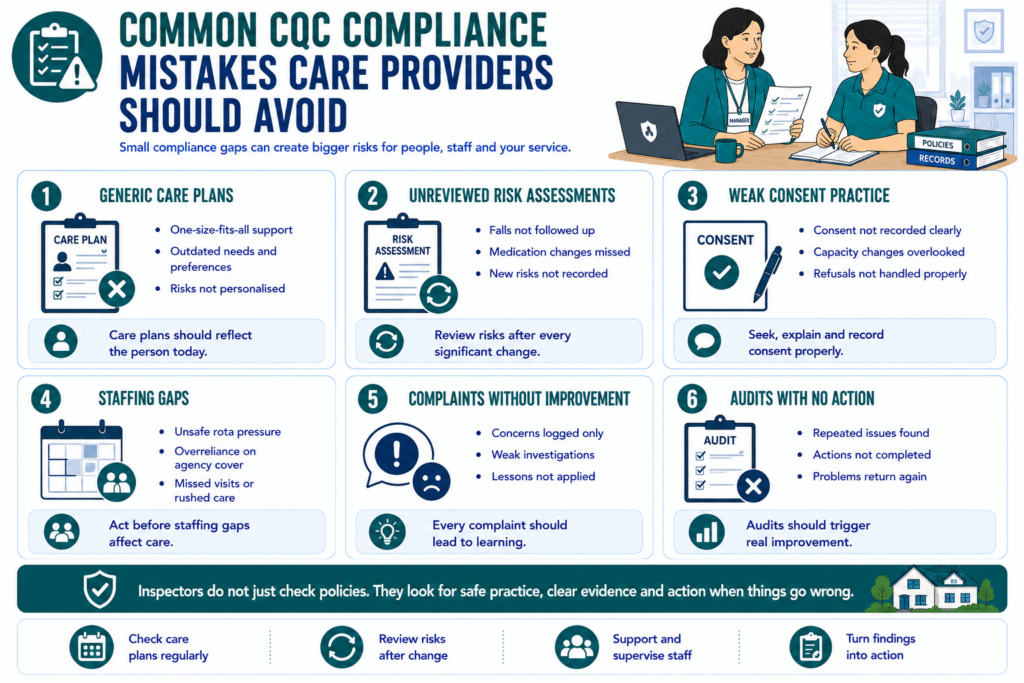
Most providers do not fail the CQC Fundamental Standards because they lack policies. They fall short when daily practice does not match those policies.
Common mistakes include:
- Using generic care plans that do not reflect the person’s current needs, choices or risks.
- Leaving risk assessments unchanged after a fall, hospital admission, medication change or safeguarding concern.
- Recording consent once and assuming it remains valid forever.
- Relying on agency cover or staff goodwill instead of addressing unsafe staffing levels.
- Logging complaints without investigating the root cause or showing how the service improved.
- Completing audits but failing to act on repeated errors.
- Treating duty of candour as an apology only, rather than being open, honest and supportive when something goes wrong.
- Keeping staff training records up to date on paper while staff lack confidence in practice.
A CQC inspection often exposes the gap between written systems and what carers actually do. Managers should regularly ask staff: “Can you explain this person’s risks, preferences and support needs?” If the answer differs from the care plan, the service needs to act quickly.
CQC Fundamental Standards Checklist for Care Providers
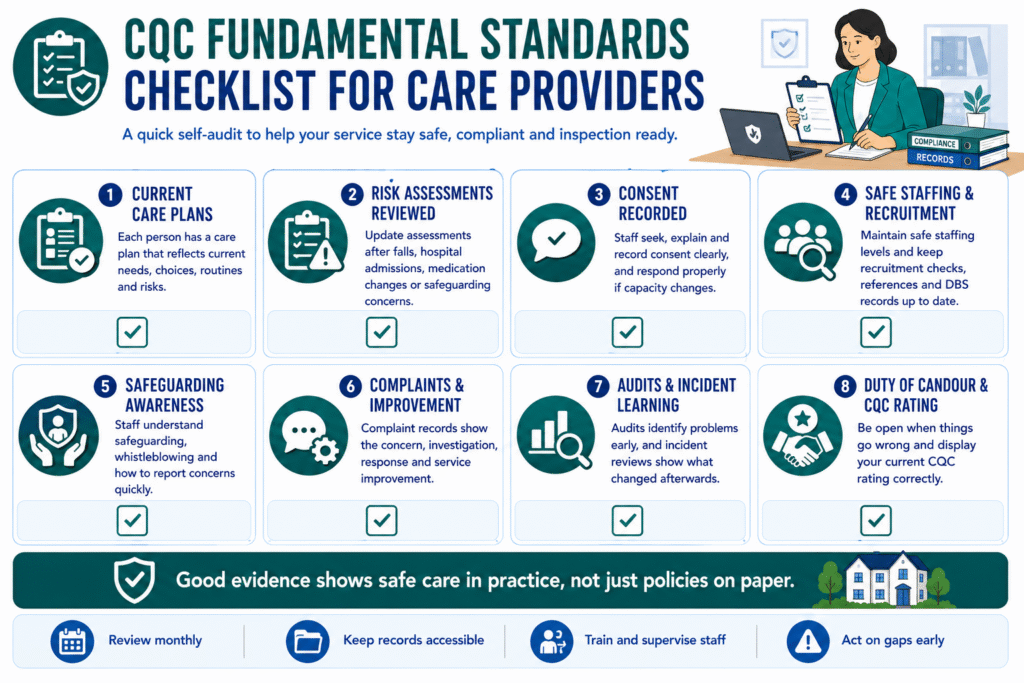
Before your next CQC inspection, make sure you can show how your service meets the CQC Fundamental Standards in daily practice.
Use this quick checklist:
- Each person has a current care plan that reflects their needs, choices, routines and risks.
- Staff review risk assessments after falls, hospital admissions, medication changes, safeguarding concerns or other major changes.
- Care teams record consent clearly and know what to do when someone refuses care or may lack capacity.
- Managers monitor staffing levels, and act before missed visits, rushed care or unsafe workloads affect people.
- Recruitment files include the right checks, references and evidence that staff can safely carry out their roles.
- Staff understand safeguarding, whistleblowing and how to report concerns without fear.
- Complaint records show the concern, investigation, response and improvement made.
- Audits identify problems early, and managers track actions through to completion.
- Incident reviews show what the service learned and how it reduced the chance of repeat harm.
- Duty of candour records show that the provider acted openly, explained what happened, apologised and offered support where required.
- Your current CQC ratings are displayed correctly, and your latest inspection report is available to people who use the service.
This checklist will not replace a full compliance audit, but it helps managers spot gaps before they become risks for people, staff or the business. CQC expects providers to have effective systems that monitor safety and quality, reduce risks and drive improvement.
Treat the Standards as Your Daily Operating System
The CQC Fundamental Standards should not become a once-a-year inspection project. They should guide how your caregiver business operates every day.
When managers keep care plans current, support staff properly, act on risks and learn from complaints or incidents, they protect the people who rely on their service. They also build stronger evidence for a future CQC inspection.
CQC expects providers to meet the legal standards below which care must never fall. Where it finds that a service is not meeting them, it can consider enforcement action.
The best approach is simple: do not wait for an inspector to expose a gap. Find it, fix it and show your team how better practice improves people’s care.
Need Help Meeting the CQC Fundamental Standards?
Strong CQC compliance is not about scrambling before an inspection. It is about building safer systems, supporting your team and giving people the person-centred care they deserve every day.
Care Sync Experts helps care providers strengthen care plans, policies, safeguarding, staff training, governance and inspection readiness. We work with you to identify gaps, turn requirements into practical actions and build evidence that reflects the quality of care your team delivers.
Do not wait for a complaint, incident or CQC inspection to reveal weaknesses. Get practical support now and build a safer, more confident and better-led service.
FAQ
What Are the 5 C’s in Care?
The 5 C’s in care are commonly described as:
– Compassion
– Competence
– Communication
– Courage
– Commitment
They are values that guide how staff support people, work with colleagues, and speak up when care is unsafe. They are not the same as the CQC Fundamental Standards, but they support the kind of respectful, person-centred care that CQC expects.
What Are the 6 Principles of Safeguarding CQC?
The six adult safeguarding principles are:
Empowerment — support people to make informed choices.
Prevention — act early to stop harm.
Proportionality — use the least intrusive response that fits the risk.
Protection — support people at greatest risk of harm.
Partnership — work with other professionals, agencies and communities.
Accountability — make roles, decisions and actions clear.
These are Care Act safeguarding principles rather than separate CQC standards, but providers should build them into safeguarding policies, training and daily practice.
What Are the 7 Pillars of Quality?
In healthcare, people often use “the 7 pillars” to mean the seven pillars of clinical governance:
– Patient and public involvement
– Clinical audit
– Clinical effectiveness
– Risk management
– Education and training
– Information management
– Staff management
For care providers, these pillars help turn good governance into daily action through audits, safer systems, capable staff and service improvement.
What Are the Six Pillars of High-Quality Healthcare?
A widely used quality model describes high-quality healthcare as:
– Safe
– Effective
– Person-centred
– Timely
– Efficient
– Equitable
These are broader healthcare quality principles, not CQC’s five key questions. They help providers assess whether care prevents harm, achieves good outcomes, respects the person’s preferences, avoids unnecessary delay, uses resources wisely and treats people fairly.