What Is a Tender in Health and Social Care? 2026 Update

Text to speech
Duration: 00:00
Font size
Published: 15 Jun, 2026
Share this on:
If you run a domiciliary care agency, supported living service, or care home, understanding what a tender is could be the difference between relying on private clients and securing long-term contracts worth thousands, or even millions, of pounds.
So, what is a tender?
A tender is a formal invitation from a buyer, such as a local authority, NHS organisation, housing association, or Integrated Care Board (ICB), asking providers to submit proposals to deliver specific services. The buyer then evaluates all submissions and awards the contract to the provider that offers the best combination of quality, compliance, experience, and value for money.
In simple terms, what is tendering? Tendering is the competitive process providers follow to win those contracts.
Within health and social care, commissioners use tenders to procure services such as:
- Domiciliary care
- Supported living
- Residential care
- Reablement services
- Respite care
- Learning disability support
- Children’s services
- Community-based care programmes
Many providers searching online for what does tender mean, what is a tender process, or what is a tender in business often assume tendering is only relevant to construction or large corporations. In reality, care providers of all sizes compete for public sector contracts every year through formal procurement exercises.
A tender is a formal request for organisations to submit proposals to deliver services under agreed terms, pricing, and performance standards. In health and social care, councils, NHS bodies, and other commissioners use tenders to identify the most suitable provider for a care contract.

What Is a Tender in Business?
A business tender is simply a competitive proposal submitted by an organisation in response to a buyer’s requirements. For care providers, that proposal typically includes evidence of CQC compliance, staffing structures, safeguarding arrangements, service delivery plans, pricing schedules, and examples of previous work.
The strongest tender submissions do more than promise excellent care. They prove that the provider can deliver safe, effective, person-centred services while meeting contractual and regulatory requirements.
Understanding what a tender is forms the foundation of every successful care business growth strategy. Before you can win contracts, you must understand how commissioners buy services, and why they choose one provider over another.
RELATED: Bid Writing Service: Top 5 Mistakes Care Providers Make in 2026
Why Care Tenders Matter for Care Providers
Care tenders matter because they can move your business from unpredictable enquiries to structured, long-term contract income. Instead of waiting for private referrals, you can win commissioned work from local authorities, NHS bodies, housing associations, and other public sector buyers.
For a care provider, a tender is not just paperwork. It is a growth route.
A successful tender can help your organisation:
- Secure multi-year care contracts
- Build a stable income pipeline
- Expand into new local authority areas
- Recruit staff with more confidence
- Strengthen your reputation with commissioners
- Serve more people who need regulated care and support
This is especially important for domiciliary care, supported living, reablement, respite care, and specialist adult social care services. These services often depend on public sector commissioning, which means providers need to understand what is tendering and how to compete properly.
However, winning care tenders takes more than being passionate about care. Buyers want proof. They want to see your CQC registration, safeguarding systems, staffing model, training records, quality assurance process, financial stability, and ability to deliver the service safely from day one.
That is why the best care providers treat tendering as part of their business strategy, not as a last-minute admin task. When you understand what a tender means in business, you start preparing before the opportunity appears.
Understanding the Care Tender Process Step by Step
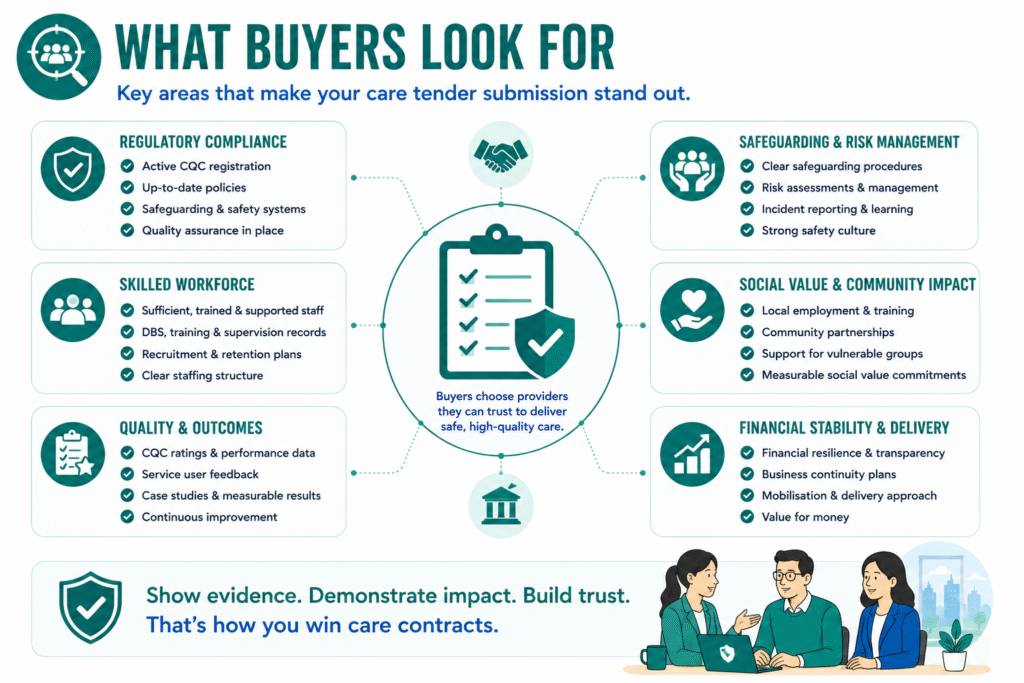
Many providers understand what a tender is, but far fewer understand how the tender process actually works. Knowing the stages helps you prepare the right documents, avoid costly mistakes, and improve your chances of winning contracts.
Step 1: Find Tender Opportunities
Most care contracts are advertised through procurement portals such as Find a Tender, Contracts Finder, NHS Atamis, and local authority procurement systems. Successful providers set up alerts so they can identify opportunities early rather than rushing a submission close to the deadline.
Step 2: Complete Pre-Qualification Requirements
Before a buyer considers your proposal, they need evidence that your organisation can legally and safely deliver the service.
This stage often includes:
- Company information
- Financial checks
- Insurance documents
- CQC registration details
- Safeguarding policies
- References from existing or previous clients
If your documentation is incomplete or out of date, you may fail before the evaluation even begins.
Step 3: Review the Service Specification
The specification explains exactly what the buyer wants.
It may include:
- Service hours
- Staffing requirements
- Quality standards
- Reporting expectations
- Performance targets
- Contract length
Strong providers read the specification carefully and align every part of their response to the buyer’s requirements.
Step 4: Write Your Tender Response
This is where you explain how you will deliver the service.
Your response should clearly demonstrate:
- Relevant experience
- Staffing capacity
- Quality assurance systems
- Safeguarding procedures
- Service delivery approach
- Social value commitments
Many providers searching for how to write a tender proposal or how to write a tender bid struggle at this stage because they focus on what they do rather than how they will solve the buyer’s challenges.
Step 5: Submit Your Bid
Most tenders require submission through an online procurement portal.
Always submit early. Technical issues, missing attachments, or portal errors can prevent a last-minute submission and automatically disqualify an otherwise strong bid.
Step 6: Evaluation and Contract Award
Once the deadline passes, evaluators score each submission against predetermined criteria.
Typical scoring areas include:
- Quality
- Service delivery
- Safeguarding
- Workforce capability
- Social value
- Price
The highest-scoring provider does not always offer the cheapest price. Buyers often prioritise quality, compliance, and evidence of successful service delivery when awarding care contracts.
READ MORE: CQC Registered Manager: Requirements, Interview Tips for 2026
How to Write a Tender Proposal That Scores Well
Understanding how to write a tender proposal is often the difference between winning a contract and receiving a rejection email.
Many care providers lose tenders because they write generic responses. Evaluators do not award marks for good intentions. They award marks for evidence, relevance, and clear answers that address the question directly.
Understand the Scoring Criteria First
Before writing a single sentence, review the evaluation criteria.
Ask yourself:
- What is the buyer actually asking?
- How many marks is this question worth?
- What evidence can we provide?
A question worth 20% of the total score deserves far more attention than one worth 5%.
Answer the Question Directly
One of the biggest mistakes providers make when learning how to write a tender bid is writing around the question instead of answering it.
For example, if the buyer asks how you will manage safeguarding concerns, do not spend half the response talking about your company history. Focus on your safeguarding process, escalation pathways, staff training, reporting procedures, and quality monitoring.
Use Real Evidence
Commissioners want proof.
Instead of writing:
“We provide high-quality care.”
Write:
“Our service achieved a Good CQC rating, maintained a 98% visit completion rate, and delivered mandatory safeguarding training to 100% of care staff during the previous 12 months.”
Specific evidence builds trust and earns marks.
Demonstrate Compliance
Strong tender responses reference:
- CQC regulations
- Safeguarding responsibilities
- Quality assurance systems
- Risk management processes
- Staff training requirements
Buyers need confidence that your organisation can meet both contractual and regulatory obligations.
Show Outcomes, Not Activities
Many providers describe what they do but fail to explain the results.
Rather than saying:
“We conduct regular staff supervision.”
Explain the outcome:
“Regular supervision helps us identify training needs early, improve staff retention, and maintain consistent standards of care for service users.”
Tailor Every Submission
Even if you have written similar bids before, avoid copying and pasting entire sections.
The strongest tender responses reflect:
- The buyer’s priorities
- Local population needs
- Service requirements
- Contract objectives
Providers who tailor their submissions consistently outperform those who rely on generic templates.
Learning how to write a tender is not about producing the longest response. It is about giving evaluators clear, evidence-based answers that show why your organisation is the best choice to deliver the service.
SEE ALSO: How to Start a Healthcare Recruitment Agency Uk in 2026
Common Reasons Care Providers Lose Tenders
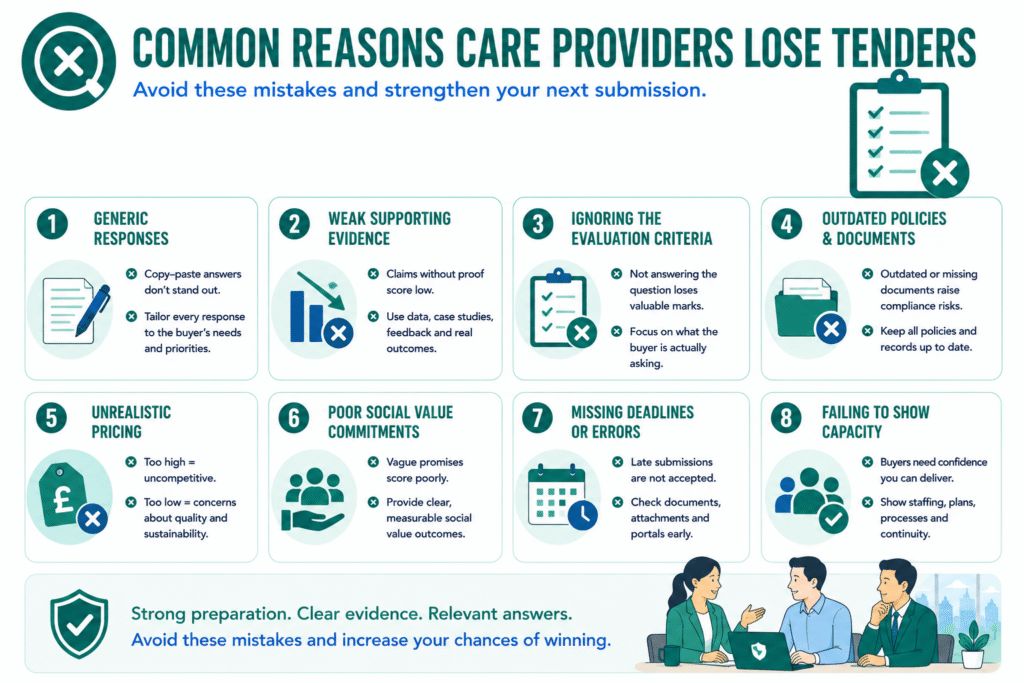
Many care providers assume they lost a tender because another organisation offered a lower price. In reality, most bids fail long before pricing becomes the deciding factor.
Commissioners often reject submissions because they lack evidence, miss key requirements, or fail to answer the questions properly.
Here are the most common reasons care providers lose tenders.
Generic Responses
Buyers can spot a copied response immediately.
If your answer could apply to any care provider in the UK, it will not stand out. Strong bids reference the specific service, location, challenges, and outcomes the commissioner wants to achieve.
Weak Supporting Evidence
Claims without evidence rarely score well.
Statements such as “we provide excellent care” carry little weight unless you support them with measurable results, inspection outcomes, service-user feedback, or performance data.
Ignoring the Evaluation Criteria
Every tender contains scoring criteria.
Some providers spend pages describing their business history while barely addressing the actual question. The highest-scoring responses mirror the evaluation criteria and provide evidence against each requirement.
Outdated Policies and Documents
Commissioners expect current documentation.
Expired policies, missing training records, outdated insurance certificates, or old safeguarding procedures can raise concerns about compliance and governance.
Unrealistic Pricing
Pricing too high can make your bid uncompetitive.
Pricing too low can create concerns about sustainability and service quality.
Buyers want confidence that you can deliver the contract safely, legally, and consistently throughout its duration.
Poor Social Value Commitments
Many providers treat social value as an afterthought.
Successful bidders demonstrate how they will create local employment opportunities, support communities, improve wellbeing, reduce inequalities, or contribute to wider social outcomes.
Missing Deadlines or Submission Errors
A strong bid submitted late is still a failed bid.
Procurement portals close automatically once the deadline passes. Missing attachments, uploading incorrect documents, or waiting until the final hour can eliminate your chances before evaluation begins.
Failing to Demonstrate Capacity
Buyers need reassurance that you can deliver the contract from day one.
If your submission does not explain staffing levels, mobilisation plans, management oversight, or service continuity arrangements, evaluators may question whether your organisation can handle the contract successfully.
The most successful providers do not simply learn what a tender process is. They learn why bids fail and build systems that prevent those mistakes from happening in the first place.
What Buyers Look for in Winning Care Tender Submissions
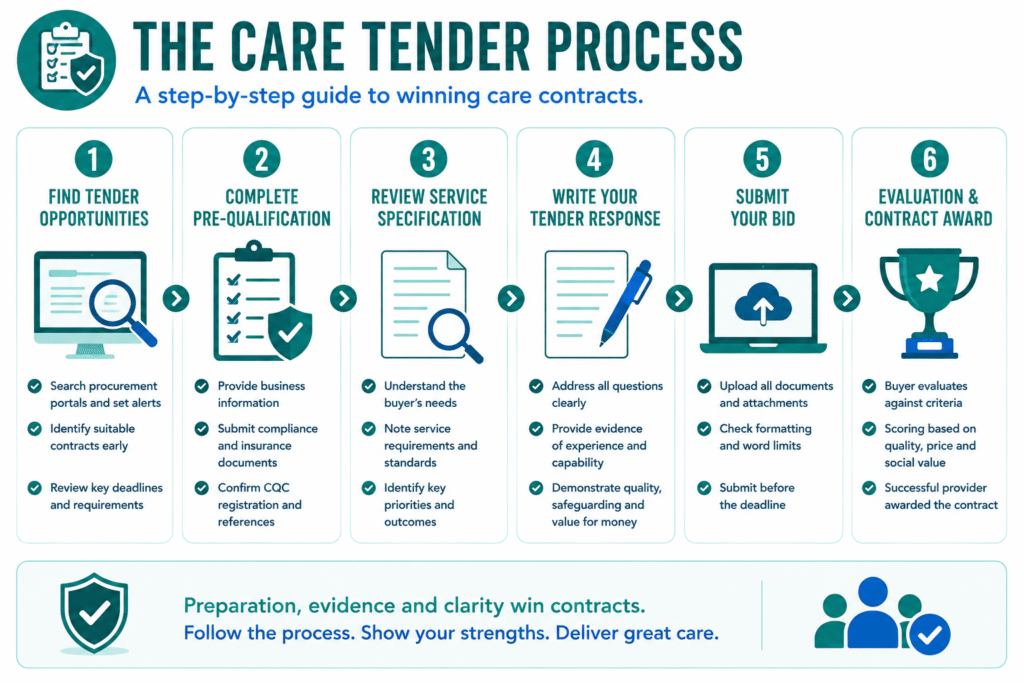
Every commissioner wants reassurance that the provider they appoint can deliver safe, effective, and person-centred care from the first day of the contract.
While evaluation criteria vary between organisations, most buyers look for the same core qualities when scoring care tender submissions.
Strong Regulatory Compliance
Buyers expect providers to demonstrate a clear understanding of CQC requirements and wider regulatory obligations.
This includes:
- CQC registration details
- Safeguarding arrangements
- Quality assurance systems
- Policies and procedures
- Governance structures
A provider that can clearly evidence compliance often starts with a significant advantage.
A Skilled and Stable Workforce
Care services depend on people.
Commissioners want confidence that you can recruit, train, retain, and support the workforce required to deliver the contract.
Strong bids explain:
- Recruitment processes
- Induction programmes
- Mandatory training
- Supervision arrangements
- Workforce retention strategies
Evidence of Quality Care
Buyers look beyond promises.
They want evidence that demonstrates your ability to achieve positive outcomes for the people you support.
Useful evidence may include:
- CQC inspection outcomes
- Service-user feedback
- Family testimonials
- Performance reports
- Case studies
- Quality audits
Effective Safeguarding and Risk Management
Safeguarding remains one of the highest-priority areas in most care tenders.
Commissioners want to understand:
- How concerns are identified
- How incidents are reported
- How risks are managed
- How lessons learned improve services
Clear processes and real examples strengthen your response considerably.
Social Value and Community Impact
Many public sector tenders allocate a percentage of the total score to social value.
Buyers increasingly favour providers that create wider benefits beyond direct care delivery.
Examples include:
- Local employment opportunities
- Apprenticeship programmes
- Community partnerships
- Volunteering initiatives
- Support for disadvantaged groups
The strongest submissions provide measurable commitments rather than vague promises.
Financial Stability and Service Continuity
Commissioners need assurance that your organisation can remain operational throughout the contract period.
They often assess:
- Financial standing
- Business continuity plans
- Contingency arrangements
- Leadership structure
- Operational resilience
A provider that demonstrates stability reduces risk for the buyer.
Ultimately, winning care tenders comes down to trust. Buyers want evidence that your organisation can deliver high-quality care, manage risks effectively, meet regulatory standards, and provide value for money over the life of the contract.
MORE: Inheritance Tax Threshold UK: 2026 Update
Care Tender Checklist Before You Submit
Even the strongest tender response can fail if key documents are missing or important requirements are overlooked. Before you submit any bid, run through this checklist to make sure your organisation is genuinely tender-ready.
Business and Compliance
✓ CQC registration is active and up to date
✓ Companies House details match your tender submission
✓ Insurance certificates are current
✓ Policies and procedures have been reviewed within the last 12 months
✓ Safeguarding policies align with current legislation and best practice
Workforce Readiness
✓ Staff training records are complete and accessible
✓ DBS checks are current
✓ Supervision and appraisal records are available
✓ Recruitment and retention plans are documented
✓ Registered Manager details are included where required
Quality and Performance Evidence
✓ Recent case studies demonstrate similar service delivery
✓ Service-user feedback and testimonials are available
✓ Quality assurance reports support your claims
✓ CQC inspection outcomes are referenced where relevant
✓ Performance data supports key statements within the bid
Financial and Operational Information
✓ Financial accounts meet the buyer’s requirements
✓ Pricing schedules have been checked for accuracy
✓ Business continuity plans are current
✓ Mobilisation plans are realistic and achievable
✓ Key personnel and escalation contacts are identified
Tender Submission Checks
✓ Every question has been answered fully
✓ Responses stay within the word count
✓ Supporting documents are attached
✓ Social value commitments are specific and measurable
✓ Another team member has completed a final review
✓ Submission deadline has been scheduled well in advance
The most successful providers treat tender preparation as an ongoing process rather than a last-minute task. Keeping your evidence, policies, training records, and case studies updated throughout the year makes it much easier to respond quickly when the right opportunity appears.
How Care Sync Experts Helps Providers Win More Tenders
Care tendering rewards preparation. The providers that win consistently do not wait until a deadline appears before organising their policies, evidence, pricing, and compliance documents.
Care Sync Experts helps care providers build that readiness before they bid.
Our support covers the key areas commissioners expect to see in a strong tender submission, including CQC registration evidence, policies and procedures, safeguarding documentation, staff training records, quality assurance systems, service delivery models, and social value planning.
We also support providers with care tender writing, bid reviews, tender readiness assessments, and document preparation. This helps you submit stronger responses that answer the buyer’s questions clearly and evidence your ability to deliver safe, compliant, high-quality care.
If you are new to tendering, we can help you understand what a tender is, how the tender process works, and what buyers expect from a credible care provider. If you already bid for contracts, we can help you strengthen your method statements, improve your evidence, and reduce the common mistakes that lead to lost marks.
The goal is simple: help your care business become tender-ready, commissioner-ready, and contract-ready.
FAQ
Why do they call it a tender?
They call it a tender because a supplier “tenders” or formally offers to provide goods or services for a stated price and standard. In care procurement, this means a provider submits a structured offer to deliver services such as domiciliary care, supported living, respite care, or community support.
What are the three types of tendering?
The three common types of tendering are open tendering, restricted tendering, and negotiated tendering. Open tendering allows any qualified provider to apply. Restricted tendering invites only shortlisted providers. Negotiated tendering involves direct discussion with selected suppliers, often for specialist or urgent services.
What are the 5 pillars of procurement?
The five pillars of procurement are value for money, transparency, fairness, competition, and accountability. In care tenders, these principles help commissioners choose providers who can deliver safe, compliant, high-quality services at a sustainable cost.
What are the 5 C’s of caring?
The 5 C’s of caring are compassion, competence, confidence, conscience, and commitment. Care providers can strengthen tender responses by showing how these values shape staff training, safeguarding, quality assurance, and everyday service delivery.