Child Benefit End Dates: When Payments Stop in the UK
When Does Child Benefit Stop in the UK? (2026 Guide)
Text to speech
00:00
5sec
Duration: 00:00
Font size
Published: 23 Feb, 2026
Share this on:
If you’re asking when does Child Benefit stop in the UK, the standard rule is simple: payments usually stop on 31 August after your child turns 16. Child Benefit can continue until age 20 if your child stays in full-time, non-advanced education (such as A-levels, T-levels, or NVQs) or approved training and started the course before turning 19.
If your child leaves education or training at 16 or 17, HMRC will stop Child Benefit at the next official cut-off date, and you must report the change to avoid overpayments.
In child benefit 2026, the same core rule applies under current UK Child Benefit eligibility guidance: you must tell HMRC if your child stays in or leaves education, or payments may stop automatically. If you do not report changes, HMRC can suspend or recover overpaid child benefit.
Many parents ask: “My child turns 18 – when does Child Benefit stop?”
The answer depends on education, not just age.
Child Benefit does not automatically stop at 18. If your child remains in full-time, non-advanced education or approved training, payments can continue until:
They finish their course, or
They turn 20 (whichever happens first), provided they started the course before their 19th birthday.
If your child leaves education at 18, HMRC stops payments at the next official payment cut-off date (February, May, August, or November). You must inform HMRC as soon as circumstances change to avoid overpayment.
Quick Age Guide
Your Child’s Age
What Happens to Child Benefit
16
Stops automatically on 31 August unless they stay in approved education or training
17
Continues if in approved education; stops if they leave
18
Continues if still in approved education or training
19
Continues only if they started their course before turning 19
20
Stops on their 20th birthday
Under the current UK Child Benefit eligibility rules for child benefit 2025, education status controls the payment, not simply whether your child turns 18.
In short, if you’re wondering when does child benefit stop, check whether your 18-year-old remains in qualifying education. Age alone does not end it.
What Counts as Approved Education or Training?
Whether child benefit continues after age 16 depends entirely on the type of education or training your child attends. If the course qualifies under UK Child Benefit eligibility rules, payments continue. If it does not, HMRC will stop payments.
Full-Time Non-Advanced Education
HMRC defines full-time education as more than 12 hours per week of supervised study, tuition, or course-related work experience.
Non-advanced education includes:
A-levels or equivalent (including International Baccalaureate)
T-levels
GCSEs
Scottish Highers
NVQs and vocational qualifications up to Level 3
Study programmes in England
Home education (if started before 16 and continuing)
Pre-apprenticeships
If your child stays enrolled in one of these programmes, child benefit 2025 rules allow payments to continue until they finish the course or turn 20.
Approved Training (By UK Nation)
Some unpaid training programmes also qualify:
Wales: Foundation Apprenticeships, Traineeships, Jobs Growth Wales+
Scotland: No One Left Behind programme
Northern Ireland: Training for Success, Skills for Life and Work, PEACEPLUS Youth Programme
These programmes must be government-approved and unpaid.
Education That Does NOT Qualify
Child Benefit stops if your child studies:
A university degree
Higher National Certificate (HNC) or Higher National Diploma (HND)
Foundation degree or access to higher education course
Certificate of Higher Education (CertHE)
Most paid apprenticeships
University-level study counts as advanced education, which falls outside UK Child Benefit eligibility rules.
If you’re unsure whether a course qualifies, check directly with HMRC before assuming payments will continue. Many cases of wrongly stopped child benefits happen because parents misunderstand what qualifies as approved education.
In simple terms, if the course sits below university level and your child studies more than 12 hours per week, Child Benefit usually continues. If it moves into higher education, payments stop.
Understanding when does child benefit stop requires more than knowing your child’s age. HMRC uses fixed cut-off dates throughout the year.
Automatic Stop at 16
If your child leaves education at 16, Child Benefit stops automatically on 31 August after their 16th birthday.
Example:
If your child turns 16 in March 2025 and does not continue into approved education, payments stop on 31 August 2025.
HMRC applies this rule across the UK under current child benefit 2025 guidance.
If Your Child Leaves Education Later
If your child continues education after 16 but later leaves before completing the course, payments stop at the next official quarterly cut-off date.
HMRC uses four fixed dates:
End of February
31 May
31 August
30 November
Payments stop on whichever of these dates comes first after your child leaves.
Example Timeline
If your child leaves college in October, HMRC stops Child Benefit on 30 November. If they leave in January, payments stop at the end of February.
This rule applies whether your child is 17, 18, or 19.
Maximum Age Limit
Even if your child remains in approved education, Child Benefit stops on their 20th birthday. Payments cannot continue beyond that point.
Why Parents Get Caught Out
Many parents assume Child Benefit stops exactly on a birthday. It does not. HMRC uses:
The 31 August rule at age 16
The quarterly stop dates after course completion
If you do not inform the Child Benefit Office when your child leaves education, HMRC may continue paying temporarily and later recover the overpayment. This often leads to cases of wrongly stopped child benefits or unexpected repayment letters.
To avoid confusion, always report changes immediately.
What Happens If Your Child Leaves School at 16 or 17?
When Does Child Benefit Stop?
If your child leaves education at 16 or 17 and does not move into approved training, Child Benefit stops under HMRC rules.
Most parents ask this after GCSE results:
If your child does not enrol in A-levels, NVQs, T-levels, or another qualifying course, payments stop on 31 August after their 16th birthday.
If your child already continued education past 16 but later drops out at 17, HMRC stops payments at the next quarterly cut-off date (February, May, August, or November).
What You Must Do Immediately
You must inform HMRC as soon as your child leaves education or training. Only the person claiming Child Benefit can report the change.
You can:
Report the change online (via Gov.uk cancel Child Benefit service)
Contact the Child Benefit Office
Call the official child benefit contact number
Write to HMRC
If you delay reporting, HMRC may continue paying temporarily and later demand repayment. Many cases of wrongly stopped child benefits actually begin with delayed reporting.
Can You Get Support After They Leave?
If your child is 16 or 17 and leaves education, you may qualify for a 20-week extension (explained in the next section). However, strict conditions apply.
If you want to know how to stop Child Benefit properly, report the change immediately through the official Gov.uk system rather than waiting for HMRC to act automatically.
When it comes to when does child benefit stop, leaving education without approved training triggers the stop, not simply age alone.
If your child leaves approved education or training at 16 or 17, you may still receive child benefit for up to 20 weeks, but only if you meet strict conditions.
HMRC calls this a Child Benefit extension.
Who Qualifies?
Your child must:
Be 16 or 17
Register with a local careers service (such as Connexions or a similar organisation)
Or register with the Ministry of Defence if applying to join the armed forces
Work less than 24 hours per week
Not receive certain benefits (such as Universal Credit)
Have been eligible for Child Benefit immediately before leaving education
You must apply within 3 months of your child leaving education or training.
If you miss that window, HMRC will not grant the extension.
When Does the Extension Stop?
The extension ends at the earliest of:
20 weeks after it starts
Your child turning 18
Your child starting work of 24+ hours per week
Your child starting non-qualifying education or training
This extension does not override the main age limit. Even under extension rules, payments cannot continue beyond age 20.
Many parents search “when does child benefit stop” after their child leaves school at 16 and assume payments end immediately. In some cases, the extension allows temporary continuation, but only if you act quickly.
If you need to apply, contact the Child Benefit Office directly or use the official HMRC online service. Do not assume the extension applies automatically; HMRC requires action from you.
How to Cancel Child Benefit Online or Report Changes
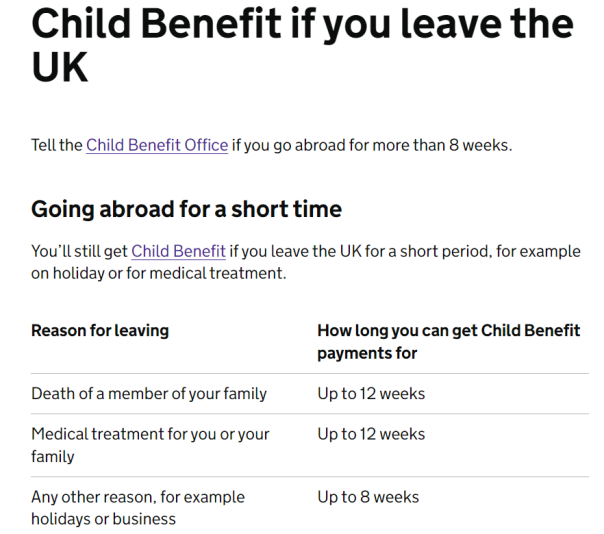
Child Benefit If You Leave UK
If your child leaves approved education or training, you must tell HMRC immediately. Only the person claiming child benefit can report the change.
Many parents search how to cancel Child Benefit online or how to stop Child Benefit when circumstances change. You have three main options.
Cancel or Report Changes Online (Fastest Method)
Use the official Gov.uk cancel Child Benefit service through your personal tax account. This allows you to:
Confirm your child is staying in education
Report that they have left education or training
Stop payments
Update personal details
This method reduces the risk of overpayment and avoids delays.
Contact the Child Benefit Office
You can also contact the Child Benefit Office directly by phone or post.
Have ready:
Your child benefit number (sometimes called your family allowance number)
Your National Insurance number
Your child’s details
If you search for the child benefit contact number, always use the official GOV.UK website to avoid incorrect listings.
When Should You Report Changes?
Report changes immediately if your child:
Leaves education or training
Moves abroad
Starts paid work over 24 hours per week
Enters university
Marries or forms a civil partnership
If you delay reporting, HMRC may continue paying and later request repayment. Many cases labelled as wrongly stopped child benefits actually involve delayed notifications or incomplete updates.
Important Reminder
If you’re unsure when does child benefit stop, do not guess. Confirm your child’s education status first, then notify HMRC promptly. Acting early protects you from repayment demands and prevents sudden payment suspensions.
What To Do If Your Child Benefit Was Wrongly Stopped
Sometimes HMRC stops child benefit even though your child still qualifies. Parents often discover this after payments suddenly disappear or after receiving a letter.
Before assuming an error, check three common triggers:
HMRC did not receive confirmation that your child stayed in education
Your child’s school or college did not report continued enrolment
You missed a response letter asking about post-16 plans
If your child still meets UK Child Benefit eligibility rules, you can challenge the decision.
Step 1: Confirm Your Child’s Status
Check:
Are they still in full-time, non-advanced education?
Did they start the course before turning 19?
Are they under 20?
If the answer is yes, payments should normally continue.
Step 2: Contact the Child Benefit Office Immediately
Call the official child benefit contact number or use your online account to report that your child remains in qualifying education.
Have ready:
Your child benefit number
Your National Insurance number
Details of your child’s school or training provider
If HMRC stopped payments incorrectly, they can reinstate them and issue backdated payments.
Step 3: Avoid Overpayment Issues
Sometimes HMRC stops payments because they suspect a change but lack confirmation. If you delay responding, the system may automatically suspend payments.
Many cases described as wrongly stopped child benefits result from incomplete information rather than actual ineligibility. Acting quickly usually resolves the issue.
When You May Need to Repay
If your child left education earlier and you did not report it, HMRC may request repayment. In this case, you can discuss repayment arrangements with the Child Benefit Office.
If you’re unsure when does child benefit stop, always verify your child’s education status first. Clear communication with HMRC prevents both unexpected suspensions and repayment demands.
How Much Is Child Benefit in 2026?
Many parents ask not only when does child benefit stop, but also how much they receive before it ends.
Current Child Benefit Rates (2026)
Under child benefit 2026 rates:
Eldest or only child: £25.60 per week
Each additional child: £16.95 per week
If you claim child benefit for 3 children, you receive:
£25.60 for the first child
£16.95 for the second
£16.95 for the third
Payments usually go directly into your bank account every 4 weeks (or weekly if you qualify).
These figures reflect the latest confirmed child benefit rates, including the recent child benefit increase 2025 adjustment.
High Income Child Benefit Charge (HICBC)
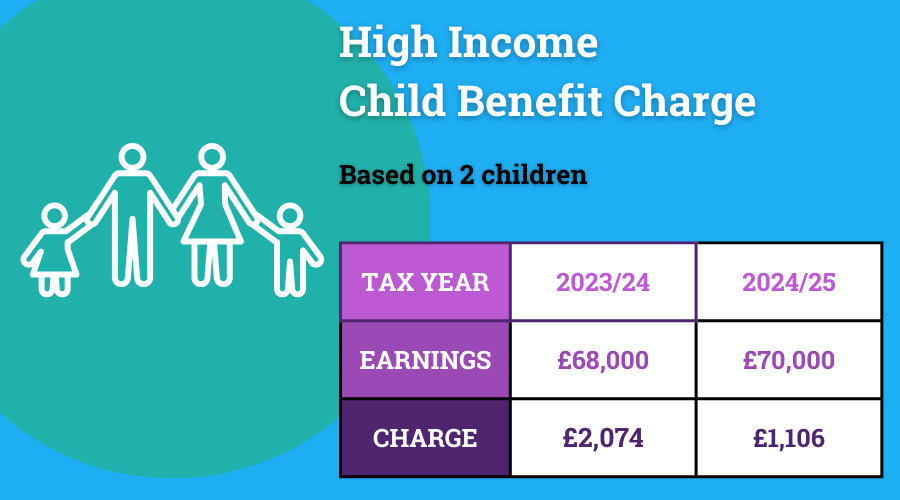
Child Benefit is not means-tested. However, if you or your partner earns over £50,000 per year, the High Income Child Benefit Charge may apply.
Income between £50,000 and £60,000 → partial repayment through tax return
Income over £60,000 → full repayment
Even if the charge applies, many families still claim to protect National Insurance credits.
2025 Updates and October/November Changes
Parents frequently search for:
UK child benefit changes October 2025
HMRC child benefit changes October 2025
November 2025 child benefit changes
At present, no confirmed rule changes alter the age or education eligibility structure. If HMRC introduces updates later in 2025, they will publish them through official GOV.UK channels.
Always rely on official guidance rather than social media claims.
When Does Child Tax Credit Stop?
Parents also confuse Child Benefit with child tax credit.
Child Tax Credit has largely been replaced by Universal Credit for new claims. Its stop dates depend on different eligibility rules and do not follow the same 16–20 education framework as Child Benefit.
If you receive both benefits, check each separately.
Understanding how much you receive helps you plan for the point when payments end.
When Does Child Maintenance Stop vs Child Benefit?
Child Benefit Claimant
Many parents confuse when does child maintenance stop with when does child benefit stop. They follow different legal rules.
Child Benefit
Child Benefit:
Stops on 31 August after your child turns 16, unless they stay in approved education or training
Can continue until age 20 if they remain in qualifying education
Uses fixed quarterly stop dates if a course ends early
Education status controls payment, not simply age.
Child Maintenance
Child maintenance usually stops:
When the child turns 16, or
When they turn 20 if they remain in approved education
If a court order or Child Maintenance Service (CMS) arrangement exists, the exact end date depends on:
The education status
The wording of the agreement or order
Maintenance does not always follow the same administrative stop dates as Child Benefit.
Child Tax Credit vs Child Benefit
Parents also search when does child Tax Credit stop. These rules differ again.
Child Tax Credit (now largely replaced by Universal Credit) usually stops:
On 31 August, after the child turns 16
Or at 20 if they remain in approved education
However, eligibility rules differ from Child Benefit, and reporting requirements fall under Universal Credit systems rather than the Child Benefit Office.
You can stop receiving Child Benefit while maintenance continues — or vice versa — depending on circumstances.
If you’re planning ahead, always check:
Education status
Any CMS agreements
HMRC records
Whether the High Income Child Benefit Charge affects you
Quick Summary: When Does Child Benefit Stop?
If you need a clear answer to when does child benefit stop, use this checklist:
Age 16: Payments stop automatically on 31 August after your child turns 16, unless they stay in approved education or training.
Age 17–18: Payments continue if your child remains in full-time, non-advanced education or approved training.
Age 19: Payments continue only if they started the course before turning 19.
Age 20: Child Benefit stops on their 20th birthday, even if they remain in education.
Leaving education early: HMRC stops payments at the next quarterly cut-off (end of February, 31 May, 31 August, or 30 November).
20-week extension: Available for 16–17-year-olds who register with a careers service and meet strict conditions.
Reporting changes: You must notify HMRC through GOV.UK or contact the Child Benefit Office to avoid overpayments.
In short, education status controls child benefit, not just age.
If your child approaches 16, 18, or 20, confirm whether their course qualifies under current child benefit 2025 rules and inform HMRC promptly. Acting early prevents unexpected stops, repayment demands, or confusion about eligibility.
Final Thoughts…
Child Benefit does not stop randomly. It stops because of age, education status, or reporting gaps. Most payment problems happen when families assume the system will update itself automatically.
If your child turns 16, 18, or 20 soon, take control early. Confirm whether their course qualifies. Check the quarterly stop dates. Report changes immediately. Keep records of communication with HMRC.
When you understand exactly when does child benefit stop, you avoid overpayments, sudden suspensions, and financial surprises.
Clarity protects your household income. Preparation prevents repayment letters. Accurate reporting keeps your payments running smoothly under current child benefit 2025 rules.
Supporting UK Families Through Benefit & Care Transitions?
If you searched “when does child benefit stop,” “my child turns 18 when does Child Benefit stop,” “how to cancel Child Benefit online,” or “wrongly stopped child benefits,” you are likely managing a financial transition while supporting a young person moving into adulthood.
Clear, accurate information matters. Misreporting education status, misunderstanding quarterly stop dates, or confusing Child Benefit with child maintenance or child tax credit can lead to overpayments, repayment demands, or avoidable stress.
Care Sync Experts supports families and regulated care providers across the UK with:
Clear interpretation of HMRC rules affecting Child Benefit and related entitlements
Structured compliance guidance aligned with GOV.UK eligibility frameworks
Practical support on reporting obligations and documentation standards
Governance advice for domiciliary and supported living providers supporting young adults
Policy development for education-to-adulthood transition planning
Financial clarity for households affected by the High Income Child Benefit Charge
Tender-writing and compliance support for services assisting families with benefit navigation
Inspection-readiness frameworks for providers delivering structured family support services
Whether you are managing your household finances or leading a regulated care service supporting families through transition periods, we help you replace confusion with clarity and structured compliance.
You can receive child benefit from birth until: – 31 August, after your child turns 16, unless they stay in approved education or training – Up to age 20, if they remain in full-time, non-advanced education or approved training and started the course before turning 19 – Payments never continue beyond the child’s 20th birthday under standard rules.
Why Has My Child Benefit Stopped in the UK?
HMRC usually stops Child Benefit for one of these reasons: – Your child turned 16 and did not continue into approved education – HMRC did not receive confirmation that your child stayed in education – Your child left their course – Your household became affected by the High Income Child Benefit Charge, and payments were voluntarily stopped – You moved abroad without updating HMRC
If payments stopped unexpectedly, contact the Child Benefit Office and confirm your child’s current education status. Many suspensions occur because HMRC did not receive updated information.
Do You Get Child Benefit for a 3rd Child in the UK?
Yes. There is no limit on the number of children you can receive Child Benefit for.
Under current child benefit rates: – Eldest child: £25.60 per week – Each additional child (including a 3rd child): £16.95 per week
If you have three children, you receive: – £25.60 for the first child – £16.95 for the second – £16.95 for the third
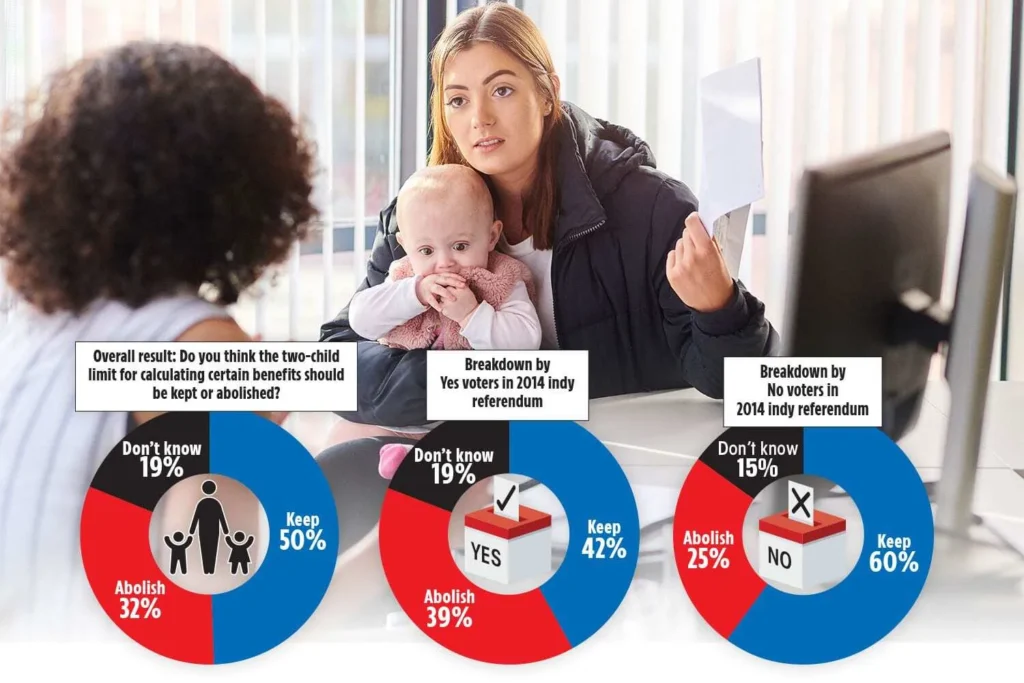
Child Benefit differs from certain other benefits that apply a two-child limit. Child Benefit pays for every eligible child.
Can You Back Claim Child Benefit in the UK?
Yes, but only for a limited period.
You can backdate a new Child Benefit claim for up to 3 months from the date HMRC receives your application. You cannot normally claim beyond that period unless exceptional circumstances apply.
If you believe HMRC stopped your payments incorrectly and you remained eligible, contact the Child Benefit Office promptly. They may reinstate and backdate payments if you can prove continuous eligibility.