

Where Care Excellence Meets Business Success. Transform your operations today - 0333 577 0877
We are here to help 24/7.

CareSync Logo

Home

About Us

CQC Consultancy service icon
CQC Consultancy

Independent CQC consultancy for providers already registered. Inspection readiness, the evidence behind each quality statement, governance that holds up when it is looked at, and formal responses to draft reports, warning notices and rating reviews.

CQC Registration service icon
CQC Registration

Get your service registered with CQC.

Marketing Support service icon
Marketing Support

Websites, SEO and social media for care providers.

Comprehensive Training service icon
Comprehensive Training

On site training for your care team.

Tender Writing service icon
Tender Writing

We write your bids for NHS and council work.

Ofsted Related Services service icon
Ofsted Related Services

Register with Ofsted and stay compliant.

PIR Writing service icon
PIR Writing

We write your Provider Information Return.

Business Setup service icon
Business Setup

Start a care business from scratch.

Compliance Management service icon
Compliance Management

Stay ready for inspection all year.

Client Acquisition service icon
Client Acquisition

Find private clients and win council work.

Branding service icon
Branding

A logo and a brand for your care service.

Domiciliary Care service icon
Domiciliary Care

All you need to open a home care agency.

Temporary Staffing service icon
Temporary Staffing

Set up and run a care staffing agency.

Combined Care Agency service icon
Combined Care Agency

Run home care and staffing from one office.

Supported Living service icon
Supported Living

Set up a supported living service.

CIW Domiciliary Care Agency service icon
CIW Domiciliary Care Agency

Register a home care agency in Wales.

RQIA Domiciliary Care Agency service icon
RQIA Domiciliary Care Agency

Register a home care agency in Northern Ireland.

Domiciliary Care service icon
Domiciliary Care

Live home care tenders across the UK.

Supported Living service icon
Supported Living

Live supported living tenders across the UK.

Residential Care service icon
Residential Care

Live care home tenders across the UK.

Extra Care service icon
Extra Care

Live extra care housing tenders.

Reablement service icon
Reablement

Live reablement and short term care tenders.

Children & Young People service icon
Children & Young People

Live tenders for children and young people.

Tenders

Website Development service icon
Website Development

We build websites for care providers.

Policy Development service icon
Policy Development

Policies and procedures written for your service.

Business Training service icon
Business Training

Training for owners and registered managers.

Guidance and Support service icon
Guidance and Support

Talk to us when you are stuck.

Knowledge Hub service icon
Knowledge Hub

Plain guides to CQC, CIW, RQIA and Ofsted.

Success Stories service icon
Success Stories

What we did for other care providers.

Videos service icon
Videos

Short videos on running a care service.

Brochures service icon
Brochures

Download our service brochures.

Ebooks service icon
Ebooks

Free guides you can download and keep.

Blogs service icon
Blogs

News and advice for care providers.

FAQ service icon
FAQ

Answers to the questions we get asked most.

CQC Compliance: The Complete Guide for Care Providers in England

This guide breaks down every element of CQC compliance that care providers in England need to understand in 2026, from the 13 fundamental standards and the single assessment framework through to practical checklists and the most common compliance failures that Care Sync Experts sees across the sector.

Book a Free ConsultationCall 0333 5770877
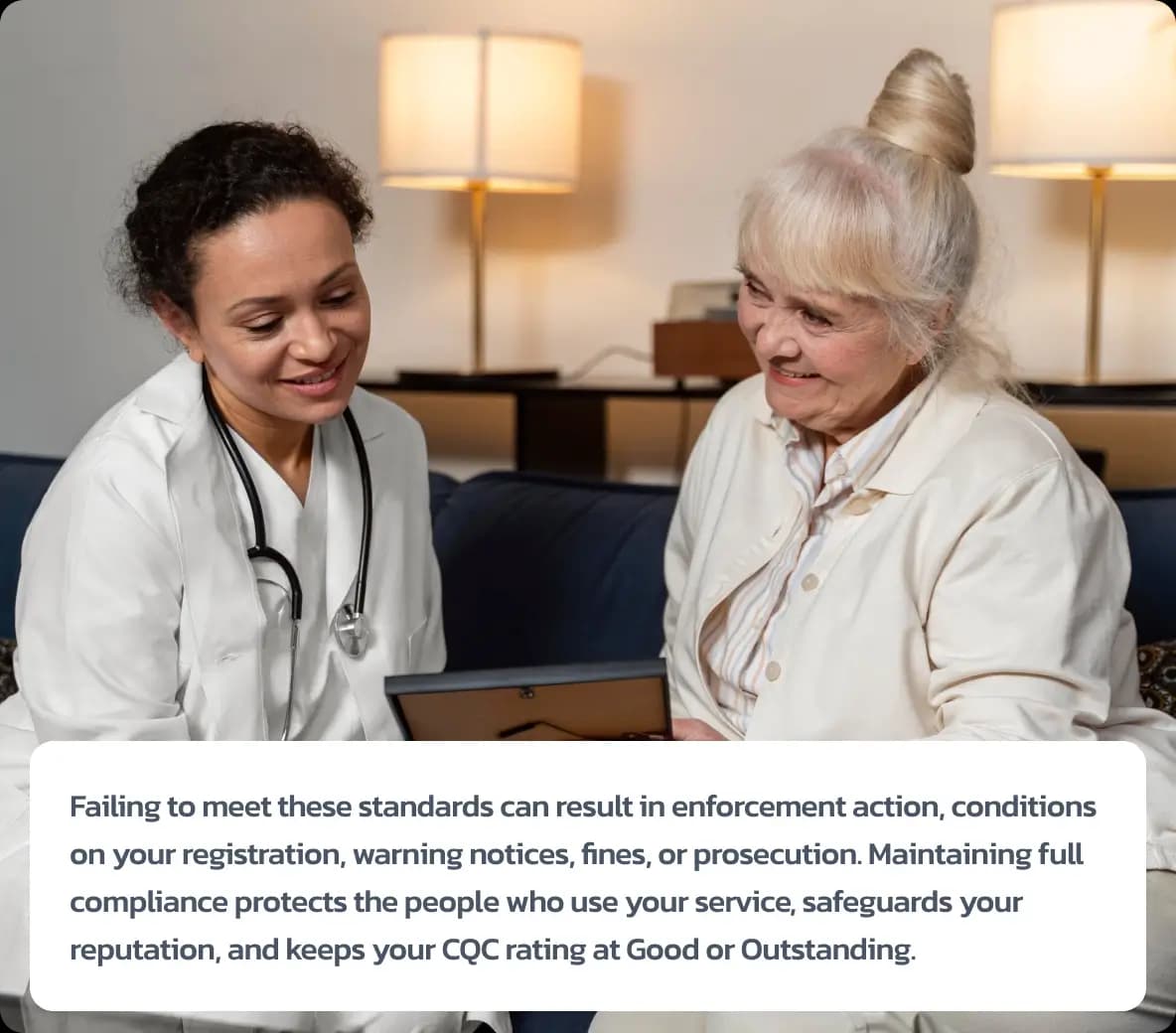
Doctor reviewing care with an older woman

Failing to meet these standards can result in enforcement action, conditions on your registration, warning notices, fines, or prosecution. Maintaining full compliance protects the people who use your service, safeguards your reputation, and keeps your CQC rating at Good or Outstanding.

Care worker supporting an older person
Doctor helping an older man at home

Every health and social care provider registered with the Care Quality Commission must meet a defined set of legal standards. CQC compliance means meeting every requirement set out in the Health and Social Care Act 2008 (Regulated Activities) Regulations 2014, covering the quality and safety of the care you deliver, the way you run your service, and the governance structures you have in place.

What Is CQC Compliance and Why Does It Matter

CQC compliance refers to the ongoing obligation every registered provider has to meet the fundamental standards of quality and safety set by the Care Quality Commission. The CQC regulates all health and social care services in England, and every provider must treat compliance as a continuous obligation rather than a one-off exercise completed at the point of registration. It requires continuous monitoring, regular self-assessment, and a culture of improvement embedded into every layer of your organisation.

Legal Basis for CQC Compliance

The legal basis for CQC compliance sits within the Health and Social Care Act 2008. The Act gives the CQC the power to register providers, set standards, inspect services, publish ratings, and take enforcement action where standards fall below acceptable levels. The regulations made under this Act set out the specific requirements that every provider must meet at all times.


Protects People in Your Care

First, it protects the people who use your service. The standards exist to prevent harm, promote dignity, and make sure every person receives care that meets their individual needs.

Serious Consequences for Non-Compliance

Second, non-compliance carries serious consequences. The CQC can issue warning notices, impose conditions on your registration, suspend your registration, cancel it entirely, or pursue prosecution through the courts.

Directly Affects Your Reputation

Third, your CQC rating directly affects your ability to win local authority contracts, attract private clients, recruit quality staff, and maintain your reputation in the communities you serve.

Understanding what the CQC expects and embedding those expectations into your daily operations is the foundation of running a safe, effective, and well-led care service. Care Sync Experts works with providers across England to build compliance frameworks that go beyond the minimum requirements and position services to achieve Outstanding ratings.

The 14 Fundamental Standards of Care

The fundamental standards are the minimum requirements that every health and social care provider must meet. CQC lists 14. The fourteenth, visiting and accompanying, arrived on 6 April 2024 and applies to care homes, hospitals and hospices rather than to services registered for personal care, which is why most guides still say 13.

Every person who uses your service must receive care and treatment that meets their individual needs, reflects their preferences, and involves them in decisions about their care. You must carry out an assessment of needs before delivering care, create a care plan that reflects the assessment findings, review care plans regularly, and make sure the person or their representative has meaningful involvement at every stage. Person-centred care also means recognising cultural, religious, and personal preferences and adapting your approach accordingly.
This is the fundamental standard almost every guide still leaves out. Regulation 9A was inserted by the Health and Social Care Act 2008 (Regulated Activities) (Amendment) Regulations 2023 and came into force on 6 April 2024. It requires that people staying in a care home, hospital or hospice can receive visits from the people they want to see, that care home residents are not discouraged from going out to visit others, and that someone attending an appointment without an overnight stay can be accompanied. Read Regulation 9A(6) before you assume it applies to you: it excludes the regulated activity of personal care, so a domiciliary care or supported living service registered only for personal care is held to the other 13 standards and not to this one.
You must treat every person with dignity and respect at all times. This covers privacy during personal care, maintaining confidentiality of personal information, supporting people to make choices about their daily routines, and making sure staff communicate with people in a way that is respectful and age-appropriate. Regulation 10 also protects people from discrimination, including discrimination based on age, disability, gender reassignment, marriage and civil partnership, pregnancy and maternity, race, religion or belief, sex, or sexual orientation.
Care and treatment must only be provided with the consent of the relevant person. Where a person lacks capacity to consent, you must act in accordance with the Mental Capacity Act 2005. This means carrying out capacity assessments for specific decisions, making best-interests decisions where capacity is lacking, considering any advance decisions or lasting powers of attorney, and applying to the Court of Protection where required. You must never assume a person lacks capacity based on their age, appearance, condition, or behaviour.
You must assess the risks to health and safety of people who use your service and do everything reasonably practicable to mitigate those risks. This regulation covers clinical safety, medicines management, infection prevention and control, risk assessment processes, the management of medical devices, and learning from safety incidents. Your risk assessments must be thorough, regularly reviewed, and lead to clear mitigation plans that staff understand and follow.
You must have effective systems and processes in place to prevent abuse and neglect. Staff must receive training in recognising signs of abuse, understand how to report safeguarding concerns, and know the local safeguarding procedures for your area. You must work in partnership with local authority safeguarding teams and follow the principles set out in the Care Act 2014. Regulation 13 also covers deprivation of liberty safeguards and the requirement to apply for standard or urgent authorisations where appropriate.
Where your service provides meals or supports people with eating and drinking, you must make sure their nutritional and hydration needs are met. This includes assessing individual dietary requirements, monitoring food and fluid intake where clinically indicated, accommodating cultural and religious dietary preferences, and making sure meals are nutritious and presented in a way that encourages eating.
The premises and equipment used for delivering care must be clean, suitable for purpose, properly maintained, and used in a way that minimises risk. For domiciliary care providers, this applies to any equipment you supply to people in their homes. For residential services, it covers the physical environment, fire safety, accessibility, and the suitability of communal and private spaces.
You must have a system in place for receiving and responding to complaints. The system must be accessible to the people who use your service, their families, and their representatives. You must investigate complaints thoroughly, respond within a reasonable timeframe, take action to resolve issues, and use complaints data to drive service improvements. People must not suffer any detriment from raising a complaint.
You must have effective governance systems in place to assess, monitor, and improve the quality and safety of your service. This covers audit schedules, quality monitoring reports, risk registers, incident tracking, policy review cycles, management oversight, and the use of key performance indicators. Good governance means you can demonstrate at any point that you know how your service performs, where the risks are, and what you are doing to address them.
You must deploy enough suitably qualified, competent, skilled, and experienced staff to meet the needs of the people using your service at all times. This includes safe recruitment practices, ongoing training and professional development, regular supervision and appraisals, and workforce planning that accounts for sickness, annual leave, and fluctuations in demand. The CQC looks at staffing levels, training records, recruitment files, and turnover rates as key indicators under this regulation.
Every director of a registered provider must be a fit and proper person. This means they must have the qualifications, skills, and experience needed for the role, they must not have been responsible for serious misconduct or mismanagement in a previous health or social care role, and they must be of good character. You must carry out appropriate checks before appointing directors and keep records of those checks.
When something goes wrong with care or treatment that causes, or has the potential to cause, harm or distress, you must be open and transparent with the person affected. The duty of candour requires you to tell the person what happened, apologise, offer appropriate support, and provide a written account of the incident. You must also carry out a thorough investigation and share the findings. The duty applies to notifiable safety incidents as defined in the regulations.
You must display your CQC rating conspicuously at your registered premises and on your website. The rating must be in a format provided by the CQC, and it must be displayed in a place where people who use the service, visitors, and members of the public can easily see it.

The CQC introduced these standards to replace the earlier Essential Standards of Quality and Safety. They apply to every registered service, regardless of size, type, or location. Each standard maps to a specific regulation within the Health and Social Care Act 2008 (Regulated Activities) Regulations 2014, and the CQC assesses your service against every one of them.

Duty of Candour in Health and Social Care

Duty of candour is a legal requirement under Regulation 20. Our guide explains what counts as a notifiable safety incident, the steps you must follow, and what happens if you fail to comply.

Read the duty of candour guide

The CQC Single Assessment Framework Explained

The CQC replaced its previous inspection methodology with the single assessment framework in 2023. This framework changed how the CQC collects evidence, makes assessments, and determines ratings. Every care provider in England must understand how the new framework operates and what it means for demonstrating compliance.

The Five Key Questions

The CQC continues to assess every service against five key questions. These questions form the foundation of every assessment, and your compliance efforts must address all five areas.

Safe

Safe asks whether people are protected from abuse, neglect, and avoidable harm. The CQC looks at how you manage risks, handle medicines, control infections, learn from incidents, and create an environment where people feel secure.

Effective

Effective asks whether your care achieves good outcomes and helps people maintain quality of life. The CQC examines how you assess needs, deliver evidence-based care, support nutrition and hydration, manage pain, coordinate care across services, and obtain consent.

Caring

Caring asks whether staff treat people with kindness, respect, and compassion. The CQC looks at how staff interact with people, how you support emotional wellbeing, how you involve people in their care, and how you maintain privacy and dignity.

Responsive

Responsive asks whether your service meets the needs of the people who use it. The CQC examines how you plan and deliver person-centred care, how you handle complaints, how accessible your service is, and how you support people at the end of their lives.

Well-led

Well-led asks whether the leadership, management, and governance of your service support the delivery of high-quality care. The CQC looks at your vision and values, governance framework, culture, partnerships, and approach to innovation and continuous improvement.

Quality Statements and Evidence Categories

Under the single assessment framework, the CQC uses quality statements to describe what good care looks like under each key question. The CQC groups evidence into six categories to assess whether you meet those expectations.

1People's experiences of health and care services
2Feedback from staff and leaders
3Feedback from partners
4Observation of care
5Processes applied in delivering care
6Outcomes for people using the service

I Statements and We Statements

The single assessment framework uses two types of statements to define expectations.

I STATEMENTS

From the person's perspective. For example, an I statement might say that a person feels safe, is treated with dignity, or has a say in their care.

WE STATEMENTS

What the provider does. For example, a we statement might describe how the provider trains staff, monitors quality, or responds to feedback.

Aligning your policies, procedures, training, and daily practice with both the I statements and we statements gives the CQC clear evidence that your service meets the expected standards. Care Sync Experts builds every compliance framework around this dual-statement approach.

Mental Capacity Act 2005 for Care Providers

The five statutory principles, best interests decisions, and how to assess mental capacity in practice. Essential reading for every care provider in England and Wales.

Read the MCA guide

How CQC Inspections Work Under the New Framework

How CQC Plans and Conducts Assessments

The CQC uses a risk-based approach to decide when and how to assess a service. Assessments can be triggered by routine scheduling, information of concern, whistleblowing reports, statutory notifications, or feedback from people who use the service. The CQC can carry out on-site inspections, off-site assessments using documentary evidence, or a combination of both.

Before an Assessment, the CQC reviews:

  • Your most recent Provider Information Return (PIR)
  • Previous inspection reports
  • Statutory notifications you have submitted
  • Complaints data and safeguarding referrals
  • Feedback from local authorities and partners

During an on-site assessment, inspectors observe care delivery, speak with people who use the service, interview staff at all levels, review documentation, and examine the physical environment.

How Ratings Are Determined

The CQC rates every service across the five key questions on a four-point scale. Your overall rating reflects performance across all five key questions.

OutstandingYou perform exceptionally well beyond the fundamental standards.
GoodYou meet the fundamental standards.
Requires ImprovementYou fall below the expected standards in one or more areas.
InadequateThere are significant failings that affect the safety or quality of care.

What Happens After an Inspection

1

Draft Report Issued

After an assessment, the CQC produces a report that sets out its findings, the evidence it relied on, and the rating for each key question assessed.

2

Factual Accuracy Check

This factual accuracy check is your opportunity to challenge any findings you believe are incorrect, provide additional evidence the CQC may have missed, or correct errors of fact.

3

Regulatory Action (if required)

If the CQC identifies areas of non-compliance, it may take regulatory action. The type of action depends on the severity and nature of the concerns.

Options include requirement notices that set out specific improvements you must make, warning notices for more serious concerns, conditions on your registration that restrict how you operate, suspension of your registration, cancellation of your registration, or prosecution for criminal offences under the regulations.

CQC Compliance Checklist for Care Providers

Maintaining CQC compliance requires systems, processes, and documentation that demonstrate you meet every fundamental standard at all times. The following checklist covers the core areas every domiciliary care and supported living provider should address.

Policies and Procedures

Your policies and procedures form the backbone of your compliance framework. Every policy must align with current legislation, reference the correct regulations, use person-centred language, and reflect your actual operating practices. Policies must be reviewed at least annually or whenever legislation changes.

Key requirements include:

  • Safeguarding adults and children
  • Medicines management
  • Infection prevention and control
  • Recruitment and selection
  • Moving and handling
  • Mental capacity
  • Positive behaviour support
  • Complaints and compliments
  • Whistle-blowing
  • Lone working
  • Risk assessment
  • Equality and diversity
  • Health and safety
  • Business continuity

Staffing and Training

Every member of staff must receive induction training that meets the Care Certificate standards before working unsupported. Training must be role-specific, refreshed regularly, and supported by competency checks where staff perform regulated or high-risk tasks.

Key requirements include:

  • Care Certificate completion and sign-off
  • Safeguarding awareness
  • Manual handling
  • Medication administration
  • Mental capacity and DoLS
  • First aid
  • Infection prevention and control
  • Fire safety
  • Food hygiene
  • Positive behavioural support
  • Role-specific competency assessments

Care Planning and Person-Centred Records

Your care plans must reflect the individual assessed needs, preferences, wishes, communication needs, and outcomes of each person you support. They must be reviewed whenever needs change and updated with the involvement of the person or their representative.

Key requirements include:

  • Assessed needs and personal outcomes
  • Communication preferences
  • Mobility and daily living needs
  • Medication requirements
  • Risk assessments and management plans
  • Mental capacity assessments
  • Consent documentation
  • Review dates
  • Named key worker

Governance and Quality Assurance

Effective governance means you can demonstrate continuous monitoring, learning, and improvement across your service at all times. You need clear audit schedules, assigned responsibilities, action plans, and evidence that lessons are embedded into everyday practice.

Key requirements include:

  • Monthly service audits
  • Medication administration audits
  • Staff supervision records
  • Spot checks and observations
  • Accident and incident reviews
  • Complaints tracker
  • Compliments log
  • CQC statutory notifications log
  • Meeting minutes
  • Learning and improvement log
  • Provider Information Return preparation
  • Quality assurance visits

Right Support, Right Care, Right Culture

CQC guidance for learning disability and autism services. Our guide explains what Right Support, Right Care, Right Culture means in practice and how inspectors assess it.

Read the RSRCRC guide

Common CQC Compliance Failures and How to Avoid Them

The CQC publishes enforcement data and inspection reports that reveal consistent patterns of non-compliance across the sector. Understanding these patterns helps you identify gaps in your own service before the CQC finds them.

Incomplete or Outdated Care Plans

Regulations 9

Care plans that do not reflect the person's current needs, lack evidence of regular review, or use generic rather than person-centred language will raise concerns under Regulation 9.

The Solution

Build review schedules into your governance calendar, train staff to write person-centred records, and audit care plans on a rolling basis.

Medicines Management Errors

Regulations 12

Common issues include gaps in medication administration records (MARs), lack of competency assessments for staff administering medicines, inadequate protocols for PRN (as required) medication, and failure to audit medicines practices regularly.

The Solution

Implementing a structured medicines audit cycle and providing refresher training every six months significantly reduces this risk.

Insufficient Staffing or Poor Recruitment

Regulations 18 & 19

The CQC checks whether you have enough staff to meet demand, whether recruitment files contain all required checks (including DBS, references, right to work, and proof of identity), and whether you fill gaps safely when staff are unavailable.

The Solution

Maintaining a compliant recruitment checklist for every new hire and using dependency tools to calculate safe staffing levels addresses this area.

Weak Governance

Regulation 17

Services that cannot demonstrate regular audits, do not maintain a risk register, or cannot show how feedback leads to improvement will score poorly. This is the most common driver of a Requires Improvement or Inadequate rating for Well-Led.

The Solution

Building a monthly audit calendar, assigning clear ownership for each governance activity, and presenting findings at formal management meetings creates the governance trail the CQC expects to see.

Failure to Submit Statutory Notifications on Time

Well-Led

The CQC requires notification of certain events including deaths, serious injuries, safeguarding incidents, allegations of abuse, police involvement, and applications to the Court of Protection. Late or missing notifications can affect your Well-Led rating and trigger an unannounced assessment.

The Solution

Create a clear internal process for identifying notifiable events, assigning responsibility, and tracking submission deadlines.

How Care Sync Experts Supports Your CQC Compliance

Care Sync Experts provides end-to-end CQC compliance support for domiciliary care, supported living, and residential care providers across England. Our team includes former CQC inspectors and senior managers who bring direct regulatory experience to every engagement. See our CQC application and statement of purpose support, mock inspections, and interview preparation.

New Registrations

We support providers at every stage of the compliance cycle. For new registrations, we prepare your CQC application, statement of purpose, policies and procedures, and fit person interview preparation.

Mock Inspections and

We deliver mock inspections that mirror the CQC methodology, giving you a clear picture of where you stand before the real thing.

Compliance Audits

We assess every fundamental standard, produce action plans that address identified gaps, and prepare you for registered manager interviews.

Ongoing Mentorship

We work alongside your leadership team to embed quality improvement into daily operations, including governance frameworks and training matrices aligned with Skills for Care standards.

Get In Touch

Whether you need to move from Requires Improvement to Good, maintain your Good rating, or reach Outstanding, Care Sync Experts delivers the regulatory expertise and practical support to make it happen. Call us or email hello@caresyncexperts.co.uk to discuss your compliance needs.

Call 0333 5770877

Frequently Asked Questions

CQC compliance means meeting all the legal standards set by the Care Quality Commission under the Health and Social Care Act 2008. Every registered health and social care provider in England must comply with the fundamental standards, which cover person-centred care, safe treatment, safeguarding, staffing, governance and duty of candour. CQC lists 14 of them. Non-compliance can result in warning notices, conditions on registration, or prosecution.
CQC lists 14. They are person-centred care (Regulation 9), visiting and accompanying (Regulation 9A), dignity and respect (Regulation 10), consent (Regulation 11), safe care and treatment (Regulation 12), safeguarding (Regulation 13), meeting nutritional and hydration needs (Regulation 14), premises and equipment (Regulation 15), receiving and acting on complaints (Regulation 16), good governance (Regulation 17), staffing (Regulation 18), fit and proper persons for directors (Regulation 19), duty of candour (Regulation 20), and display of ratings (Regulation 20A). Most guides still say 13 because Regulation 9A was added later, by the Health and Social Care Act 2008 (Regulated Activities) (Amendment) Regulations 2023, in force on 6 April 2024. Regulation 9A applies to care homes, hospitals and hospices and not to the regulated activity of personal care, so a domiciliary care or supported living service is held to the other 13.
The CQC assesses every service against five key questions: Is the service Safe, Effective, Caring, Responsive, and Well-led. Under the single assessment framework, each key question contains quality statements that describe what good care looks like. Inspectors gather evidence across six categories to determine whether a provider meets the expected standards under each question.
If the CQC finds non-compliance during an inspection, it can take regulatory action proportionate to the severity of the concerns. This ranges from requirement notices specifying improvements you must make, to warning notices for more serious issues, conditions on your registration, suspension, cancellation, or criminal prosecution. Providers rated Requires Improvement or Inadequate must produce action plans addressing every concern and may face more frequent inspections.
The CQC uses a risk-based approach to scheduling inspections and does not follow a fixed timetable. Services rated Outstanding or Good may wait longer between assessments, while services rated Requires Improvement or Inadequate receive more frequent monitoring. The CQC can also trigger assessments based on information of concern, whistleblowing reports, statutory notifications, or feedback from people who use the service.
Preparing for a CQC inspection requires maintaining compliance at all times rather than preparing only when an inspection is announced. Key preparation steps include keeping all policies and procedures up to date, maintaining complete staff training records, ensuring care plans reflect current needs, running regular internal audits, keeping your risk register current, submitting statutory notifications on time, and making sure all staff understand the CQC quality statements and can articulate how your service meets them. Working with a compliance consultant like Care Sync Experts can help identify gaps before the CQC does.
Image 1
Image 1
Image 1

Still have questions?

Can't find the answer you're looking for? Please chat to our friendly team.

Get In Touch

Related reading

  • CQC Fundamental Standards Guide
  • CQC Mock Inspections
  • CQC Consultancy
  • Compliance for CQC CIW RQIA and Ofsted
CareSync Logo

Would you like to receive update from CareSync Experts?

Our Packages

  • Domiciliary Care
  • Supported Living Services
  • Temporary Staffing Solutions
  • Combined Care Agency

Quick Links

  • Knowledge Hub
  • Our Services
  • Setup Packages
  • Resources
  • FAQs
  • Success Stories
  • Download Our Brochures
  • Privacy Policy

Stay Connected

  • +44 333 577 0877
  • hello@caresyncexperts.co.uk

All rights reserved. Copyright © - Care Sync Experts.

Care Sync Experts on LinkedInCare Sync Experts on FacebookCare Sync Experts on YouTubeCare Sync Experts on TikTok

Call us

Enquire online

CareSync Logo
Home
About Us
Our Services
CQC Registration
Get your service registered with CQC.
Marketing Support
Websites, SEO and social media for care providers.
Comprehensive Training
On site training for your care team.
Tender Writing
We write your bids for NHS and council work.
Ofsted Related Services
Register with Ofsted and stay compliant.
PIR Writing
We write your Provider Information Return.
Business Setup
Start a care business from scratch.
Compliance Management
Stay ready for inspection all year.
Client Acquisition
Find private clients and win council work.
Branding
A logo and a brand for your care service.
Our Packages
Domiciliary Care
All you need to open a home care agency.
Temporary Staffing
Set up and run a care staffing agency.
Combined Care Agency
Run home care and staffing from one office.
Supported Living
Set up a supported living service.
CIW Domiciliary Care Agency
Register a home care agency in Wales.
RQIA Domiciliary Care Agency
Register a home care agency in Northern Ireland.
Sectors
Domiciliary Care
Live home care tenders across the UK.
Supported Living
Live supported living tenders across the UK.
Residential Care
Live care home tenders across the UK.
Extra Care
Live extra care housing tenders.
Reablement
Live reablement and short term care tenders.
Children & Young People
Live tenders for children and young people.
Tenders
Elevate Your Care Services
Website Development
We build websites for care providers.
Policy Development
Policies and procedures written for your service.
Business Training
Training for owners and registered managers.
Guidance and Support
Talk to us when you are stuck.
Knowledge Hub
Plain guides to CQC, CIW, RQIA and Ofsted.
Our Resources
Success Stories
What we did for other care providers.
Videos
Short videos on running a care service.
Brochures
Download our service brochures.
Ebooks
Free guides you can download and keep.
Blogs
News and advice for care providers.
FAQ
Answers to the questions we get asked most.
Contact Us