Mock CQC Inspection:
A Practical 2026 Checklist for Care Providers
Text to speech
Duration: 00:00
Font size
Published: 29 Jun, 2026
Share this on:
A mock CQC inspection gives care providers the chance to test their service before the Care Quality Commission assesses it. It looks beyond policies and paperwork. It asks whether carers deliver safe, respectful and person-centred support during real working days.
For a registered manager, that may mean checking whether staff can explain safeguarding procedures, follow a person’s current care plan, manage medicines safely and raise concerns with confidence. For carers, it should feel like a practical quality check, not a blame exercise.
A strong mock CQC inspection helps your team spot gaps early, act on risks and show how improvements make everyday care safer. It cannot guarantee a future CQC rating, but it can help you prepare for the evidence, conversations and observations that shape a Care Quality Commission report.
CQC continues to assess services through five key questions: are they safe, effective, caring, responsive and well-led. A useful mock inspection should test each of these areas in the reality of your service, not only in files stored in the office.

What Is a Mock CQC Inspection?
A mock CQC inspection is a planned review of your care service that helps you find compliance gaps before a real CQC assessment. Your own quality team can run it, or you can bring in an independent CQC consultant for an outside view.
The review should test more than documents. It should check whether your carers understand people’s needs, follow current care plans, raise safeguarding concerns, manage risks and put your policies into practice during a busy shift.
A strong mock CQC inspection looks at evidence across the five CQC key questions: safe, effective, caring, responsive and well-led. It should also consider the quality statements or assessment questions that apply to your service type.
In simple terms, the process asks: does the evidence in your files match the care people actually receive? If the answer is no, your team has an opportunity to fix the issue before it affects safety, staff confidence or a future CQC inspection.
RELATED: What Are the CQC Fundamental Standards? 2026 Update
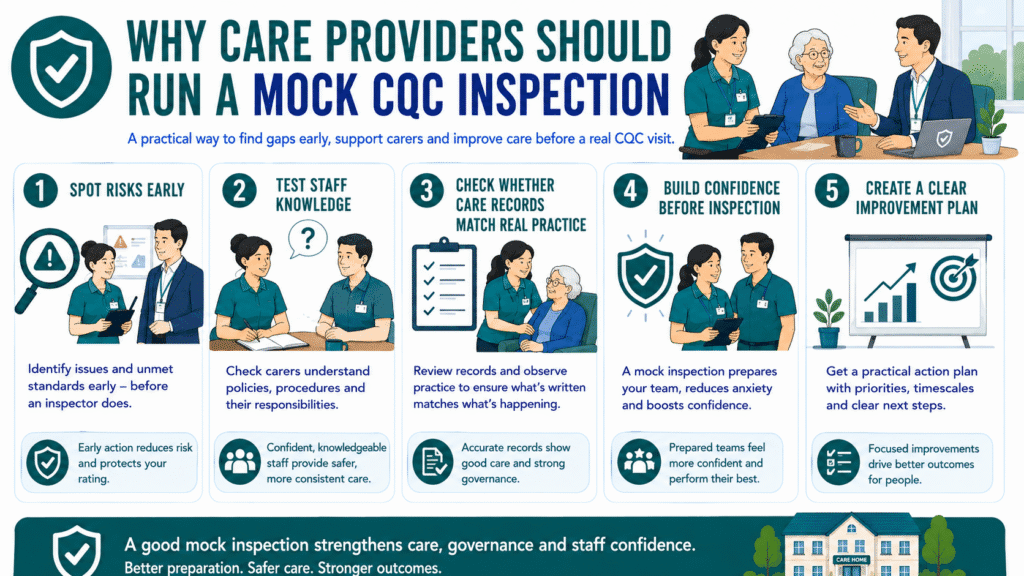
Why Care Providers Should Run a Mock Inspection Before a CQC Visit
A mock inspection helps you see your service the way an inspector, family member or new employee might see it. It often reveals issues that routine audits miss.
For example, your care plans may look complete, but carers may not know where to find the latest version. Your safeguarding policy may be up to date, but staff may feel unsure about what to do when they spot a concern. Your audits may record incidents, but they may not show what the service learned or changed afterwards.
A practical mock CQC inspection helps you:
- spot risks before they affect people using your service;
- test whether staff understand their responsibilities;
- check whether care records reflect real day-to-day practice;
- prepare managers for evidence requests and inspection conversations;
- reduce staff anxiety by making the inspection process more familiar; and
- create a clear improvement plan with actions, owners and deadlines.
You can use an internal CQC self-assessment tool for regular checks, but an external review can bring a fresh and objective perspective. Many providers also work with CQC compliance consultants when they need specialist support, especially after a poor inspection outcome, rapid growth, a change in leadership or concerns about governance.
The aim is not to “pass” a mock inspection. The aim is to make care safer, more consistent and easier for staff to deliver well.
READ MORE: What Is an Unregulated Care Provider? 2026 Update
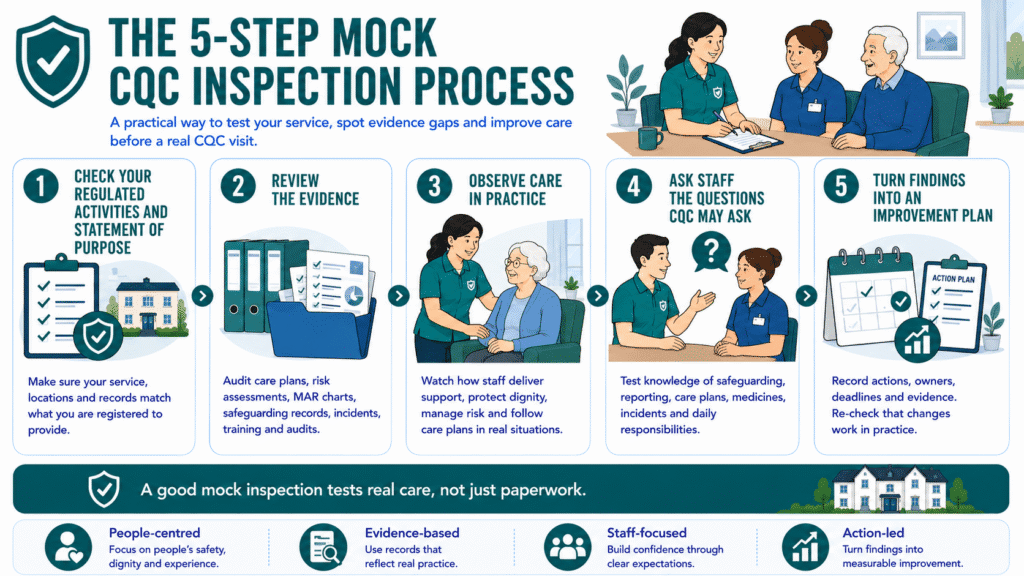
The 5-Step Mock CQC Inspection Process
A useful mock inspection should follow a clear process. It should test your records, your staff knowledge and the care people receive every day.
1. Check your regulated activities and statement of purpose
Start by checking that your service delivers what it says it delivers.
Your CQC statement of purpose should accurately describe your service, the people you support, your locations and the CQC regulated activities you provide. If your service has changed, make sure your records and CQC information reflect that change.
Ask:
- Does our statement of purpose still match our current service?
- Do our care packages match the activities we are registered to provide?
- Can managers explain our service model clearly?
2. Review the evidence before observing practice
Use your CQC inspection checklist to review the records that show how your service manages care and risk.
Check:
- Care plans and reviews
- Risk assessments
- Medication administration records
- Safeguarding logs
- Incident and accident reports
- Complaints and compliments
- Staff training, supervision and competency records
- Quality audits and action plans
Do not only check whether a document exists. Check whether it is current, complete and useful to carers during a real shift.
3. Observe care where it happens
Walk through the service and watch how carers deliver support.
In a care home, observe handovers, mealtimes, infection control, call-bell responses, medication rounds and staff interactions.
In domiciliary care, review call monitoring, late or missed visits, communication between carers, visit notes and how staff respond when a person’s needs change.
Look for practical evidence of dignity, consent, choice and person-centred care. The strongest policies mean very little if carers cannot follow them when the service becomes busy.
4. Ask staff the questions CQC may ask
Speak with staff at different levels, including carers, seniors, coordinators and managers.
Ask questions such as:
- What would you do if you suspected abuse?
- How do you report a safeguarding concern?
- Where do you find the latest care plan?
- What would you do if someone refused care or medication?
- How do you report an incident or medication error?
- What has changed after recent feedback, complaints or incidents?
These conversations show whether staff understand policies and whether leaders have communicated expectations clearly.
5. Turn findings into a live improvement plan
Do not let the inspection report sit in a folder.
For every finding, record:
- the risk level;
- the action needed;
- the person responsible;
- the deadline;
- the evidence required; and
- the date you will check that the change works.
A strong mock CQC inspection does not end when you identify a problem. It ends when your team fixes the issue, tests the improvement and can show how care has become safer or better.
SEE ALSO: Ofsted Regulations for Children’s Homes: What Providers Need to Know
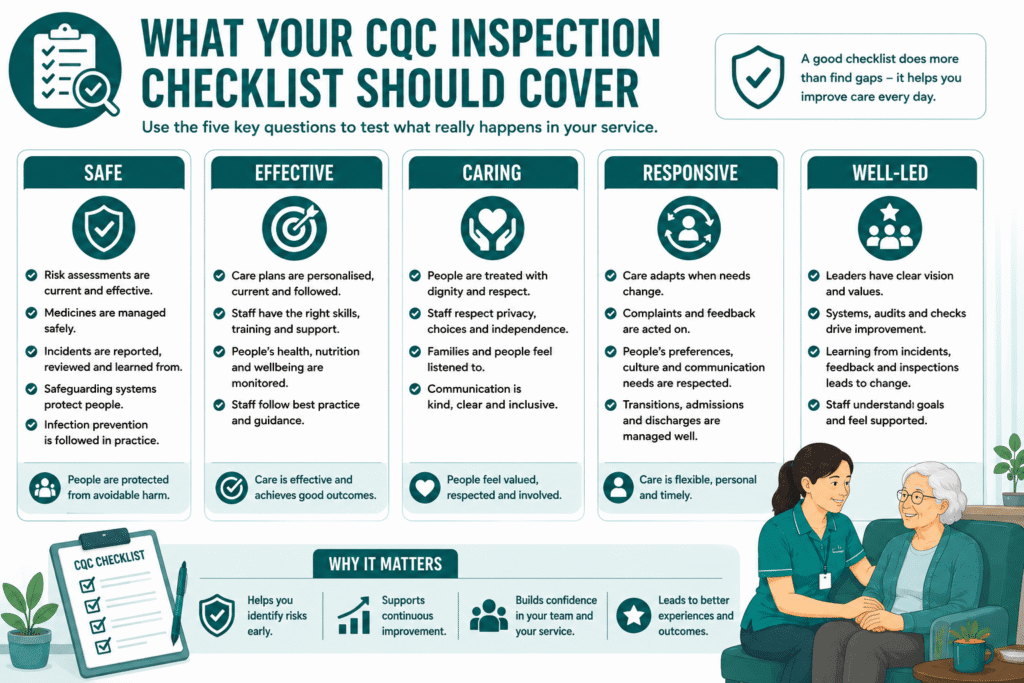
What Should Your CQC Inspection Checklist Cover?
A good CQC inspection checklist should help your team test what happens in practice, not just confirm that policies exist. Use the five CQC key questions to organise your checks.
Safe
Check whether people are protected from avoidable harm.
- Risk assessments reflect current needs and risks.
- Carers know how to report concerns and follow CQC safeguarding procedures.
- Medicines are stored, administered and recorded safely.
- Staff report accidents, incidents and near misses.
- Managers review incidents and show what the service changed afterwards.
- Infection prevention measures work in daily practice.
Effective
Check whether staff have the knowledge and support to deliver good care.
- Care plans are current, personalised and easy for staff to use.
- Staff complete required training and competency checks.
- Managers provide regular supervision and support.
- The service monitors nutrition, hydration, mobility, health needs and outcomes where relevant.
- Staff follow current guidance and best practice.
Caring
Check whether people receive respectful, compassionate support.
- Carers protect privacy, dignity and confidentiality.
- Staff ask for consent and respect people’s choices.
- Care plans reflect routines, preferences, communication needs and culture.
- Families and people using the service feel listened to.
Responsive
Check whether the service adapts when needs change.
- Staff update care plans after changes in health, mobility, behaviour or risk.
- The service responds to complaints and feedback promptly.
- Managers make reasonable adjustments for communication, disability, faith or cultural needs.
- Admissions, transfers and discharges are planned safely.
Well-led
Check whether leaders know what is happening across the service.
- Leaders use audits to identify risks and improve care.
- Action plans have clear owners and deadlines.
- Staff understand the service’s values and expectations.
- Managers can show how they learn from complaints, incidents, feedback and inspections.
- Governance systems support the CQC fundamental standards rather than simply producing paperwork.
Your checklist should help you identify evidence gaps early, but it should also show whether your service lives its values during ordinary working days.
CQC Key Lines of Enquiry, Quality Statements and the 2026 Framework
Many older guides still refer to CQC key lines of enquiry (KLOEs). CQC replaced KLOEs with quality statements under its Single Assessment Framework, while keeping the five key questions: safe, effective, caring, responsive and well-led.
For your mock inspection, do not rely on an old CQC inspection toolkit without checking whether it still reflects current guidance. Test the quality of care against the evidence CQC expects now: people’s experiences, staff practice, leadership oversight, records, feedback and learning.
CQC is also piloting and developing sector-specific assessment frameworks during 2026. That means care providers should review the latest CQC guidance before every major mock inspection, especially if they use an older template based only on KLOEs.
The practical rule is simple: use your mock inspection to test real outcomes for people, not just whether your team can complete a checklist.
MORE: Care Home Risk Assessment: 2026 Practical Guide to Safer, Person-Centred Care
How Much Does a Mock CQC Inspection Cost?
Mock CQC inspection cost varies because no two services face the same level of risk, complexity or evidence review.
A small domiciliary care provider may only need a focused desktop audit and a short visit. A larger care home, multi-site provider or service responding to an Inadequate or Requires Improvement rating may need a deeper review of records, staff interviews, observations, governance and follow-up support.
The cost often depends on:
- service type and number of locations;
- number of people supported;
- current CQC rating or known concerns;
- whether the review includes an on-site visit;
- how many records, care plans and staff files need checking;
- whether you need a written report and improvement plan; and
- whether a CQC consultant will support implementation afterwards.
When comparing CQC compliance consultants, do not choose only on price. Ask what the review includes, how findings will link to evidence, and whether the final report gives your managers clear actions, owners and deadlines.
A cheaper review can become poor value if it only lists gaps without helping your team understand what to fix first.
Final Thought…
Do not run a mock CQC inspection only because you worry about the next CQC visit.
Use it to strengthen everyday care.
Your carers need clear guidance when risks change. Your managers need honest evidence about what works and what does not. People using your service need safe, respectful and reliable support every day, not only when an inspector arrives.
The best mock inspection gives your team more than a report. It gives them a practical improvement plan, clearer responsibilities and confidence in the way they deliver care.
When staff can explain how they keep people safe, follow current care plans, respond to concerns and learn from mistakes, your service becomes easier to manage and stronger at inspection time.
Need support preparing for a CQC inspection? Care Sync Experts can help you run a practical mock inspection, identify evidence gaps and create an improvement plan your team can use.
FAQ
What are the three types of CQC inspections?
CQC’s current approach is better described as planned assessments and responsive assessments, rather than a fixed three-type inspection model for every care service. Planned assessments form part of CQC’s routine regulatory activity.
Responsive assessments happen when CQC receives concerning information or evidence that suggests people may face risks.
CQC may also carry out focused activity that looks closely at a specific concern, such as medicines, safeguarding or governance. Providers should prepare for both routine and risk-led scrutiny.
What triggers a CQC inspection?
CQC may plan an assessment as part of its normal monitoring cycle. It can also act when it receives information that raises concerns about quality or safety.
This may include safeguarding alerts, statutory notifications, complaints, whistleblowing concerns, incidents, poor-quality evidence, concerns from partner agencies, or information that suggests a service has deteriorated or improved.
CQC says it uses the information it gathers to focus activity where evidence suggests the greatest risk to people using services.
What are the 34 quality statements in CQC?
The 34 quality statements sit under CQC’s five key questions: safe, effective, caring, responsive and well-led. They replaced the older CQC key lines of enquiry (KLOEs) in the Single Assessment Framework and describe what good care should look like.
They cover areas such as safeguarding, safe systems, medicines, consent, staffing, equity, person-centred care, listening to people, governance and learning from incidents.
A provider does not need to memorise every statement word for word, but managers should understand which statements apply to their service and how they can evidence them.
What is the first thing a CQC inspector wants to see?
There is no single universal document that every inspector asks for first. Before any visit, CQC reviews available information to decide what matters most and what it needs to explore.
During an inspection, inspectors often need to understand the service quickly: who it supports, how it operates, what risks it manages and what evidence shows safe, person-centred care.
Keep your current statement of purpose, key contacts, care and risk records, staffing information, quality audits, incident learning and action plans organised and easy to explain. The most important point is that your records must match what staff do and what people experience.
Related reading
Book a CQC mock inspection, from £1,000 plus VAT
- How to Apply for CQC Registration in 2026: Forms, Evidence and Assessment
- CQC Personal Care Form: 7 Essential Application Checks
- Service User Feedback in Health and Social Care: How to Build Better CQC Evidence
- CQC Application Stages: What Happens After You Submit?
- CQC First Assessment: Essential 2026 Guide for Unrated Care Providers
- CQC Regulation 9A After the 2026 Review: A Practical Visiting Policy Guide for Care Home Providers
Browse every article on CQC, Ofsted, CIW and RQIA compliance