Care Staff Supervision Records:
What Registered Managers Should Document in 2026

Text to speech
Duration: 00:00
Font size
Published: 11 Aug, 2026
Share this on:
Care staff supervision records should show what was discussed, what evidence was reviewed, what decisions were made, who owns each action and when progress will be checked. A signed form on its own is not enough. Registered managers need a reliable trail from the supervision conversation to safer practice, staff development and management follow-up.
In England, CQC Regulation 18 guidance says staff must receive the support, training, professional development, supervision and appraisal necessary for their role. It also says staff should receive ongoing or periodic supervision so competence is maintained. The regulation does not set one universal timetable or one mandatory supervision form for every service.
Key Facts About Care Staff Supervision Records
- CQC Regulation 18: CQC Regulation 18 guidance says care staff must receive the support, training, professional development, supervision and appraisal necessary for their role.
- No fixed interval: Regulation 18 does not set one universal supervision timetable or one mandatory supervision form for every care service.
- Informal discussions: Skills for Care recommends recording informal supervision discussions and adding them to existing notes, because memory alone is not a dependable governance control.
- Data protection law: Supervision records are employment records, and ICO guidance explains that worker records are subject to UK GDPR and the Data Protection Act 2018.
- Registered manager accountability: A trained supervisor may carry out sessions, but the registered manager remains responsible for ensuring an effective supervision system operates in the regulated service.
- Competence decisions: Training attendance is not the same as observed competence, so a supervision record should state the task assessed, the evidence used and the decision.
Why care staff supervision records matter
Supervision is a management process, not a filing exercise. It gives the worker and supervisor protected time to review practice, workload, wellbeing, competence, learning and concerns. A good record helps the service demonstrate that it identified risks, agreed proportionate action and checked whether the action improved practice.
The Skills for Care effective supervision guide describes supervision as a regular process for reviewing work. It says even informal supervision discussions should be recorded and added to existing notes. This matters because a quick conversation can contain an important decision, but memory alone is not a dependable governance control.
Care staff supervision should therefore connect four things: the person’s role, the evidence reviewed, the decision reached and the follow-up. If any link is absent, the record may confirm that a meeting happened without showing what changed.
| Weak record | Stronger record | Why it matters |
|---|---|---|
| Discussed training | Reviewed moving and handling observation dated 28 July; refresher booked for 14 August | Connects the discussion to evidence and action |
| No concerns | Worker raised no new concerns; safeguarding and whistleblowing routes were checked | Shows what was tested rather than relying on a vague conclusion |
| Improve documentation | Three daily notes sampled; manager identified missing outcome detail and set a coached-recording review | Defines the practice gap and how improvement will be checked |
Nine essential care staff supervision records for 2026
1. Session identity and purpose
Record the worker, supervisor, date, time, format and purpose of the session. Note whether it is planned, return-to-work, probationary, capability-focused or an additional risk-led meeting. Keep the title neutral and accurate.
2. Agenda and preparation evidence
List the agenda and the records considered before or during the session. These may include observations, spot checks, complaints, compliments, training records, care documentation audits and previous actions. Only include records that were genuinely reviewed.
3. The worker’s account
Capture the worker’s explanation, reflections and questions fairly. Separate what the worker reported from what the supervisor observed or concluded. If accounts differ, record both and identify what further evidence or process is needed.

4. Practice and outcomes reviewed
Record the practice evidence sampled and what it showed. Use specific, proportionate examples without copying unnecessary information about people receiving care into an employment record. Where concerns relate to care delivery, follow the correct safeguarding, incident or quality process as well.
5. Competence decision
State the task or responsibility assessed, the evidence used and the decision. Training attendance is not the same as observed competence. If direct observation is required, record who will carry it out, the standard to be used and what happens until competence is demonstrated.
6. Learning and development plan
Link identified needs to role-specific learning, coaching, shadowing or assessment. Give each activity an owner and target date. Care Sync’s comprehensive training support for care providers can help organisations connect training plans with practical development needs.
7. Wellbeing, workload and support
Give the worker space to discuss workload, support needs and factors affecting their role. Record only what is necessary and relevant. Where health information is involved, use the organisation’s data protection, occupational health and HR processes. The ICO employment information guidance explains that worker records are subject to UK GDPR and the Data Protection Act 2018.
8. Actions, owners and deadlines
Write each action so another authorised manager can understand it. State what will be done, who owns it, the target date and the evidence needed to close it. Avoid vague actions such as monitor, improve or keep under review without a defined test.
9. Agreement, amendments and next review
Record whether the worker received the notes, whether they requested corrections and how any disagreement was preserved. Include the next planned review or an earlier follow-up date where risk or development actions require it. A signature confirms receipt or participation only if your policy says so; it should not be presented as automatic agreement with every conclusion.
How often should care staff supervision take place?
There is no single CQC interval that fits every worker and service. Your policy should set a defensible baseline and allow additional supervision when the person’s experience, time in role, complexity of work, support needs or current risks require it. Skills for Care identifies these as relevant factors when deciding frequency and length.
A new starter, a worker learning a delegated task or someone returning after a long absence may need closer supervision. An experienced worker may still need an earlier session after a complaint, incident, practice concern, role change or significant learning need. The reason for changing the frequency should be recorded.
| Trigger | Management response | Record to retain |
|---|---|---|
| New role or probation | Set closer review points and observation opportunities | Role expectations, evidence reviewed and next checkpoint |
| New or delegated task | Supervise until acceptable competence is demonstrated | Assessment standard, observation outcome and delegation decision |
| Complaint or incident learning | Use the correct formal process and bring relevant learning into supervision | Proportionate cross-reference, action and follow-up evidence |
| Stable performance | Maintain the policy baseline and periodic competence checks | Balanced review of strengths, learning and objectives |
Turning supervision notes into evidence of improvement
The most useful care staff supervision record is not the longest. It is the one that helps the manager answer three questions quickly: What did we learn? What did we decide? Did the action work?
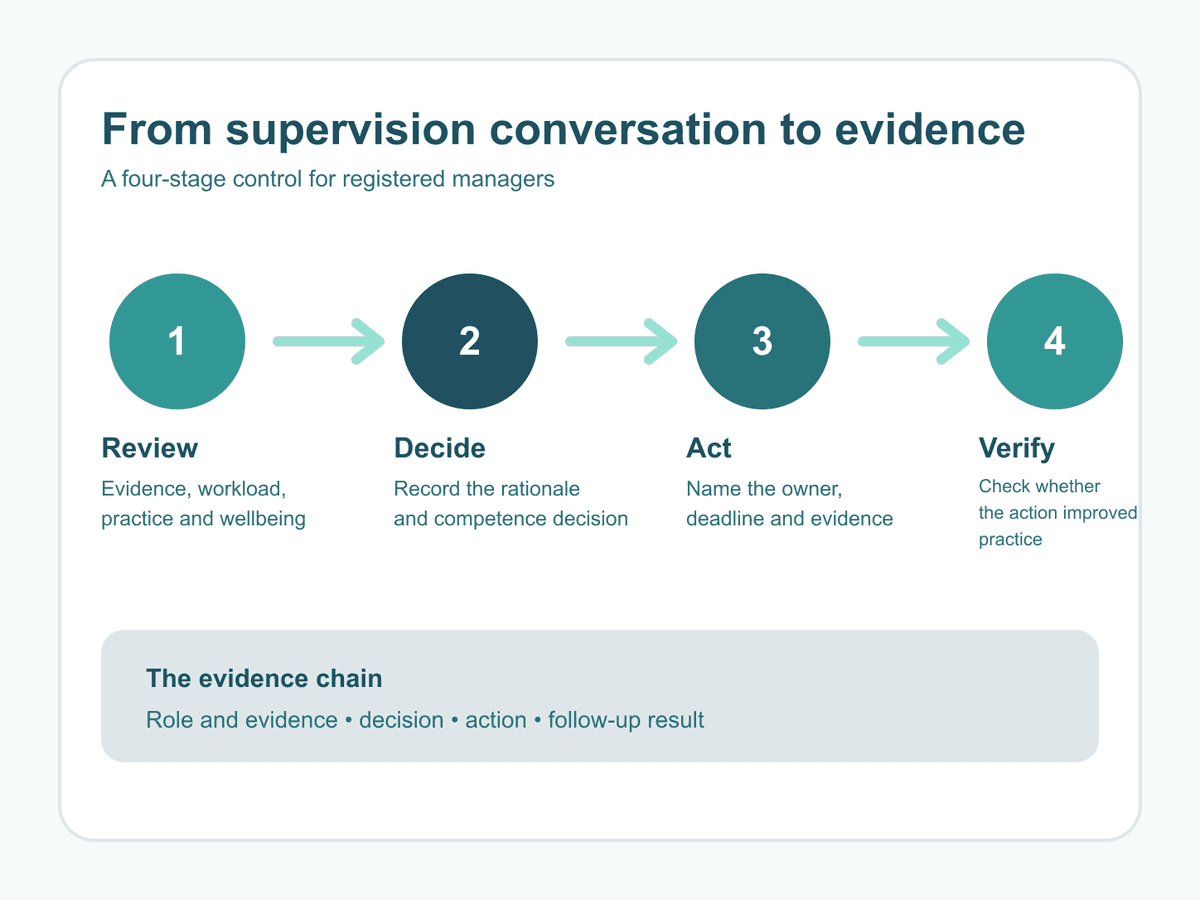
- Open the previous actions. Mark each as complete, carried forward or overdue, with evidence.
- Review a balanced evidence set. Include strengths and positive feedback as well as gaps.
- Write decisions, not transcripts. Retain the material facts, the worker’s account and the management rationale.
- Route formal matters correctly. Supervision notes should not replace safeguarding, grievance, disciplinary or incident procedures.
- Close the loop. Sample the agreed practice or record after the action date and record the result.
This evidence chain also supports role clarity. Our Care Workforce Pathway Part 3 guide explains how supervision and practice leadership connect to competence and development. The registered manager and nominated individual guide separates daily operational control from provider-level oversight.
Keep supervision separate from appraisal and formal processes
Supervision, appraisal, disciplinary action, grievance handling and safeguarding each serve different purposes. A service may refer to the same underlying event in more than one process, but the record should make clear which process is being used and why. A routine supervision note should not become an informal substitute for a fair disciplinary investigation or a safeguarding referral.
Appraisal normally takes a wider and longer-term view of performance, objectives and development. Supervision is usually more frequent and focuses on current practice, support and immediate actions. Keeping the two distinct helps managers avoid postponing urgent matters until an annual review and prevents an appraisal record from becoming overloaded with operational detail.
If a concern emerges during care staff supervision, record the concern in neutral terms, note any immediate safety action and identify the formal route used next. Do not record a final finding before the relevant process has been completed. Where the worker disagrees, preserve their account and avoid language that treats an allegation as an established fact.
| Issue raised in supervision | Immediate record | Next route |
|---|---|---|
| Possible safeguarding concern | Material facts, immediate protection and escalation time | Safeguarding procedure and external notification where required |
| Possible misconduct | Neutral summary and any proportionate interim control | HR and disciplinary procedure |
| Worker grievance | The worker’s concern and how it was acknowledged | Grievance procedure |
| Learning or confidence gap | Task, evidence, support need and agreed action | Development plan, coaching and competence review |
Record defensible competence decisions
A competence decision should identify the task, the evidence and the decision maker. Course attendance can support the decision, but it does not by itself show that a worker can perform safely in practice. Depending on the task, evidence may include direct observation, a discussion of scenarios, a documentation sample, feedback or a supervised demonstration.
Write the decision precisely. State whether the worker is competent to practise independently, requires further supervised practice or must not perform the task until a defined assessment is completed. Name any temporary control, such as shadowing or second checking, and set the review date. This makes the care staff supervision record useful to authorised managers who need to allocate work safely.
| Weak action | Stronger action | Closure evidence |
|---|---|---|
| Improve medicines knowledge | Complete medicines refresher by 18 August, then undertake a directly observed round with the deputy manager | Training record, observation checklist and recorded competence decision |
| Monitor record keeping | Supervisor will sample five daily notes on 20 August against the service recording standard | Audit result, feedback provided and any follow-up action |
| More support needed | Arrange two shadow shifts with the named senior, followed by a review on 25 August | Shadowing feedback and review outcome |
Protect confidentiality and control access
Care staff supervision records are employment records. They may also contain health information, allegations or information about people receiving care. Record only what is necessary for the management purpose, avoid copying whole incident or care records, and use a proportionate cross-reference where the detailed evidence is held in the correct system.
Access should be limited to authorised people with a genuine need to know. The service should define where records are stored, who can view or amend them, how amendments are tracked and how long records are retained. These controls should align with the organisation’s current privacy information, retention schedule and employment-record procedures.
Before sharing a record, check whether the recipient needs the full note or only a specific action. Sensitive information should not be copied into general rotas, handover notes or open action trackers. If a supervision action affects safe deployment, managers still need a reliable way to communicate the operational restriction without disclosing unnecessary personal detail.
A practical first 30 days for registered managers
Days 1 to 7: test the current system
Compare the supervision schedule with completed records for a small, representative sample. Include new starters, experienced workers, night staff, agency-facing roles and anyone with an open development action. Record gaps without assuming their cause. Check whether postponed sessions have an authorised reason and a new date.
Days 8 to 14: strengthen the template
Review whether the template prompts supervisors to cite evidence, record the worker’s account, make a competence decision and assign actions. Remove prompts that encourage unnecessary personal detail. Keep enough flexibility for role-specific discussion rather than forcing every session into identical wording.
Days 15 to 21: calibrate supervisors
Use anonymised examples to agree what strong evidence and clear actions look like. Check that supervisors understand the boundaries between routine supervision and formal procedures. Give them an escalation route for uncertainty, especially where safeguarding, health information or possible misconduct is involved.
Days 22 to 30: close actions and report themes
Review overdue actions, sample closure evidence and identify themes across teams. Separate individual matters from service-wide learning. Report material gaps through the provider’s governance route and set the next audit date. The aim is a repeatable control, not a one-off document tidy-up.
At the end of the first month, keep a short improvement log. Record the original gap, the change made, the evidence sampled and the result. This gives the registered manager a clear basis for deciding whether the new control is working. If the sample still shows missed sessions, vague decisions or overdue actions, adjust supervisor support and repeat the test. Do not mark the work complete merely because a revised template has been issued.
A monthly supervision record audit for registered managers
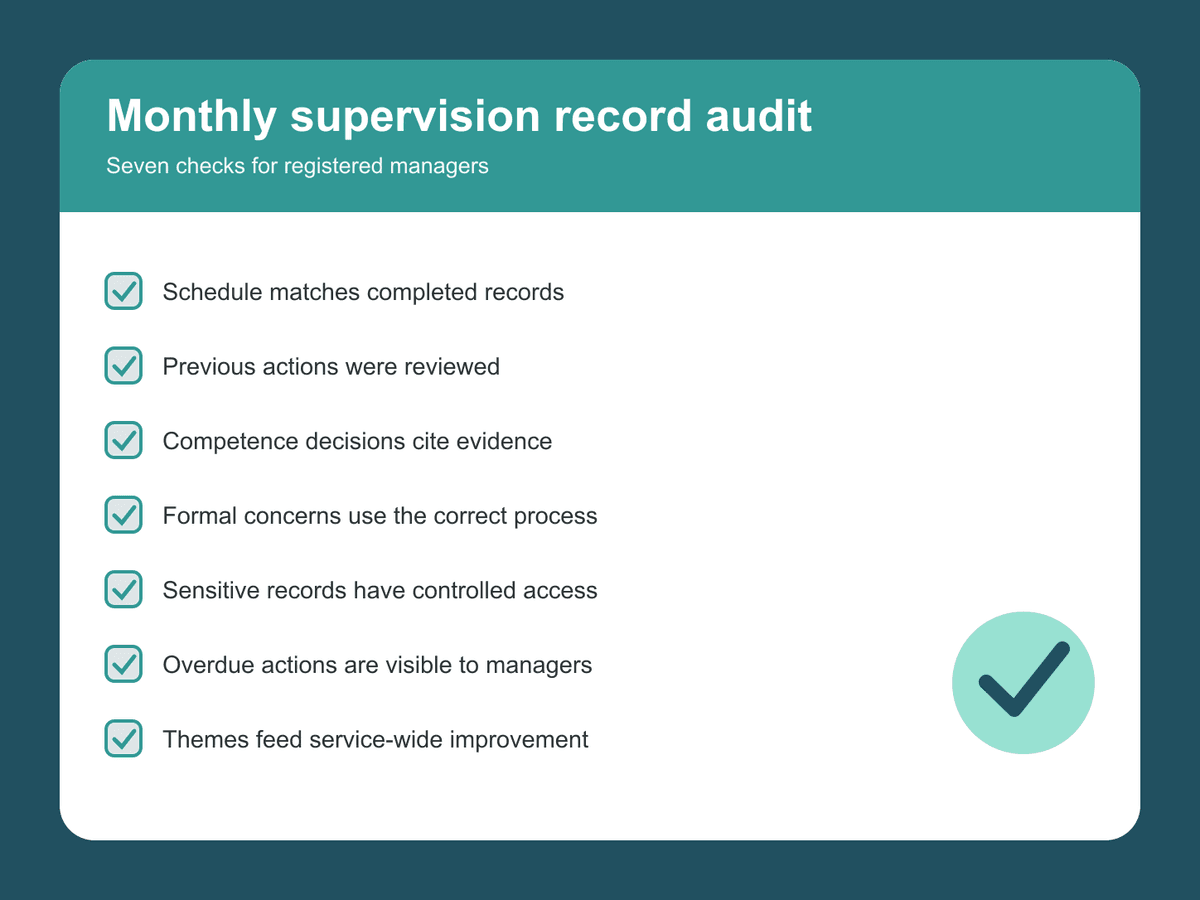
- Compare the supervision schedule with completed records and approved postponements.
- Sample whether previous actions were reviewed before new actions were added.
- Check that competence decisions identify the task, evidence and decision maker.
- Confirm safeguarding, disciplinary and grievance issues were routed through the proper process.
- Check access controls for employment records, particularly health or other sensitive information.
- Test whether overdue actions are visible to the responsible manager.
- Record themes that require service-wide learning, training or quality action.
Use trends carefully. A missed meeting may be an isolated scheduling problem or part of a wider control weakness. Record what the audit shows, investigate the cause and avoid turning an unexplained gap into a conclusion about an individual.
How Care Sync Experts can help
Care Sync Experts can help providers strengthen supervisor capability, training plans and the link between learning and practice. We can review whether your supervision process produces clear actions, proportionate evidence and useful management oversight.
If you want practical support to improve your supervision framework or develop managers, book a consultation with Care Sync Experts.
Frequently asked questions
What should a care staff supervision record include?
Include the session details, agenda, evidence reviewed, the worker’s account, practice and competence decisions, development needs, support offered, agreed actions, owners, deadlines and follow-up date. Keep the record accurate, proportionate and linked to evidence.
How often should care staff supervision take place?
Set a policy baseline, then adjust it according to experience, time in role, work complexity, support needs and risk. CQC requires necessary ongoing or periodic supervision, but does not prescribe one universal interval for every care worker.
Can informal catch ups count as supervision?
Informal discussions can support day-to-day management, but they should not automatically replace the structured supervision required by your policy. Skills for Care recommends recording informal supervision discussions and adding them to existing notes.
Should supervision notes include health information?
Only record information that is necessary for the employment and support purpose. Health information needs particular care, lawful handling and appropriate security. Follow current ICO guidance and your organisation’s HR, privacy and occupational health procedures.
Who is accountable when supervision is delegated?
A trained and competent supervisor may carry out sessions, but the registered manager remains responsible for ensuring that an effective supervision system operates in the regulated service. Delegation should include clear authority, escalation routes and quality checks.
How can registered managers audit supervision records?
Compare the schedule with completed sessions, sample whether evidence supports decisions, check action closure, test confidentiality and review themes across the service. Record the audit date, sample, findings, actions and named owner.
Official source check completed 4 August 2026. Check the latest CQC Regulation 18 guidance, Skills for Care supervision guidance and ICO employment information guidance before changing policy or record-retention controls.
Related reading
- CQC Personal Care Form: 7 Essential Application Checks
- Domiciliary Care Business Continuity Plan: A Practical 2026 Guide
- Adult Social Care Winter Planning 2026/27: 9 Actions Before September
- Adult Social Care Fair Pay Agreement: What Care Providers Should Prepare for Before 2028
- ASC-WDS 2026: A Practical Guide to Workforce Records and Training Funding for Care Providers
- Data Security and Protection Toolkit for Care Providers: A Practical DSPT Guide for 2026
Browse every article on CQC, Ofsted, CIW and RQIA compliance