Regulation 4
Requirements where the service provider is an individual or partnership
The individual or partners must be fit, capable and of good character.
Where Care Excellence Meets Business Success. Transform your operations today - 0333 577 0877
We are here to help 24/7.
Expert guides on CQC regulations, registration and compliance, written by our team, led by a former CQC Senior Inspector Manager.
Last reviewed
Three changes to how CQC registers and assesses services, each with its source.
Draft published 24 March 2026
CQC's draft frameworks keep the five key questions but replace the 34 quality statements with key lines of enquiry (24 in the adult social care draft), add rating characteristics and remove scoring. Feedback closed on 12 June, pilots were planned for the summer and no start date has been set.
In force from 5 May 2026
If a location needs building regulations approval, you must send its building control final certificate. CQC rejects applications with missing, wrong or out of date documents, so check every document before you apply.
Updated 29 July 2026
You can now send notifications of abuse allegations, deaths, serious injuries, police involvement, unauthorised absence, DoLS outcomes and events that stop a service running safely through the portal. Other notifications still go by email.
Pick your service and follow five guides in order, from registration to running a good service.
Or I am about to start one. Register, stay compliant and win local authority work.
Or I am about to start one. Get the model right, protect people's rights and win placements.
The guides our clients read most before starting their care business
 20 min readHow to Start a Domiciliary Care AgencyEverything from company formation and CQC registration to hiring your first care workers and winning contracts. The most complete guide available for anyone starting a home care business in England.Read Full Guide
 18 min readHow to Start a Supported Living ServiceLearn what CQC expects, how to structure your service, when registration is required, and the steps to get operational. Covers commissioning models, housing arrangements, and staffing requirements.Read Full Guide
 15 min readCQC Fundamental Standards ExplainedAll 14 fundamental standards under the Health and Social Care Act 2008 explained in plain English. Practical examples for domiciliary care and supported living, with guidance on how inspectors assess each one.Read Full Guide
 18 min readCQC Quality Statements GuideA complete walkthrough of all 34 quality statements under the Single Assessment Framework. Organised by the five key questions: Safe, Effective, Caring, Responsive, and Well-led.Read Full Guide
Every regulation care providers in England must meet, in plain English, with a link to the law and to our guide.
The standards every registered provider must meet. Regulations 9 to 20A are the fundamental standards.
Regulation 4
The individual or partners must be fit, capable and of good character.
Regulation 5
Directors and equivalents must be of good character, competent and free of serious misconduct.
Regulation 6
An organisation must name a suitable person to supervise its regulated activities.
Regulation 7
Registered managers must be of good character, with the right skills, experience and health.
Regulation 8
Providers must meet Regulations 9 to 19 and 20A whenever they carry on a regulated activity.
Regulation 9
Care must be appropriate, meet the person's needs and reflect their preferences.
Fundamental standard
Regulation 9A
Care homes, hospitals and hospices must support visits and the right to be accompanied.
Fundamental standard
Regulation 10
People must be treated with dignity and respect, including their privacy and independence.
Fundamental standard
Regulation 11
Care must only be given with consent, or lawfully under the Mental Capacity Act 2005.
Fundamental standardCQC can prosecute
Regulation 12
Risks must be assessed and reduced, and medicines, infection control and equipment managed safely.
Fundamental standardProsecution if harm results
Regulation 13
Systems must prevent abuse, with no unlawful restraint or deprivation of liberty.
Fundamental standardProsecution if harm results
Paragraphs (1) to (4)
Regulation 14
People must get enough suitable food and drink to stay healthy.
Fundamental standardProsecution if harm results
Regulation 15
Premises and equipment must be clean, secure, suitable, properly used and maintained.
Fundamental standard
Regulation 16
An accessible complaints system, with every complaint investigated and acted on.
Fundamental standardProsecution in part
Paragraph (3): a summary within 28 days of a request
Regulation 17
Systems to monitor and improve quality and safety, and accurate records.
Fundamental standardProsecution in part
Paragraph (3): a written report within 28 days of a request
Regulation 18
Enough qualified, competent and skilled staff, supported with training and supervision.
Fundamental standard
Regulation 19
Staff must be of good character and competent, with safe recruitment checks.
Fundamental standard
Regulation 20
Be open and honest, and notify and apologise after a notifiable safety incident.
Fundamental standardProsecution in part
Paragraphs (2)(a) and (3): notifying the person
Regulation 20A
Display your CQC rating at your premises and on your website.
Fundamental standardCQC can prosecute
Your statement of purpose, and what you must tell CQC and when.
Regulation 12
A written statement of your aims, services and who you support, kept up to date with CQC.
Regulation 13
Stay financially viable, and give CQC financial information when it asks.
Regulation 14
Tell CQC when a registered person will be absent for 28 days or more.
Regulation 15
Tell CQC about changes such as your name, address, officers or nominated individual.
Regulation 16
Tell CQC without delay about a death during, or linked to, a regulated activity.
Regulation 17
Report these deaths and absences promptly.
Regulation 18
Report serious injuries, abuse or allegations of abuse, police incidents, DoLS outcomes and similar events.
Some sites still list 13 fundamental standards. CQC lists 14, including Regulation 9A on visiting and accompanying, which applies to care homes, hospitals and hospices. Offence markers follow CQC's offences guidance.
Everything you need to know about registering with the CQC and getting started
Videos on CQC registration
Domiciliary Care Business Setup: Don't Miss These Critical CQC Steps
The CQC steps to plan for when setting up a domiciliary care business.
Starting a Supported Living Service? Don't Make These 5 Mistakes
Five common mistakes when starting a supported living service, and how to avoid them.
CQC Registered Manager vs Nominated Individual: What's the Difference?
How the registered manager and nominated individual roles differ under CQC registration.
Regulatory standards, legal requirements, and compliance frameworks for care providers
Videos on compliance and standards
The 10 Types of Abuse: Is Your Care Agency Ready for 2026?
The ten types of abuse in the Care Act 2014, with home care examples, and how to evidence safeguarding.
Is Your Governance Real? How to Prove It to the CQC
How to turn routine audits into governance evidence CQC will accept.
Don't Let Medication Records Ruin Your CQC Inspection
What CQC looks for in medication records, and the gaps that let providers down.
Running your care service day to day, from staffing and contracts to technology and notifications
Videos on running your service
The Missing Link in Your CQC Staff Files (And How to Fix It)
What is often missing from staff files, and how to fix it before CQC looks.
Care Plans Don't Fail on Length. They Fail on This
Why care plans fall short, and how to write ones that show person-centred care.
Training Certificates Don't Mean Competent Staff: CQC Wants This Instead
Why certificates alone do not prove competence, and what evidence CQC expects instead.
Winning care contracts, understanding procurement, and demonstrating social value
Videos on tenders and commissioning
How New Care Providers Can Win NHS and Council Care Tenders With No References
How a new care provider can bid for NHS and council work before it has references.
Care Tenders UK: Stop Searching, Start Winning
How to find the right care tenders and prepare bids that win.
Government Contracts Are Impossible Without CDP Registration (Here's Why)
Why care providers must register on the Central Digital Platform to bid for public contracts.
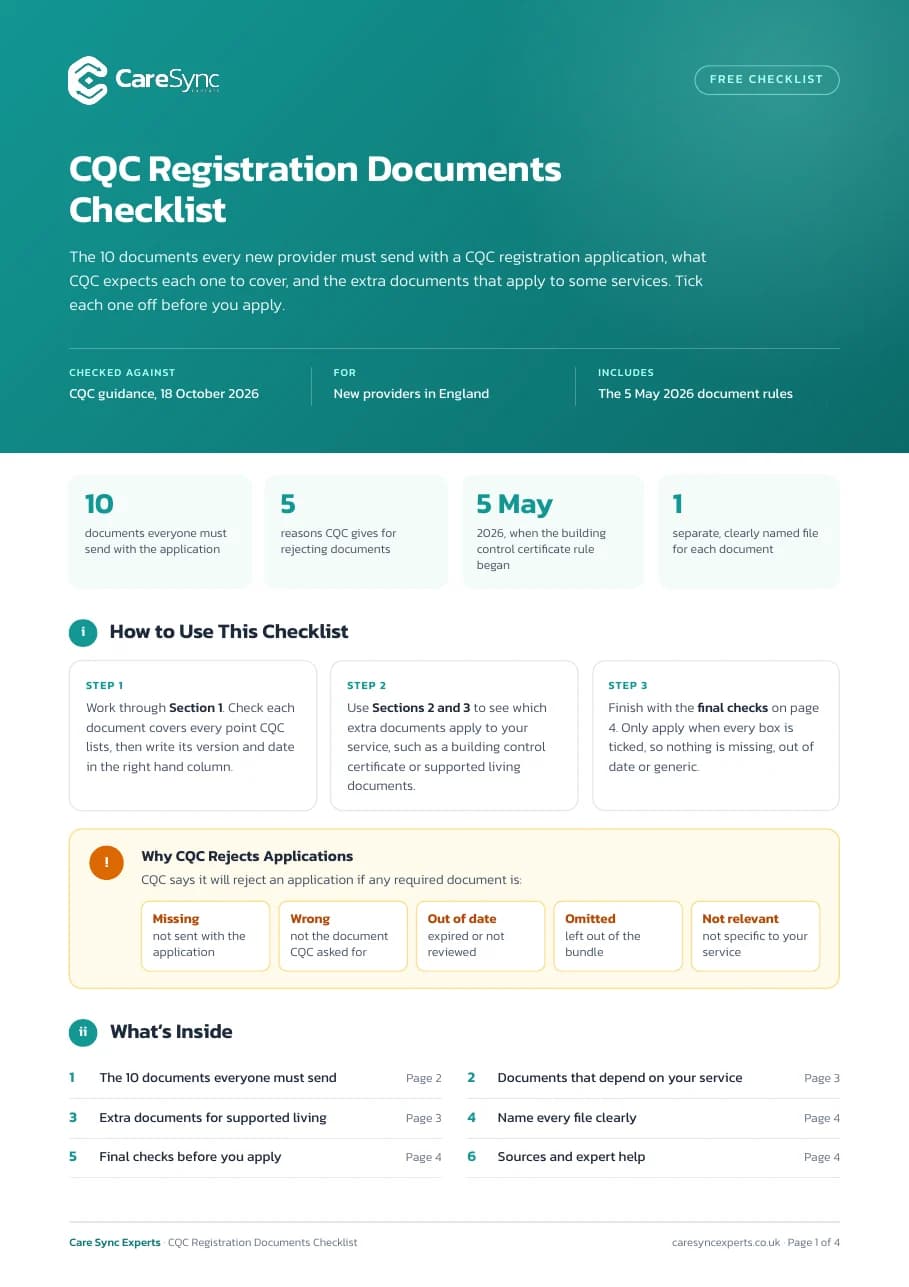
Print them, tick them off, keep them on file. Built from CQC's own guidance, with every source listed.
PDF · 4 pages · checked 18 October 2026
Everything to send with a new provider application in England, so it is not rejected for a missing or out of date document.
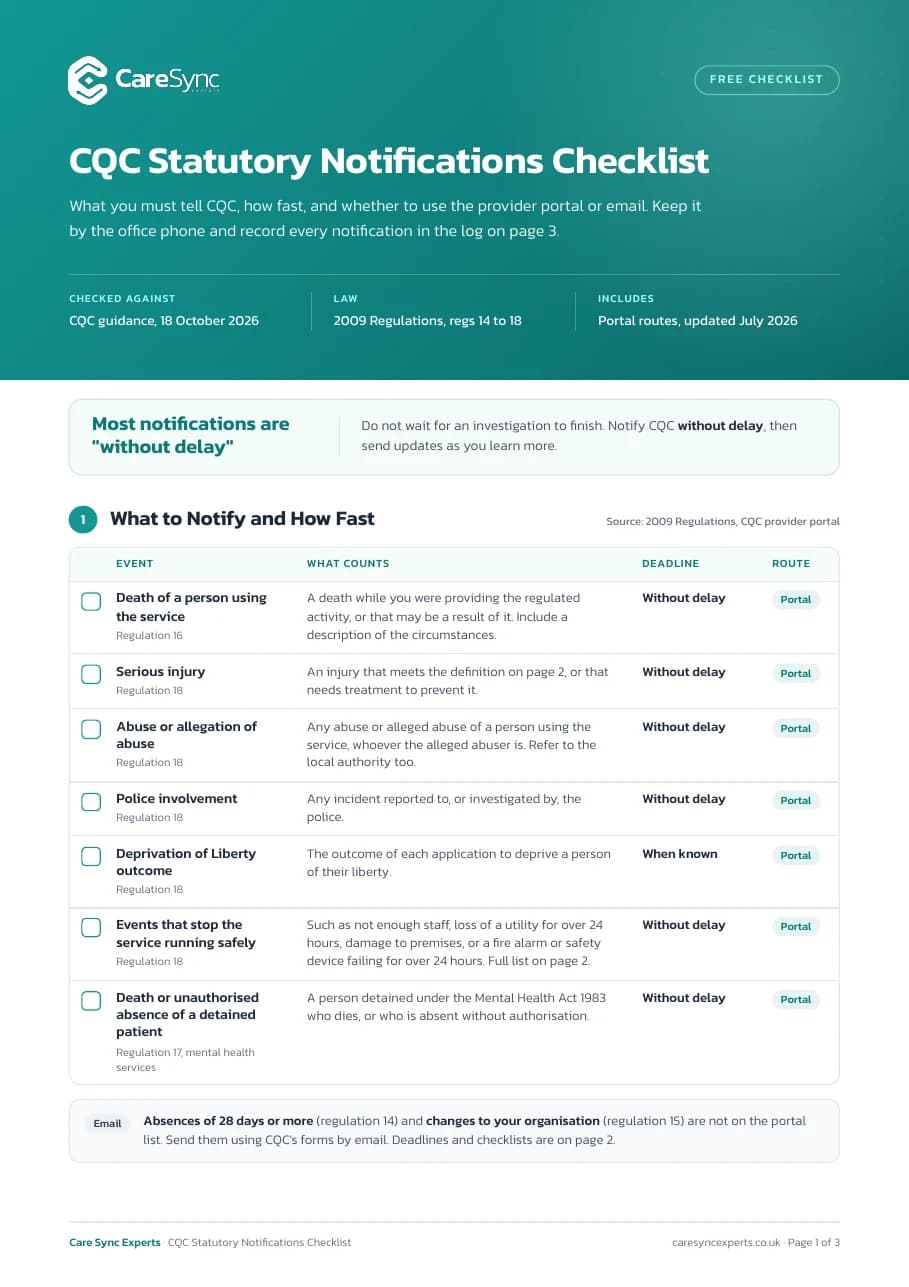
PDF · 3 pages · checked 18 October 2026
What you must tell CQC, how quickly, and whether it goes through the provider portal or by email.
Each one comes with a guide on this site. There is no form to fill in.
Track each new starter through the Care Certificate standards. See the Care Certificate standards guide.
The fundamental standards on one page, to print for your office. See the CQC fundamental standards guide.
CQC's quality statements on one poster. See the CQC quality statements guide.
What the nominated individual is responsible for. See the nominated individual guide.
Plan and track the changes you make after an inspection. See the guide to improving your CQC rating.
A letter to adapt when something goes wrong. See the duty of candour guide.
The same letter as a PDF, to read or print. See the duty of candour guide.
The words you will meet in CQC letters, forms and inspections, in plain English.
Last reviewed
Hub last reviewed
Care Sync Experts has supported more than 1,200 care providers over 10 years, and 98% of the registration applications we support are approved first time. The same team writes these guides.
Our guides are general information, not legal advice. Spotted something out of date? Tell us.
A short email when CQC changes its rules, forms or guidance, and when we publish or update a guide. Only when something changes. Unsubscribe any time.



Book a consultation with our team. We will review your plans, answer your questions, and give you a clear roadmap to registration.