Conditions of Registration
Imposed under S.12/12A — may limit the number of people supported, require named managers, or mandate specific staffing. Breaching a condition can lead to cancellation.
Severity: Moderate–High
Where Care Excellence Meets Business Success. Transform your operations today - 0333 577 0877
We are here to help 24/7.
When a care provider fails to meet regulatory requirements, the Care Quality Commission (CQC) has a range of enforcement powers at its disposal. These powers exist to protect vulnerable people and to ensure that care providers meet fundamental standards. Understanding CQC enforcement action is essential for any care provider who wants to avoid regulatory breaches, protect their registration, and maintain their reputation.
This guide explains what CQC enforcement action is, what triggers it, the different types of enforcement available to the CQC, how to respond, and how Care Sync Experts can help you avoid enforcement and recover if action is taken.


CQC enforcement action refers to the formal steps the CQC can take when a provider breaches regulations or fails to meet fundamental standards. Enforcement action is not punishment; it is designed to protect people who use services and to bring providers back into compliance. The CQC uses a proportionate approach, meaning that enforcement responses are scaled to the severity of the breach.

Enforcement action can range from issuing a warning or a requirement to make improvements, through to suspending or cancelling a provider's registration, and in serious cases, prosecution of individual directors or managers.
The CQC's enforcement powers derive from the Health and Social Care Act 2008 (as amended) and the Health and Social Care Act 2008 (Regulated Activities) Regulations 2014. These laws define what the CQC can and cannot do, and the circumstances under which each type of enforcement action can be taken.
The key principle underlying all CQC enforcement is proportionality. The CQC must consider the severity of the breach, the risk posed to people who use services, the provider's history of compliance, and the effectiveness of previous regulatory action before escalating to more serious enforcement measures.
The CQC has a range of enforcement tools at its disposal, ranging from informal to criminal.
A requirement notice (S.29A) is legally binding — sets out exactly what must be done, usually within 30 days. A warning notice (S.29) signals close monitoring with no fixed timescale. Both must be taken with urgency.
Severity: Moderate — escalates quickly if ignored
Legal basis: Health and Social Care Act 2008, S.29 & S.29A

Imposed under S.12/12A — may limit the number of people supported, require named managers, or mandate specific staffing. Breaching a condition can lead to cancellation.
Severity: Moderate–High
Under S.14/14A, the CQC can suspend for up to 12 months when there is a serious risk to safety or welfare. During suspension, you cannot provide care services. This is a drastic step taken only when there is imminent danger.
Severity: High — operations halt immediately
S.17 ends your ability to operate. Reserved for providers who have had opportunities to improve but have not. Only the CQC can cancel a registration.
Severity: Critical — permanent closure
S.30/31 — enables the CQC to act immediately without the usual notice and representations process when people are in imminent danger.
Severity: Critical — bypasses normal process
S.33–36 — targets individuals. Fines up to £50,000 and up to 2 years imprisonment for cases involving death. Reserved for deliberate non-compliance or gross negligence.
Severity: Moderate–High
Financial penalties for lower-level breaches — allows the CQC to enforce compliance without full prosecution. Typically used where compliance can be achieved quickly.
Severity: Low — administrative penalty

A quick review now can save you from serious enforcement later.
Understanding how the CQC makes enforcement decisions helps you anticipate regulatory action and respond effectively.
CQC inspectors gather evidence: speaking with people who use services, reviewing policies and records, observing care delivery, and examining governance arrangements.
CQC analysts review the evidence. Serious breaches posing immediate risks are escalated quickly. Lower-level breaches may be addressed through monitoring rather than immediate enforcement.
The CQC considers severity, number of people at risk, the provider's compliance history, and whether the provider is cooperative and willing to improve.
The CQC issues a notice or order. Providers typically have the opportunity to make representations before the notice becomes final, except for urgent procedures.
The CQC monitors compliance. If the provider complies, enforcement may be lifted. If not, further action including prosecution or cancellation follows.
CQC ratings directly influence whether enforcement action is taken. A rating of Inadequate or Requires Improvement does not automatically trigger enforcement, but it signals to the CQC that regulatory action is needed.
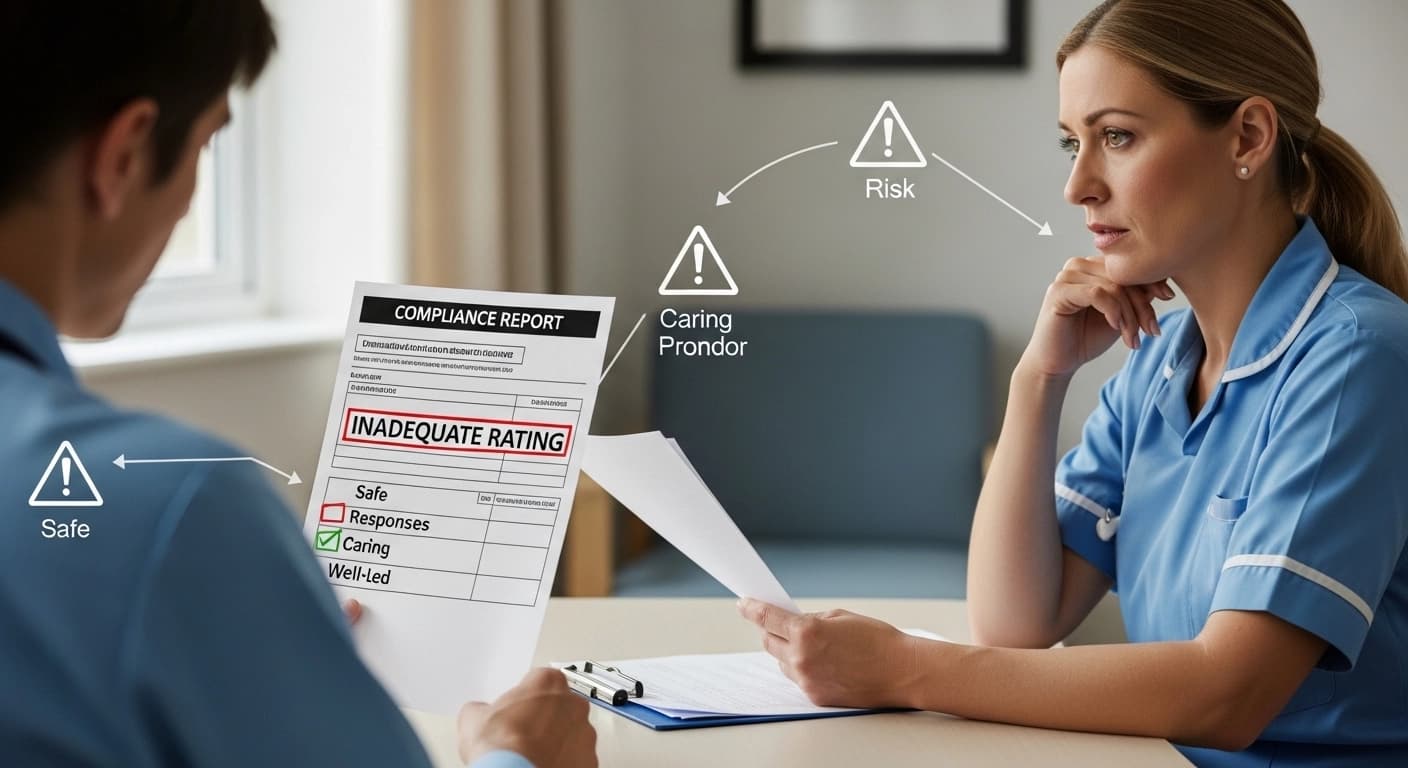
An Inadequate rating indicates that the service is not meeting fundamental standards and people who use the service are at risk of harm. If a service is rated Inadequate in any key line of enquiry (Safe, Effective, Caring, Responsive, or Well-led), the CQC will almost certainly issue a requirement notice setting out what must be improved and the timescale for improvement.

A Requires Improvement rating indicates that the service is meeting fundamental standards but there are areas where compliance could be strengthened. CQC may issue a requirement notice or conditions of registration if serious concerns are identified, even if the overall rating is Requires Improvement.
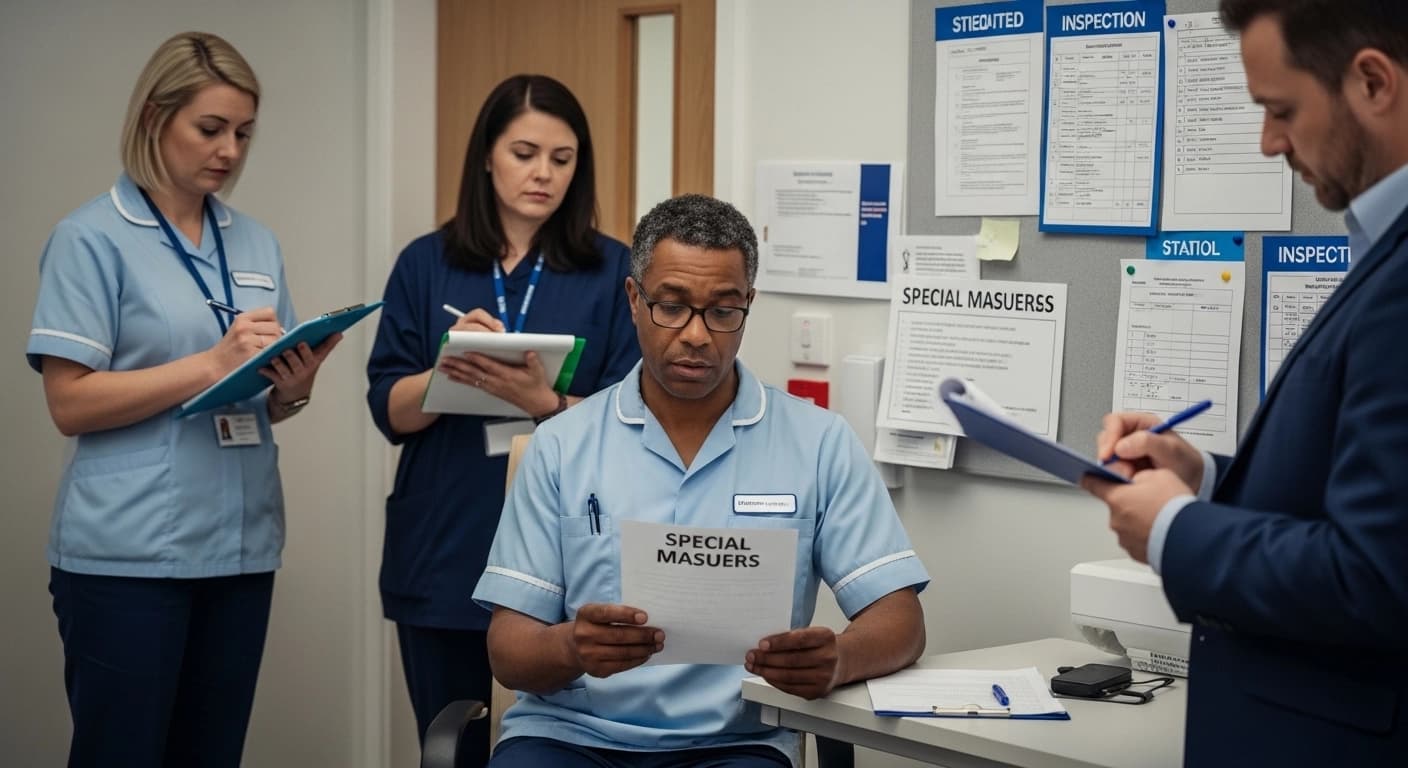
If a service is rated Inadequate, the CQC may place the provider into Special Measures. This means the service will be subject to enhanced monitoring, more frequent inspections, and potentially tighter conditions of registration. Special Measures remain in place until the service demonstrates sustained improvement and achieves a higher rating.
Special Measures is a status imposed on services rated Inadequate. It is not enforcement action in the strict sense, but it is a serious regulatory intervention that signals the CQC's lack of confidence in the provider.
There is no fixed timeline, but typically services must demonstrate significant improvement within 6-12 months to move out of Special Measures. This requires consistent evidence of compliance, positive feedback from people who use services and staff, and demonstrable progress against an improvement plan.
Responding quickly and correctly to CQC enforcement notices is critical. Follow these structured steps to protect your registration and demonstrate compliance.
You have the right to appeal to the First-tier Tribunal (Care Standards section) within 28 days of receiving the notice. Appeals must be based on specific legal grounds — CQC acted irrationally, insufficient evidence, or improper procedure.
Recovery Pathway
Many providers recover from enforcement and go on to achieve higher ratings. The path requires structured action, consistent evidence, and building momentum at every stage.
Recovery starts with a comprehensive action plan addressing every CQC concern — with clear owners, realistic timescales, and measurable outcomes.
Once you have implemented your action plan, the CQC will conduct a further inspection. During this inspection, they will assess whether the breaches have been remedied and whether the service is now meeting standards. If you have addressed the concerns, your rating will be improved and enforcement action will be lifted.
The most important aspect of recovery is building momentum. Celebrate small wins, engage your team in the improvement journey, and communicate progress transparently to the CQC. Many providers recover from enforcement and go on to achieve higher ratings.
Let Care Sync Experts guide your recovery
If you have received enforcement action, our team can help you develop an effective response plan, gather the right evidence, and prepare for reinspection with confidence.
Prevention is always better than cure. Here are practical steps to reduce your risk of enforcement action.

Effective governance is the foundation of compliance. Establish clear policies and procedures, ensure decision-making is documented and transparent, conduct regular audits of compliance, and hold regular management meetings to discuss regulatory risks and performance.
Do not wait for CQC inspection to assess your compliance. Conduct regular self-assessments against the fundamental standards and CQC assessment framework. Use these self-assessments to identify and address gaps before the CQC does.
Well-trained, well-supported staff are less likely to breach regulations. Ensure all staff receive induction training on fundamental standards, provide ongoing training relevant to their role, supervise staff regularly, and create a culture where concerns can be raised safely.
People who use services and their families often identify problems before they escalate. Establish mechanisms to gather feedback regularly, take concerns seriously, investigate complaints thoroughly, and demonstrate that you have changed practices based on feedback.
There is no shame in seeking help. Compliance with CQC regulations and fundamental standards is complex and constantly evolving. External experts can help you navigate this landscape and keep you ahead of regulatory requirements.

Care Sync Experts specialises in helping care providers navigate CQC enforcement and avoid regulatory breaches. Our services include
Comprehensive preparation to ensure you are ready for inspection and can demonstrate compliance
Regular audits to identify gaps against fundamental standards before the CQC does
If you have received enforcement action, we help you develop an effective response and recovery plan
Help embedding the quality statements and fundamental standards throughout your service
Ensuring you meet your legal obligations to be open and honest with people after incidents
If you are facing CQC enforcement action or want to reduce your risk of enforcement, contact Care Sync Experts today. Our team has extensive experience in supporting care providers to overcome enforcement challenges and achieve compliance.
Book your free consultation


Can't find the answer you're looking for? Please chat to our friendly team.