
Knowledge hub · Roles and registration
CQC Nominated Individual: Requirements, Duties and Checks
Who can be your nominated individual, what Regulation 6 requires, the DBS and fitness checks, the CQC discussion, how the role differs from the registered manager, how to change your nominated individual and where personal liability starts. Checked against the law and CQC on 20 October 2026.
- The regulation that requires one when the provider is an organisation
- Reg 6
- Fitness conditions the provider must take all reasonable steps to make sure they meet
- 4
- Nominated individual for each regulated activity (one person can cover all)
- 1
- Tell CQC about a change as soon as reasonably practicable
- Reg 15
By the Care Sync Experts registration team, who prepare nominated individuals and registered managers for CQC registration. Every rule on this page was read on legislation.gov.uk and cqc.org.uk on .
What Is a CQC Nominated Individual?
A CQC nominated individual is the senior person a care organisation names to the Care Quality Commission as responsible for supervising the management of its regulated activities. Regulation 6 requires one whenever the provider is an organisation, such as a limited company or charity, rather than a sole trader or partnership.
They must be employed as a director, manager or secretary of the organisation, and the provider must check that they are of good character, have the right qualifications, skills and experience, are fit in health, and have passed the Schedule 3 checks, including an enhanced DBS. They are CQC's main point of contact, but they are not registered with CQC.
In practice the nominated individual is the person who answers for the organisation: they oversee the registered manager, make sure governance works and speak to CQC when it matters. The registered manager runs the service day to day. See the difference.
This guide is written for care providers in England, especially home care and supported living services. It is general information, not legal advice.
At a Glance: The Nominated Individual in 2026
| What It Is | The senior person a provider organisation names to CQC as responsible for supervising the management of its regulated activities |
|---|---|
| The Law | Regulation 6 of the Health and Social Care Act 2008 (Regulated Activities) Regulations 2014 |
| Who Needs One | Providers that are organisations: companies, charities and other bodies. Not sole traders or ordinary partnerships |
| Who Can Be One | Someone employed as a director, manager or secretary of the organisation, senior enough to speak for it |
| Fitness Checks | Good character, the right qualifications, skills and experience, health, and the Schedule 3 checks, including an enhanced DBS |
| How Many | One for each regulated activity. One person can cover all of them |
| Registered With CQC? | No. The provider and the registered manager are registered persons. The nominated individual is not |
| CQC Contact | CQC's main point of contact with the organisation. CQC may hold a nominated individual discussion at registration |
| Changing Them | Notify CQC as soon as reasonably practicable on the changes form. Failing to notify is an offence |
Source: Regulation 6; regulation 2 (registered person); CQC, what is registration?; CQC, applying as a new provider.
Does your service need one?
Who Needs a Nominated Individual?
It depends on the legal form of the provider, not on the size of the service. CQC says: “If you register as an individual or partnership you do not need a nominated individual.” Every other provider must name one.
| Provider Type | Needs an NI? | What Applies |
|---|---|---|
| Sole trader (individual provider) | No | You are the provider. Regulation 4 applies your fitness checks to you instead. |
| Partnership | No | Each partner must meet the fitness tests in Regulation 4. |
| Limited liability partnership (LLP) | Yes | The 2014 Regulations say a partnership does not include an LLP, so Regulation 6 applies. |
| Limited company | Yes | Name a director, manager or company secretary employed by the company. |
| Charity, charitable company or CIO | Yes | Usually the chief executive or a senior manager employed by the charity. |
| Community interest company | Yes | It is a company, so Regulation 6 applies in the same way. |
| NHS body or local authority | Yes | A body other than a partnership, so Regulation 6 applies. |
Same Words, Different Roles
“Nominated individual” means different things to different regulators. If you also register with Ofsted, or work in Wales, check which role you are being asked about.
CQC, England (adult and health care)
Nominated individual
Not registered with CQC. The provider checks their fitness.
Ofsted, daycare (early years)
Nominated individual
Must apply to register with Ofsted personally.
Ofsted, supported accommodation (16 and 17 year olds)
Nominated individual
The organisation's single point of contact with Ofsted.
Ofsted, children's homes
Responsible individual
Supervises the management of the home for the organisation.
Care Inspectorate Wales
Responsible individual
A different Welsh role, set by the Regulation and Inspection of Social Care (Wales) Act 2016.
Source: CQC, what is registration?; Regulation 4; Ofsted, daycare roles that must register; Supported Accommodation (England) Regulations 2023, reg 2; Children's Homes (England) Regulations 2015, reg 2.
The law, word for word
Regulation 6: The Law Behind the Nominated Individual
Regulation 6 of the Health and Social Care Act 2008 (Regulated Activities) Regulations 2014 is short. Here it is in full, as in force on 20 October 2026.
Regulation 6: Requirement where the service provider is a body other than a partnership
- (1)This regulation applies where the service provider is a body other than a partnership.
- (2)The body must give notice to the Commission of the name, address and position in the body of an individual (in these Regulations referred to as “the nominated individual”) who is: (a) employed as a director, manager or secretary of the body, and (b) responsible for supervising the management of the carrying on of the regulated activity by the body.
- (3)The registered person must take all reasonable steps to ensure that the nominated individual: (a) is of good character, (b) has the necessary qualifications, competence, skills and experience to properly supervise the management of the carrying on of the regulated activity, (c) is able by reason of their health, after reasonable adjustments are made, of properly doing so, and (d) is able to supply to the registered person, or arrange for the availability of, the information specified in Schedule 3.
- (4)In assessing an individual’s character for the purposes of paragraph (3)(a), the matters considered must include those listed in Part 2 of Schedule 4.
Source: SI 2014/2936, regulation 6 (line breaks and dashes simplified). Paragraph (4) and the word “competence” were added on 1 April 2015.
What It Means in Plain English
Who it covers
Any provider that is an organisation. Sole traders and partnerships are covered by Regulation 4 instead.
Who you can name
Someone employed as a director, manager or secretary, who supervises how the regulated activity is managed.
Whose job the checks are
The provider's. The registered person must take all reasonable steps to make sure the person is fit.
Where the evidence goes
To the provider, not CQC. The nominated individual supplies the Schedule 3 information to the registered person.
Can CQC prosecute a breach?
No. CQC says it “cannot prosecute for a breach of this regulation”, but it can take other regulatory action, and it must refuse registration if it is not satisfied you will comply. Where personal liability does start.
Eligibility
Who Can Be a Nominated Individual?
Two things decide it: the person's position in your organisation, and whether they are fit for the role. CQC adds that it is up to you who to nominate, “as long as they meet these criteria”.
Condition 1: their position
Employed as a Director, Manager or Secretary, and Senior Enough to Speak for You
CQC explains that they “should be a senior person, with authority to speak on behalf of the organisation” and “in a position to speak, authoritatively, on behalf of the organisation, about the way that the regulated activity is provided.” A job title alone is not enough: an operations director who never sees governance reports would struggle to meet this.
Condition 2: they are fit for the role
Good Character (6(3)(a))
You must consider the matters in Schedule 4, Part 2: any conviction for an offence, and whether they have been struck off or removed from a register of health or social work professionals. CQC expects your checks to take account of “honesty, trustworthiness, reliability and respectfulness”, and you should record your reasons if you appoint someone despite a concern.
Qualifications, Competence, Skills and Experience (6(3)(b))
No set qualification is required. CQC expects them to know the relevant law, including the 2014 Regulations, current best practice, “and understand the consequences of failing to take action on set requirements.”Training options.
Health, After Reasonable Adjustments (6(3)(c))
CQC is clear that this “does not mean that people who have a long-term condition or disability cannot hold such positions.” Adjustments follow the Equality Act 2010.
The Schedule 3 Information (6(3)(d))
The same pre-employment checks you would hold for any senior appointment:
- Proof of identity, including a recent photograph
- An enhanced DBS certificate, with barred list information where it applies
- Evidence of conduct in previous health, social care, children's or vulnerable adults' work
- Where they worked with children or vulnerable adults, why that job ended, as far as reasonably practicable
- Documentary evidence of any qualification relevant to the role
- A full employment history, with a written explanation of any gaps
- Information about any physical or mental health condition relevant to the role, after reasonable adjustments
If your nominated individual is also a director, Regulation 5 (fit and proper persons: directors) applies to them as a director as well, including its wider tests such as bankruptcy and serious misconduct.
Source: CQC, Regulation 6 guidance (updated 16 May 2025); CQC, what is registration?; Schedule 3; Schedule 4; Regulation 5.
What the role involves
Nominated Individual Responsibilities
The law gives the nominated individual one job: supervising how the regulated activity is managed. CQC and DHSC fill in what that means. DHSC's role guidance puts it plainly: “you will have no statutory responsibilities (other than those of any other employee). Nevertheless, you will have a major and important role in the leadership of your service, encouraging improvement through robust governance.”
Set by the law and CQC
The Official Duties
- Supervise the management of the carrying on of the regulated activity. This is the one duty written into Regulation 6.
- Be CQC's main point of contact with the organisation. The first nominated individual named on the application is the one CQC sends notices to.
- Make sure a departing registered manager's registration is cancelled. The manager normally applies to cancel it. If they cannot be contacted, CQC will only accept an instruction to cancel from the nominated individual or main partner.
- Answer for how the regulated activity is provided: CQC wants someone who can speak “authoritatively, on behalf of the organisation”.
Our advice
A Governance Rhythm That Shows Supervision Is Real
Supervising means you can show it happened. This is the rhythm we set up with the providers we support. Keep a record of each item: it is the evidence CQC looks for under the Well-led key question.
Every month
- Review a quality report: incidents, safeguarding, complaints, notifications, staffing, missed or late visits and audit results
- Hold a recorded supervision meeting with the registered manager
- Check that every incident CQC must be told about was notified
Every quarter
- Visit the service, talk to people who use it and staff, and read a sample of care records
- Review the risk register and the improvement plan, and close actions that are done
- Test one area in depth, such as medicines or recruitment files
Every year
- Appraise the registered manager and agree their development
- Arrange an independent audit or mock inspection
- Review the statement of purpose, business continuity plan and your own training
Source: Regulation 6; CQC, what is registration?; CQC application form v12, section 1.9; CQC changes notification form v14, section 2; DHSC, nominated individual role category (16 July 2026).
Two different jobs
Nominated Individual vs Registered Manager
The registered manager runs the service day to day. The nominated individual supervises how the organisation runs it, and answers for the organisation. The legal differences matter more than most providers realise.
| Nominated Individual | Registered Manager | |
|---|---|---|
| The law | Regulation 6 | Regulation 7 |
| Registered with CQC? | No. Named by the provider | Yes. A registered person in law |
| Who decides they are fit? | The provider, taking all reasonable steps | CQC, through the registration process |
| CQC conversation | May have a nominated individual discussion at registration | Fit person interview |
| DBS | Enhanced DBS. The provider gives CQC the number and date | Enhanced DBS under 12 months old at application, countersigned by CQC unless they are a registered healthcare professional |
| Focus | Supervising how the organisation manages the regulated activity | Managing the regulated activity day to day |
| Qualifications | None set. DHSC says at least registered manager level knowledge | None set in law. CQC homecare guidance gives a Level 5 Diploma as an example |
| Absence of 28 days or more | No notification rule | The registered person must notify CQC |
| Personal criminal liability | Not as a nominated individual. Where the provider is a company or other body corporate, they can share its offence as a director, manager or secretary (s.91) | Can be prosecuted as a registered person |
For the registered manager's side in full, read our registered manager requirements guide or our article on nominated individual vs registered manager.
Source: Regulation 2, 6 and 7; CQC, register as a provider; CQC, DBS checks for registration; Registration Regulations 2009, reg 14; DHSC role category; CQC, before you apply (homecare agencies).
One person, two roles
Can the Registered Manager Also Be the Nominated Individual?
Yes, but CQC would rather you did not. Its new provider guidance says registered managers can act as nominated individuals “in certain circumstances”, “normally where the organisation is small”. Its registration page explains the concern:
“In very small organisations, it may be necessary for the same person to be both the registered manager and the nominated individual, but this should be avoided where possible. Where there are concerns about the way a regulated activity is being managed, there will be times when we need to speak to a more senior person within the organisation.”
Our advice if you hold both
Build In the Challenge You Are Missing
- Bring in independent scrutiny: an external audit or mock inspection at least once a year
- Name a deputy who can speak to CQC and run the service if you are away
- Keep separate records for each role: your manager's audits, then your own review of them
- Plan to split the roles as you grow, and say so in your business plan
- In the CQC conversation, answer each question from the right seat: operations as the manager, oversight as the nominated individual
CQC, applying as a new provider: guidance (updated 25 March 2026).
Criminal record checks
Does a Nominated Individual Need a DBS Check?
Yes. At registration the provider must have an enhanced DBS certificate for the proposed nominated individual. CQC's guidance for the application form says: “The law requires you to have this, and if you have not done so we will have to return your application.”
CQC and the law
What CQC asks for
Section 1.9 of the provider application asks whether you have received an enhanced DBS for each nominated individual, with the certificate number and the date it was issued. You do not post the certificate.
CQC and the law
What you must declare
Section 1.10 asks whether any nominated individual faces professional disciplinary action, investigation, or a DBS bar, or has been investigated over safeguarding concerns in any care role.
CQC and the law
How long it takes
CQC tells new providers to get the DBS check for their main point of contact before applying, as it “can usually take up to 60 days”.
CQC and the law
How old it can be
CQC's 12 month limit and its countersigned DBS route are written for registered persons: an individual provider, partner or registered manager. CQC does not state an age limit for the nominated individual's certificate.
Our advice
Our advice
Get a fresh enhanced DBS, with barred list information where the role is eligible (for example, if they regularly manage or supervise care staff), no more than 12 months before you apply. It avoids questions and matches what CQC asks of registered persons.
CQC and the law
Changing nominated individual later
CQC's change form has no DBS field, but Regulation 6 still requires you to take all reasonable steps to make sure the new nominated individual can supply the Schedule 3 information, including an enhanced DBS, so get it before they take over.
Source: CQC, applying as a new provider: guidance, sections 1.9 and 1.10; CQC, register as a provider (25 August 2026); CQC, DBS checks for CQC registration (19 December 2025).
Registration assessment
Does CQC Interview the Nominated Individual?
It can. CQC's current guidance says that once an application passes its first checks, the assessment “may include” a fit person interview, a site visit assessment and a “Nominated Individual Discussion”.
Agree a date quickly
If you cannot agree a date for an assessment activity within 28 days of CQC contacting you, CQC says your application may be returned or it may propose to refuse registration.
Ignore old advice that you will not be interviewed
One page of the Skills for Care handbook says the nominated individual “will not be interviewed by the CQC”. The same handbook later describes the nominated individual in a registration interview, and CQC now lists the nominated individual discussion as an assessment step. Prepare as if it will happen.
Need help? Our CQC interview preparation covers nominated individuals as well as registered managers.
Our practice questions
16 Questions to Prepare For
These are the areas nominated individuals are asked about in the registration conversations we prepare people for. They are our practice questions, not an official CQC list.
Governance and oversight
- 1
How will you know the service is safe when you are not there?
What it tests: The information that reaches you: reports, audits, visits and who escalates to you.
- 2
How often do you meet the registered manager, and what do you review?
What it tests: A real supervision rhythm, recorded.
- 3
What would you do if the registered manager was not following your policies?
What it tests: That you will challenge, support and, if needed, manage performance.
- 4
Who would speak to CQC if you were unavailable?
What it tests: Cover and continuity at a senior level.
Safety and safeguarding
- 5
How would you respond to a safeguarding allegation against the registered manager?
What it tests: Independence: you act, refer to the local authority and notify CQC.
- 6
Which events must be notified to CQC, and how do you check they were?
What it tests: Knowledge of statutory notifications and how you verify them.
- 7
How do you make sure staff are recruited safely?
What it tests: Schedule 3 checks, DBS and references, and your own sampling of files.
- 8
How do you monitor medicines safety?
What it tests: Audits, error reporting and what happens after an error.
Quality and people's experience
- 9
How will you hear from the people who use the service, and what will you do with it?
What it tests: A feedback loop that changes things.
- 10
What is the duty of candour, and when does it apply?
What it tests: Regulation 20: the notifiable safety incident threshold and what you must do.
- 11
How will you make sure care is person-centred and not task-led?
What it tests: How you test this yourself, beyond the paperwork.
- 12
What would you do if CQC rated the service requires improvement?
What it tests: Ownership, an action plan and how you would track it.
The law and the business
- 13
What are the fundamental standards, and which can lead to prosecution?
What it tests: Working knowledge of Regulations 9 to 20A and Regulation 22.
- 14
How will you make sure the service has enough staff and money to stay safe?
What it tests: Sustainability, workforce planning and business continuity.
- 15
How do you keep up to date with changes at CQC?
What it tests: Learning habits, such as following CQC's 2026 framework changes.
- 16
If you hold both roles, how do you challenge your own work?
What it tests: Independent scrutiny and separate records for each role.
Source: CQC, register as a provider (updated 25 August 2026); Skills for Care, nominated individual handbook, pages 15 and 16.
Qualifications and development
What Qualifications Does a Nominated Individual Need?
None is set in law. Regulation 6 asks for “the necessary qualifications, competence, skills and experience” for the role. In July 2026 DHSC published guidance for the role as part of the care workforce pathway, which says nominated individuals “should have knowledge and skills aligned with the ‘Registered manager’ role category as a minimum”.
Leadership qualifications
DHSC suggests the Level 5 Diploma in Leadership and Management in Adult Social Care, and Level 6 and 7 leadership programmes. These are suggestions, not requirements.
Learning disability and autism
DHSC suggests Oliver's Training on Learning Disability and Autism (the Oliver McGowan training), Tier 1, for the role.
Digital skills
DHSC points to the adult social care Digital Skills Framework at level 1, with level 2 optional.
What you need to know
Governance and quality assurance, risk, business and commercial awareness, culture, leadership, data, improvement and equality, among others.
Skills for Care support
A 106 page nominated individual handbook, last reviewed in September 2024, plus local nominated individual networks and national events.
What CQC expects
Knowledge of the 2014 Regulations, relevant best practice and guidance, and an understanding of what happens if requirements are not met.
- Read the full DHSC nominated individual role category: it lists the values, behaviours and knowledge expected of the role.
Source: DHSC, nominated individual role category (16 July 2026); Skills for Care handbook; CQC, Regulation 6.
Bigger organisations
One Nominated Individual for Several Services or Activities?
CQC links nominated individuals to regulated activities. Its rule: “You can nominate the same person for all or some of the regulated activities you provide. Or if you wish you can have a different individual for each regulated activity. But you can only nominate one person for each of the regulated activities you provide.”
One person can cover everything
One nominated individual can cover every regulated activity and every location you run.
Or split by activity
A group might name one person for personal care and another for treatment of disease, disorder or injury.
Never two for one activity
Each regulated activity has one nominated individual. CQC returns applications that leave an activity without one.
The first named receives CQC's notices
On the application form, the first nominated individual listed is the one CQC sends its notices to.
Can one person be the nominated individual for two separate companies? Nothing in Regulation 6 stops it, but they must be employed as a director, manager or secretary of each company, and have the time to supervise both properly. That is our reading; CQC has not published guidance on it.
Source: CQC, what is registration?; CQC, applying as a new provider: guidance; CQC application form v12, section 1.9.
When your nominated individual changes
How to Change Your Nominated Individual
Regulation 15 of the Care Quality Commission (Registration) Regulations 2009 requires the registered person to tell CQC in writing, “as soon as it is reasonably practicable to do so”, about “a change of nominated individual”. Failing to do so is a criminal offence.
Check the new person first
Make sure they meet Regulation 6 before they take over: position, good character, skills, health and the Schedule 3 checks, including an enhanced DBS.
Complete CQC's change form
Use sections 1 and 7 of the statutory notification form for changes affecting a provider or manager. Section 7 asks for their details and the regulated activities they will cover.
Add section 8 if a director is leaving or joining
If the change also means a director, secretary or other officer joins or leaves the organisation, complete section 8 as well.
Email it as soon as reasonably practicable
Send the form to HSCA_applications@cqc.org.uk. The duty covers changes that are proposed as well as those that have happened, so you can notify in advance.
Keep a copy and check it was accepted
CQC returns incomplete forms. Keep the form, your fitness checks and CQC's reply on file.
If you do not notify
Breaching Regulation 15 is an offence under Regulation 25, punishable by a fine of up to level 4 on the standard scale (£2,500). CQC says it can move straight to prosecution without a warning notice.
There is no grace period without one. Regulation 6 is a continuing requirement, so line up the replacement before the current nominated individual leaves. The 28 day absence rule in Regulation 14 applies to registered persons, not to the nominated individual.
Source: Registration Regulations 2009, reg 15; reg 25; reg 14; CQC, Regulation 15 guidance; CQC, nominated individuals, officers and directors notification form.
Where the risk sits
Can a Nominated Individual Be Prosecuted?
Not for being a nominated individual. But the person in the role is always a director, manager or secretary, and that is where personal liability can start. Many guides say the nominated individual cannot be held to account. That is only half the picture.
| Situation | What Can Happen |
|---|---|
| The provider breaches Regulation 6 | No prosecution. CQC can take other regulatory action, and must refuse registration if it is not satisfied you will comply. |
| The provider fails to notify a change of nominated individual | The provider commits an offence under Regulation 25 of the Registration Regulations 2009. |
| The provider commits an offence with the nominated individual's consent, connivance or neglect | Where the provider is a company or other body corporate, section 91 of the Health and Social Care Act 2008 means a director, manager or secretary can be guilty of the same offence as the company. Examples are failing to notify CQC or a Regulation 12 offence where people come to harm. |
| The nominated individual is also a director | Regulation 5 applies. A director found unfit, for example for serious misconduct, must not stay in post. |
What reduces your risk
- Records showing you reviewed quality and acted on what you found
- Notifications sent and checked every month
- Concerns escalated and followed up, in writing
What increases it
- Signing off reports you have not read
- Knowing about a problem and leaving it to the manager
- No record of your oversight at all
Source: CQC, Regulation 6 guidance; Registration Regulations 2009, reg 25; Health and Social Care Act 2008, s.91 and s.97; Regulation 5. Section 91 applies to bodies corporate. This is general information, not legal advice.
Pay and jobs
How Much Does a Nominated Individual Earn?
There is no official pay figure for the role, because most nominated individuals hold it alongside another senior job, such as director, operations manager or chief executive. Skills for Care's 2025 workforce report gives the closest benchmarks: average full-time equivalent pay in 2024/25.
| Role | Average Pay |
|---|---|
| Senior management, independent sector | £44,700 |
| Registered manager, independent sector | £39,100 |
| Registered manager, independent care homes with nursing | £45,800 |
| Senior management, local authorities | £95,700 |
Source: Skills for Care, the state of the adult social care sector and workforce in England 2025, charts 67 and 68 and section 5.3 (mean full-time equivalent pay, 2024/25).
Can you outsource the role?
Only If They Hold a Real Post in Your Organisation
Regulation 6 says the nominated individual must be “employed as a director, manager or secretary of the body”. An external consultant can support and advise your nominated individual, but can only be your nominated individual if they actually hold one of those positions in your organisation. The law counts a contract for services as employment, but the post must be real.
Part-time nominated individual jobs do exist in smaller providers, for example one day a week, with the person appointed as a manager or director.
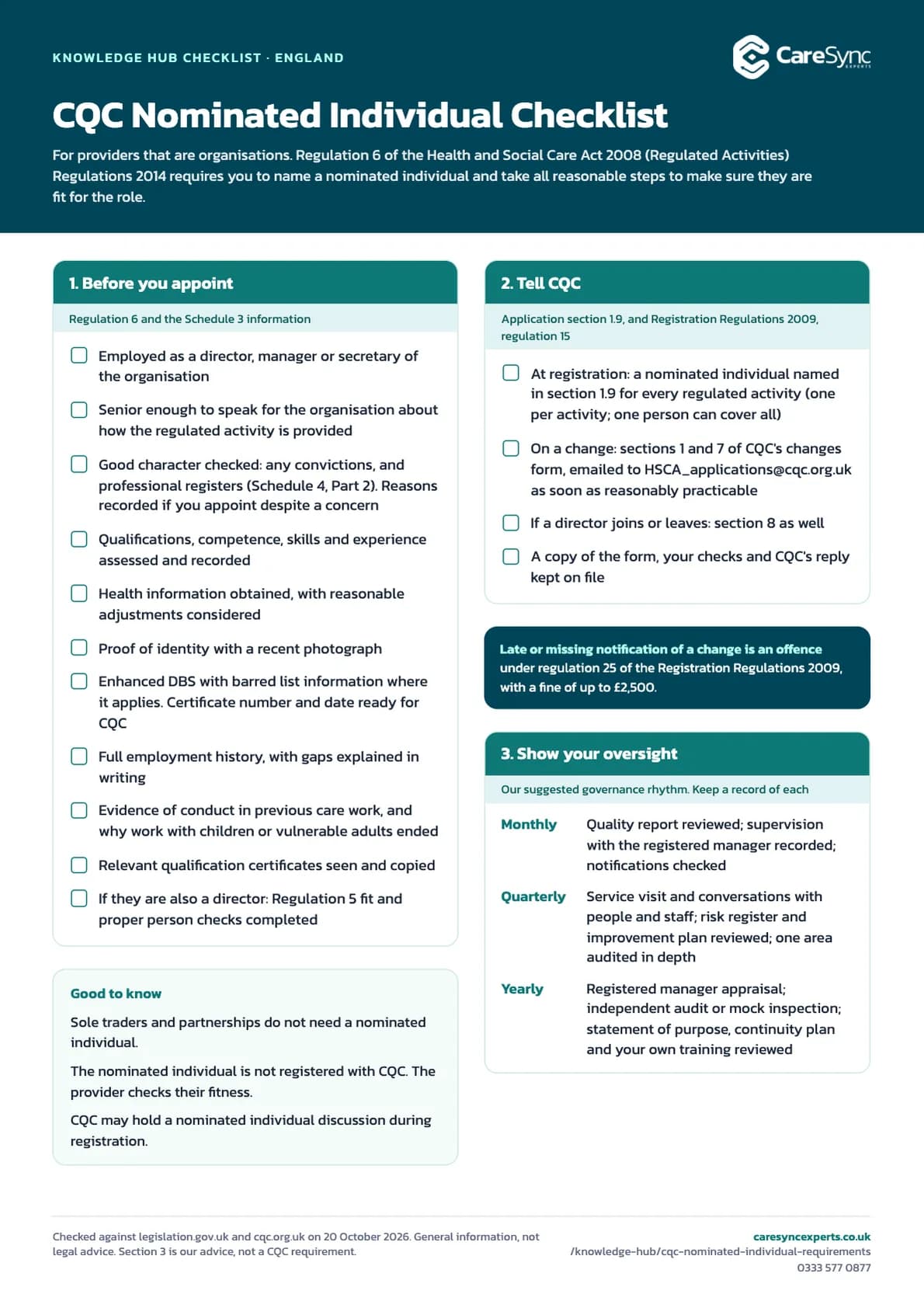
Free download, no sign up
Nominated Individual Checklist (PDF)
One A4 page with the checks to complete before you appoint, how to notify CQC of a change, and the monthly, quarterly and yearly governance rhythm. Use it when you appoint a nominated individual or prepare for registration.
- A4, prints in colour or black and white
- Built from Regulation 6 and CQC guidance, checked 20 October 2026
- Free to print and share in your organisation
Myth or fact
Six Myths About the Nominated Individual
Myth
- The nominated individual is registered with CQC.
Fact
Only the provider and the registered manager are registered persons. The provider names the nominated individual and checks their fitness.
Myth
- A nominated individual cannot be prosecuted.
Fact
Not for the role itself. But where the provider is a company or other body corporate, as a director, manager or secretary they can share its guilt for an offence committed with their consent, connivance or neglect.
Myth
- CQC never speaks to the nominated individual.
Fact
CQC's registration assessment can include a nominated individual discussion, and the nominated individual is CQC's main point of contact afterwards.
Myth
- Small providers do not need one.
Fact
Size does not matter. Any provider that is an organisation needs one. Only sole traders and ordinary partnerships do not.
Myth
- You can hire an outside consultant as your nominated individual.
Fact
The law says they must be employed as a director, manager or secretary of your organisation. That can be under a contract for services, but they must genuinely hold the post. An adviser outside your structure cannot be named.
Myth
- You can tell CQC about a new nominated individual at your next inspection.
Fact
You must notify CQC as soon as reasonably practicable. Late notification is an offence.
Watch
Registered Manager vs Nominated Individual in Under Seven Minutes
- The registered manager: day to day operations
- The nominated individual: oversight and governance
- Example questions CQC asks each role
How Care Sync Experts Can Help
We help you choose and check the right nominated individual, set up the governance that shows their oversight is real, and prepare them for the CQC conversation. 98% of the applications we support are approved first time, across more than 1,200 providers in 10 years.
- CQC Interview Preparation
- CQC Mock Inspections
- Compliance Management
- Domiciliary Care Policies
- CQC Registration Package: fixed £4,000 + VAT
Sources
Every legal rule, CQC requirement, official figure and date in this guide comes from these pages, checked on 20 October 2026. Where we give our own advice, such as the governance rhythm, the practice questions and the dual role safeguards, we say so. This guide is general information, not legal advice.
Law
- Regulated Activities Regulations 2014, regulation 6: nominated individual
- Regulation 2: interpretation, including “registered person”
- Regulation 4: requirements where the provider is an individual or partnership
- Regulation 5: fit and proper persons, directors
- Regulation 7: registered managers
- Regulation 22: offences
- Schedule 3: information required
- Schedule 4: good character and unfit person tests
- Registration Regulations 2009, regulation 14: absence of registered persons
- Registration Regulations 2009, regulation 15: notice of changes
- Registration Regulations 2009, regulation 25: offences
- Health and Social Care Act 2008, section 90: prosecutions
- Health and Social Care Act 2008, section 91: offences by bodies corporate
- Health and Social Care Act 2008, section 97: interpretation of Part 1
CQC
- CQC: Regulation 6, nominated individuals (updated 16 May 2025)
- CQC: Regulation 5, fit and proper persons: directors
- CQC: Regulation 15, notice of changes
- CQC: What is registration? (updated 1 July 2025)
- CQC: Applying as a new provider, guidance (updated 25 March 2026)
- CQC: Register as a provider (updated 25 August 2026)
- CQC: DBS checks for CQC registration (updated 19 December 2025)
- CQC: Changes to nominated individuals, officers and directors, notification form
Government, Skills for Care and other regulators
- DHSC: “Nominated individual” role category, care workforce pathway (16 July 2026)
- Skills for Care: Nominated individual handbook, a practical guide (reviewed September 2024)
- Skills for Care: The state of the adult social care sector and workforce in England 2025
- Ofsted: Daycare roles that must register with Ofsted
- Supported Accommodation (England) Regulations 2023, regulation 2
- Children’s Homes (England) Regulations 2015, regulation 2
- Regulation and Inspection of Social Care (Wales) Act 2016, section 21
Spotted something out of date? Tell us.
Frequently Asked Questions



Still Have Questions?
Can't find the answer you need? Talk to our registration team on 0333 577 0877.
Related reading
Keep exploring with Care Sync Experts.
These guides, services and client stories go hand in hand with this page, so you have everything you need to build and grow a successful care service.

CQC Registered Manager Requirements
Full requirements for becoming a CQC registered manager.

CQC Statutory Notifications
All 21 CQC notifications: what to report, the deadline, how to submit, and a do I need to notify table.

CQC Interview Preparation
Three hours of one to one coaching for registered managers and nominated individuals.