Agency Bid
Cumberland Care Framework: 8 Essential Agency Bid Priorities
A practical guide to the Cumberland Care agency support framework: roles, deadlines, evaluation, operational expectations and evidence priorities.
- Updated
- Reading time
- 9 min read

The Cumberland Care Framework is a procurement opportunity for staffing organisations that can supply Support Workers, Senior Support Workers and Registered Nurses to Cumberland Council’s adult social care services. It is not simply a directory of approved local carers or a general care-planning system.
Through the framework, Cumberland Council aims to secure reliable agency cover for residential care, domiciliary care, reablement, supported living, day services, extra care housing and Shared Lives.
Care agencies must therefore prove that they can recruit safely, match workers to different care environments, respond to urgent shifts and maintain consistent service quality at sustainable rates.
Cumberland Care Framework at a Glance

The Cumberland Care Framework gives care agencies one opportunity to join a closed staffing agreement worth an estimated £4.75 million excluding VAT. The framework will run from 1 November 2026 to 30 April 2029, with no extension option currently stated.
| Framework detail | Requirement |
| Buyer | Cumberland Council |
| Staffing roles | Support Workers, Senior Support Workers and Registered Nurses |
| Clarification deadline | 10:00am on 5 August 2026 |
| Tender deadline | 10:00am on 12 August 2026 |
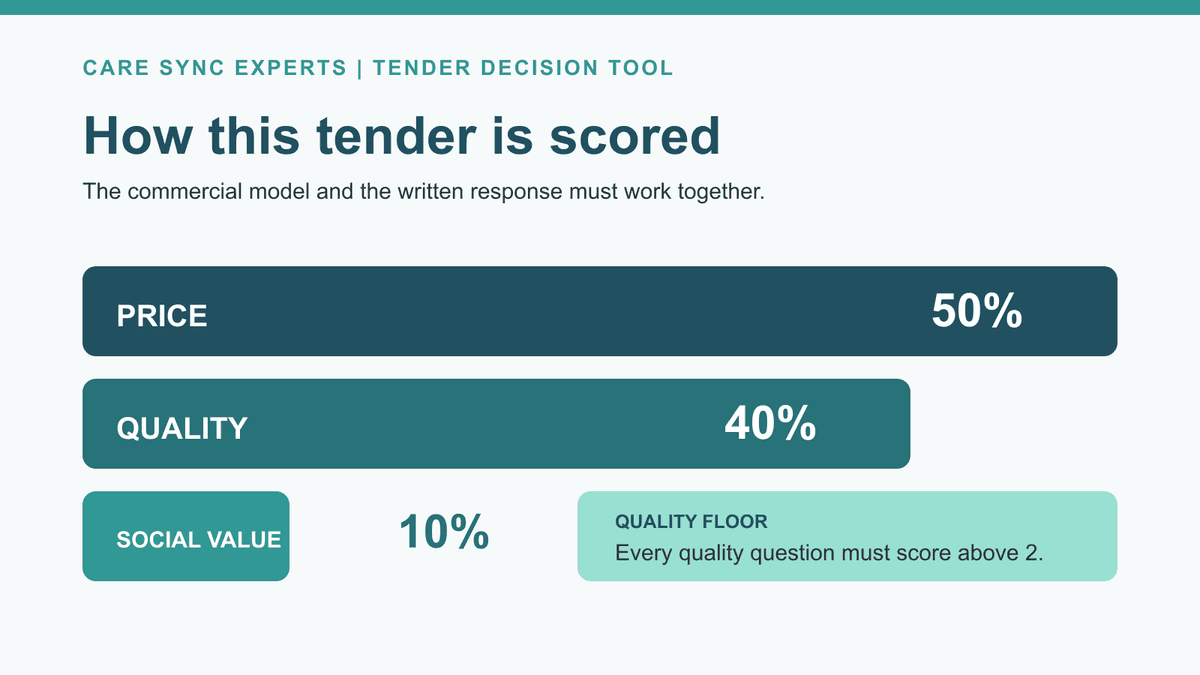
| Evaluation | 50% price, 40% quality and 10% social value |
| Submission portal | The Chest |
| Framework type | Closed framework with no later admission route |
A care agency may bid for one, two or all three staffing roles. However, it must submit every required weekday, weekend and bank holiday rate for each role it selects. Missing one required rate could remove the agency from consideration for that role.
RELATED: Setting Up Supported Living Business UK in 2026
What Services Will Agency Staff Support?
Agency workers appointed through the framework may support adults across several Cumberland Care settings, including residential homes, reablement and domiciliary care, supported living, day services, extra care housing and Shared Lives.
These services support adults aged 18 and over with physical disabilities, learning disabilities, mental health needs and age-related conditions such as dementia. Each setting brings different risks, routines and levels of responsibility, so agencies cannot treat every placement in the same way.
A worker who suits a domiciliary care shift may not automatically have the experience needed for a residential home, supported living service or nursing assignment. Care agencies must match each worker’s training, competence, experience and availability to the specific role and environment before confirming cover.
The framework also expects agencies to provide planned and urgent staffing across different shift patterns, including weekends and bank holidays.
Which Care Agencies Should Consider Bidding?
The Cumberland Care Framework suits established care agencies that can demonstrate safe recruitment, dependable workforce management and the ability to supply qualified staff across the Cumberland Council area. While the opportunity is open to organisations of different sizes, every bidder must prove that it can deliver the contract requirements from day one rather than relying on future recruitment.
Before deciding to bid, assess whether your organisation can confidently evidence:
- Safe recruitment, including identity, right-to-work, DBS and reference checks.
- A workforce of Support Workers, Senior Support Workers and Registered Nurses with the appropriate skills and training.
- Sufficient staffing capacity to cover planned, urgent and out-of-hours requests.
- Strong safeguarding, supervision and incident management procedures.
- Reliable workforce continuity that reduces unnecessary changes of staff.
- Accurate timesheets, invoicing and performance reporting.
- Business continuity plans for sickness, high demand and travel disruption.
- Financial stability to deliver the contract at the rates you submit.
Winning a care agency tender requires more than recruiting staff. Evaluators want evidence that your systems, governance and workforce can consistently deliver safe, person-centred care across every service covered by the framework.
Agencies that overstate their capacity or depend heavily on workers who have not completed pre-employment checks risk weakening both their quality score and overall credibility.
READ MORE: How to Get Contracts for Domiciliary Care UK: Complete 2026 Guide
How Cumberland Council Will Evaluate Bids
Cumberland Council will score bids across three areas: price at 50%, quality at 40% and social value at 10%. That weighting gives price the largest share, but care agencies should not treat the exercise as a race to submit the lowest rates.
Your pricing must cover the real cost of safe delivery, including recruitment, vetting, training, holiday pay, pension contributions, supervision, travel, sickness cover, out-of-hours coordination and agency overheads. A rate that looks competitive but cannot fund these responsibilities may weaken both delivery and evaluator confidence.
Quality also carries a minimum standard. Each quality response must score above the stated threshold, which means one weak answer can put the whole submission at risk. Agencies should review every response separately and make sure it explains the method, accountable person, evidence, performance measure and corrective action.
The strongest care tender evaluation strategy links the operating model and the pricing model together. Every promise in the written bid should be realistic, measurable and fully funded.
8 Essential Agency Bid Priorities
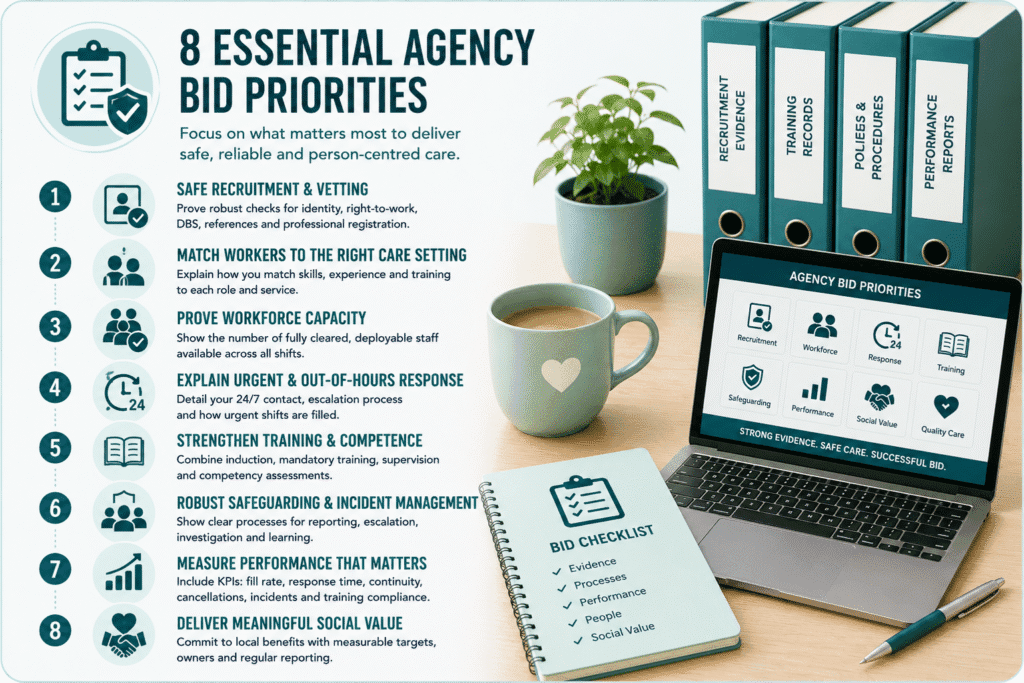
A successful Cumberland Care Framework bid depends on more than meeting the eligibility requirements. Evaluators want evidence that your agency can deliver safe, reliable and person-centred staffing across every service covered by the framework. Focus your response on these eight priorities.
1. Demonstrate Safe Recruitment and Vetting
Show how your recruitment process protects the people who receive care. Explain each stage, from identity and right-to-work checks to employment history, references, DBS clearance and professional registration where required. Make it clear who reviews the evidence, who approves deployment and how your agency manages incomplete or adverse checks.
2. Match Workers to the Right Care Setting
Avoid presenting your workforce as one interchangeable pool of staff. Explain how you match each worker’s experience, training and competence to the requested role and service. A Support Worker assigned to domiciliary care may not have the skills needed for supported living, while a Registered Nurse must meet additional professional and clinical requirements.
3. Prove Workforce Capacity
Evaluators need confidence that your agency can fill shifts without relying on future recruitment. Present realistic workforce figures and distinguish fully compliant, deployable staff from applicants who are still completing pre-employment checks. This approach demonstrates honest capacity planning and reduces concerns about mobilisation.
4. Explain Your Urgent and Out-of-Hours Response
The framework requires agencies to support planned and emergency staffing needs. Describe how your 24-hour contact arrangements work, how requests are logged, how staff are contacted, who manages escalations and what happens if the first available worker cannot accept the shift. Specific processes carry more weight than broad promises.
5. Strengthen Training and Competency Assurance
Training records alone do not prove competence. Show how your agency combines induction, mandatory training, observed practice, supervision, refresher training and competency assessments before workers support vulnerable adults. Where Registered Nurses form part of your bid, explain how you monitor professional registration and ongoing clinical competence.
6. Show Robust Safeguarding and Incident Management
Explain how safeguarding concerns move from identification to immediate action, reporting, investigation and organisational learning. Define responsibilities clearly and show how your agency communicates with Cumberland Council services throughout the process. A structured governance approach demonstrates accountability and protects both service users and staff.
7. Measure Performance That Matters
Support your quality claims with measurable performance indicators. Include metrics such as fill rates, response times, punctuality, worker continuity, cancellations, complaints, incidents and training compliance. Explain who reviews the data, how often reports are produced and what corrective action follows when performance falls below expectations.
8. Deliver Meaningful Social Value
Treat social value as more than a scoring exercise. Commit to activities that genuinely benefit Cumberland, such as creating local employment opportunities, investing in workforce development or supporting community initiatives. Every commitment should include a measurable target, an accountable owner and a practical method for reporting progress throughout the contract.
SEE ALSO: Registered Manager CQC Interview Questions and Answers: 2026 Guide
How to Make the Final Bid Decision
Before committing resources to the Cumberland Care Framework, agency leaders should test the opportunity against current evidence rather than ambition alone.
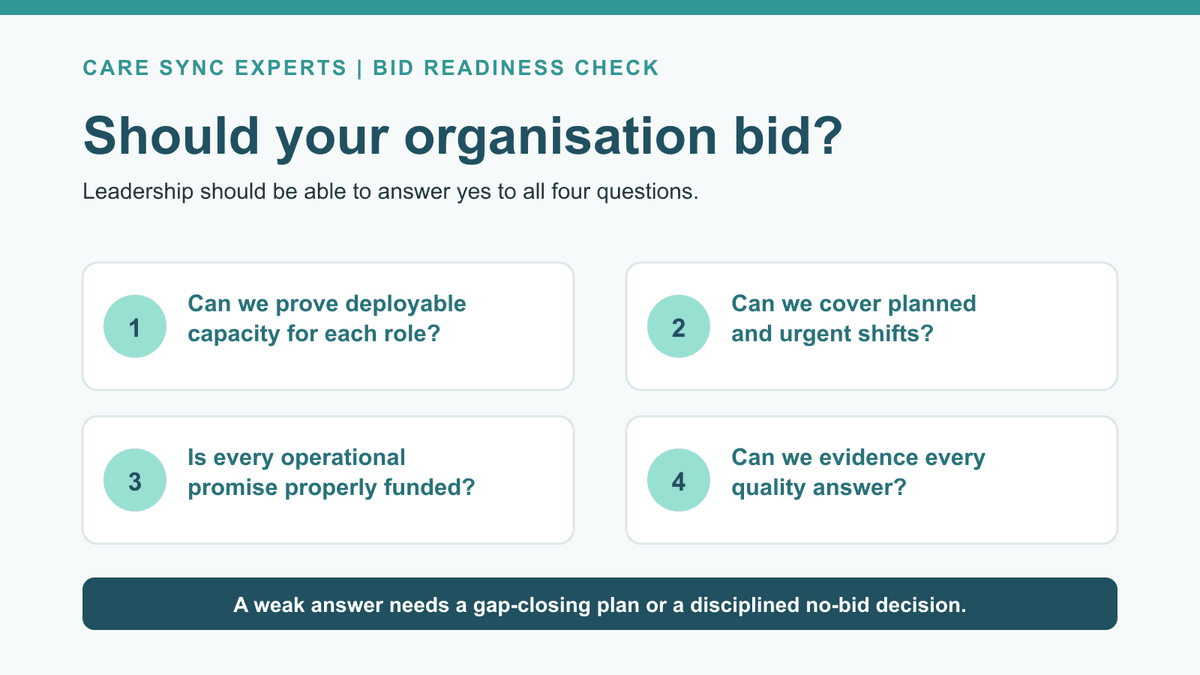
Ask four questions:
- Which roles are we bidding for, and how many fully cleared workers can we supply now?
- Can we cover planned, urgent, weekend and bank holiday shifts across Cumberland?
- Can our proposed rates fund recruitment, training, supervision, travel and out-of-hours management?
- Can we support every quality and social value promise with a clear process, owner and record?
A bid may not be commercially sensible if your agency must rely on uncleared workers, unconfirmed availability or rates that fall below the true cost of safe delivery. Because this is a closed framework, missing the opportunity matters, but submitting an unsupported bid can damage credibility and consume valuable time.
Use a formal bid or no-bid review before drafting the full response. Confirm eligibility, workforce capacity, geographic coverage, evidence quality, mobilisation requirements and financial resilience.
Common Mistakes That Can Weaken a Care Agency Bid
Even a capable agency can lose marks through avoidable errors. Before submitting, check that your team has not:
- missed a required weekday, weekend or bank holiday rate;
- counted applicants or uncleared workers as immediately deployable staff;
- used generic policy language instead of explaining how processes work;
- failed to show how the 24-hour contact route will handle urgent requests;
- treated training attendance as proof of competence;
- offered social value commitments without targets, owners or evidence;
- submitted rates that cannot support safe delivery;
- allowed one quality response to fall below the minimum threshold;
- left portal uploads and final checks until the deadline.
The strongest bids make every promise traceable. An evaluator should be able to see who owns each process, what evidence supports it, and what action the agency will take if delivery falls below the required standard.
Prepare the Evidence Before You Write the Bid
A strong Cumberland Care Framework submission starts with evidence, not persuasive wording. Confirm the latest procurement documents on The Chest, record every requirement in a compliance matrix and assign each response to a responsible owner.
Before submission, your team should:
- verify workforce capacity for every selected role;
- confirm all weekday, weekend and bank holiday rates;
- test whether pricing supports safe delivery;
- align recruitment, training, safeguarding and escalation processes;
- review every quality answer against the minimum score;
- check that social value commitments are realistic and measurable;
- complete an independent commercial and compliance review;
- upload the final response early and retain the submission receipt.
Care Sync Experts can support care agencies with bid planning, evidence development, quality responses, social value commitments and commercial alignment. The official notice, live procurement pack, buyer clarifications and portal instructions must always guide the final submission.
FAQ
What is a framework in simple terms?
A framework is an arrangement that sets the rules, standards and commercial terms under which an organisation can buy goods or services from approved suppliers.
In this case, the Cumberland Care Framework allows Cumberland Council to appoint eligible staffing providers that can supply care workers and nurses when its services need planned or urgent agency cover.
What are frameworks in healthcare?
Healthcare and social care frameworks help public bodies buy services, staffing or equipment from suppliers that have passed a formal procurement process. They usually define service standards, pricing requirements, contract terms and performance expectations.
A place on a framework does not always guarantee work, but it allows an approved provider to receive assignments or compete for call-off opportunities under the agreed rules.
Does an agency need CQC registration to bid for the Cumberland Care Framework?
CQC registration will depend on the activities the agency carries out and the exact conditions stated in the procurement documents.
A staffing agency that only supplies workers may have different registration obligations from a provider that directly manages and delivers a regulated activity.
Bidders should check their service model, the CQC regulated-activity rules and every participation requirement in the live Cumberland procurement pack before submitting.
What evidence should a care agency prepare before submitting a bid?
A care agency should prepare evidence of safe recruitment, DBS and right-to-work checks, worker competence, training compliance, safeguarding procedures, urgent-cover arrangements and current workforce capacity.
It should also gather performance data, business-continuity plans, financial assumptions, social value commitments and sample management information.
Every important claim in the bid should connect to a named owner, a working process and an auditable record.
Topics
Agency Bid · Care Tenders · Cumberland Care · Tender Writing
Written by
Collins Bonsi
Manager, Care Sync Experts
Care Sync Experts helps care providers with CQC, Ofsted, CIW and RQIA registration, compliance and tenders. Our team has more than 10 years' experience and has supported over 1,200 providers.
Published 20 Jul, 2026 · Last updated 27 Sept, 2026
Want this handled for you?
Our team has supported over 1,200 care providers with registration, compliance and tenders, with a 94% first-time approval rate.