Inspection and compliance7:59
Language Barriers in Care: The Double-Up Visit Problem (2026)
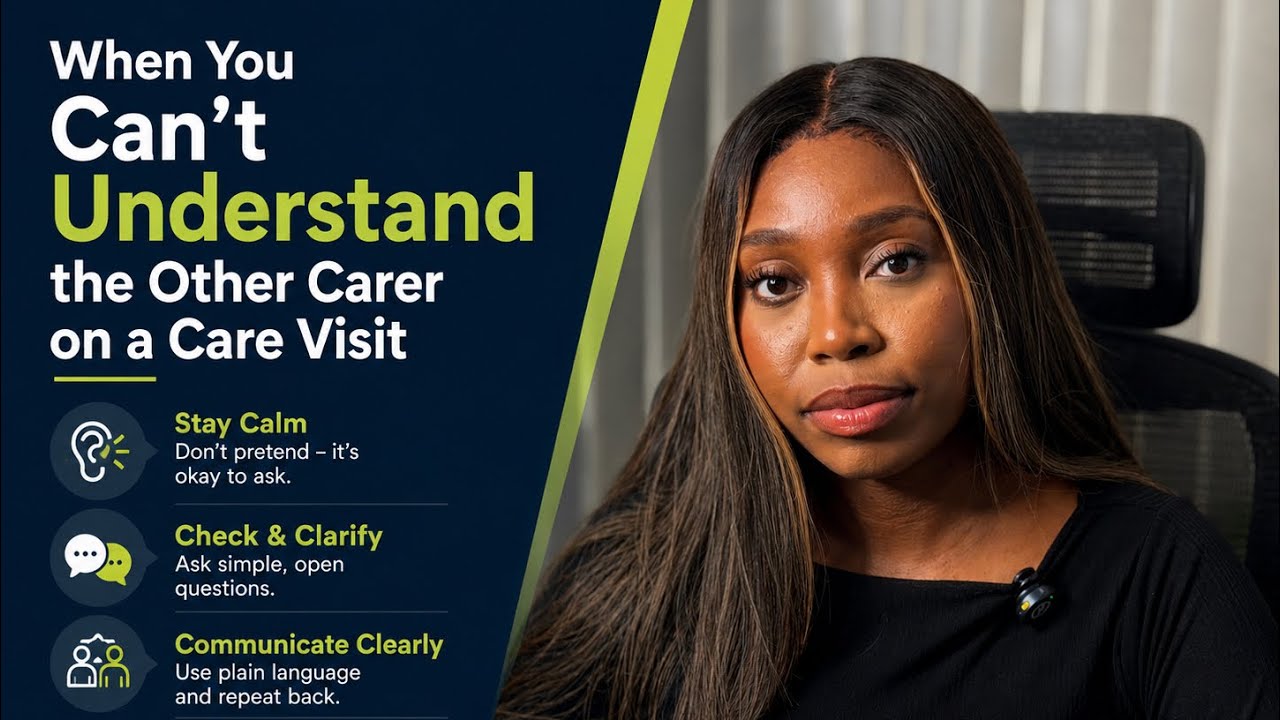
On a double-up visit, the other carer and the client speak a language you do not understand. Why that is a problem, and what to do about it.
Transcript
1,726 words, about 8 minutes to read. Press a time to play from that moment.
Hi, and welcome back to our page. So, imagine this. You're on a double-up visit, you and another carer are there to support a client together, but the client and the other carer are having a full conversation in a language you don't understand, and you're just standing there. You've got no idea what's being said.
You don't know if they're talking about the care plan, about medication, about the client, or if they're just talking about the weather. How would that make you feel? This is something that comes up all the time in domiciliary care, and I mean all the time.
It's one of those issues that people are nervous to talk about because it touches on language, culture, equality, and nobody wants to say the wrong thing. But, it's a real issue, and it affects real teams, real carers, and real clients. So, today we're going to talk about this properly.
It's also very important to note that it's becoming very common in the perspective of two carers who may go in, and they speak the same language that differs from the client. But, that's a red flag we'll talk about in another video. So, let me be clear from the start. This isn't about going against any language or any culture.
If a client's preferred language is Hindi, Urdu, Polish, Romanian, Yoruba, whatever it is, that's their right. Actually, being able to speak to a client in their own language is a massive benefit. It can help them feel comfortable, it builds trust, and it supports person-centred care. And that's a good thing. But, here's where it gets complicated.
When you've got two carers on a double-up visit, and one of them can't understand what's being discussed, and it creates a problem. And it's not a small problem. Think about it from a care perspective. You're delivering care alongside someone, and you don't know what's just been communicated about the client. How are you meant to do your job properly?
What if the client just said they're in pain? What if the family member just gave an update about medication change? What if there's a safeguarding concern raised, and you missed it because you couldn't follow the conversation? That's not just a staff morale issue, it's a care quality issue, and it's where the angle here matters. So, let's start with the client, because the client always comes first.
Under CQC's expectations around person-centred care, the care you deliver has to be based on the individual's assessed needs and preferences, and that includes communication preferences. If a client's preferred language isn't English, that should be recorded in their care plan. And as far as reasonably possible, you should try and meet that preference. Skills for Care have published guidance on culturally appropriate care, and it says the same thing.
Respect the person's language, respect their background, don't make assumptions, ask the person how they want to communicate, and then do your best to accommodate that. Honestly, if you've got carers who speak the same language as the client, that's actually a huge advantage for your service. Some families specifically choose a care provider because they know the staff can communicate with their loved one in their own language.
Especially with privately funded clients, this can be one of your biggest reasons they choose you in the first place. We're not saying that speaking another language is the problem. It's not, it's an asset. The issue is what happens when the communication excludes other members of the care team. Now, let us talk about the staff who don't speak the language, because their experience matters, too.
If you're a carer and you're regularly going into a double-up visit where the other carer and the client have an entire conversation you can't follow, that's going to wear you down. You start feeling excluded, you start feeling like you can't do your job properly. You might even start wondering whether things are being said about you, and over time, people leave.
They just go. They don't always make a formal complaint, they just quietly move on to another company where they feel included. And that's a problem for the business, because staff retention is already one of the biggest challenges in domiciliary care. You can't afford to lose good carers over something that could have been managed better. There's also a legal angle here.
Under the Equality Act of 2010, language itself isn't a protected characteristic, but it's closely linked to race and nationality, which are protected. So, if non-English speaking staff feel they're being treated differently because of their language, or if English-speaking staff feel they're being excluded because of theirs, either way, there's a potential for a discrimination claim, and it can cut both ways.
Before anyone thinks, "Right, we'll just bring in an English-only policy." Hold on, that's not the answer, either. Employment tribunals have found that blanket rules telling people they can only speak English at work can amount to indirect discrimination. You have to be careful with that. You can't just ban people from speaking their native language, that's not the solution, either.
However, when it relates to two staff members in a service user's home speaking a completely different language to that of which the service user can understand, that's a big no-no. Okay. So, if you can't ban other languages and you can't ignore the problem, what do you actually do? Here's what works in practice. Number one, record the client's preferred language in their care plan.
This is basic, but so many companies miss it. If the client's preferred language is documented, it's not a mystery. Everyone knows and it gives you the framework on how to manage the visits. Number two, where possible, pair carers who speak the client's language together on double-up visits. If the client speaks Gujarati and you have two carers who speak Gujarati, too, send them together.
That way, nobody's left out of the conversation. Simple rostering can solve a lot of these issues before they even start. Number three, when pairing is impossible and one carer speaks the language and the other doesn't, set clear expectations that key information gets translated. If the client says something about their care, the bilingual carer should summarise it in English for the other carer.
This isn't about policing conversations, it's about making sure both carers have the information they need to deliver safe care. Number four, frame this as a communication and care quality issue, not a language or culture issue. When you raise it with management, when you put it in your policies and when you discuss it with the team, keep the focus on safe coordinated care delivery.
This is what CQC cares about. This is what matters. The moment you make it about language or culture, people get defensive. Keep it about care quality always. Number five, invest in cultural awareness training for the whole team. And I don't mean a tick-box e-learning module, I mean proper training that helps everyone understand different cultures, different communication styles and how to work together respectfully.
Skills for Care has resources on this. Make sure to use them. Number six, consider using translation apps during visits where language is a barrier. There's some decent ones out there. If a client says something that the other carer needs to understand, a quick translation on a phone can bridge that gap in the moment. It's not perfect, but it definitely helps.
One thing I want to say directly, if you're a manager or a registered manager and staff have raised it with you, you can't just ignore it. I know it feels awkward, I know it feels like a minefield, but ignoring it doesn't make it go away. It actually makes it worse.
Under CQC's expectations around dignity and respect, providers must have due regard to the protected characteristics of the Equality Act. That means you have a responsibility to create a workplace where everyone feels included and respected, regardless of their background. And under the well-led quality statements around workforce equality, diversity and inclusion, CQC expects leaders to take action to build an inclusive culture where all staff feel heard.
If staff are telling you they feel excluded and you do nothing, that's a serious management failure. That's a compliance risk, and if it leads to a grievance or a tribunal, you're going to wish you dealt with it earlier. The fact that clients are privately funded doesn't change your responsibilities, either.
CQC regulations apply regardless of how the care is funded, whether it's private, local authority funded, NHS, funding makes no difference. The standards are the same. So, to sum this up, a client's right to communicate in their preferred language is important and should be protected. But the rest of the care team also needs to understand what's being discussed, so they can deliver safe, coordinated care.
It's not one or the other, it's both. And the way you balance it is good through good communication, smart rostering, clear expectations, and proper training, not by banning languages, not by ignoring the problem, just by simply managing it. If you're dealing with this right now in your service, you're not alone.
This comes up in almost every care company that has a diverse workforce, and that's a good thing. Having a diverse team, you just need the right systems in place to make everything work.
If you're setting up a new care company and you want to get things like this right from the start, or if you're going through CQC registration and you want to make sure your policies, your care plans, and your governance are all where they need to be, that's exactly what we help with here at Care Sync.
We've helped over 50 providers register with a 98% first-time success rate, and we cover everything from business plans, statement of purposes, right through to your policies, and your interview preparation. We'll leave a link in the description where you can book a consultation with our team. No pressure, no hard sell, just a chat about where you are and how we can help.
If you found this video helpful, make sure to like, comment, and share. And if you haven't already, subscribe. And we'll catch you on the next one.
Transcribed from the video's captions and lightly edited. Where the wording differs, the video is the record.
Want help with this?
Tell us where you are now and we will tell you honestly what it will take, and what we would do first.
More on inspection and compliance
All inspection and compliance videos 10 minutes 27 secondsYour Carer Was Accused of Abuse at ANOTHER Job. What You Must DoInspection and compliance
 6 minutes 58 secondsYour OT's Plan Isn't Enough: Here's What CQC Actually WantsInspection and compliance
 7 minutes 40 secondsCQC Will Find This If Your System Fails: Records Reality CheckInspection and compliance
 10 minutes 15 secondsThe 2026 CQC Warning: Why Your Evidence Is WrongInspection and compliance
 16 minutes 34 secondsCQC Is Calling Your Clients Right Now: What They're AskingInspection and compliance
 13 minutes 45 secondsCQC Asks Twice: Here's What They Want Each TimeInspection and compliance