CQC Regulation 9A After the 2026 Review:
A Practical Visiting Policy Guide for Care Home Providers

Text to speech
Duration: 00:00
Font size
Published: 19 Aug, 2026
Share this on:
CQC Regulation 9A requires relevant care home, hospital and hospice providers in England to facilitate visits unless exceptional circumstances make this unsafe. For care home providers, a visiting policy should begin with the resident’s wishes, avoid blanket restrictions, use individual risk assessment and record how any restriction will be reviewed and removed.
The Department of Health and Social Care reviewed CQC Regulation 9A in 2026 and confirmed that the standard remains in force. Its review found that the regulation had clarified expectations, but that awareness, decision making, communication and monitoring were still inconsistent. This guide turns the current Care Quality Commission guidance on Regulation 9A and the 2026 government review into a practical policy and evidence check for care home leaders.
Key takeaways
- CQC Regulation 9A applies to relevant regulated activities in care homes, hospitals and hospices in England.
- Residents should be supported to receive visits and should not be discouraged from visits out, unless exceptional circumstances apply.
- Restrictions should be individual, necessary, proportionate, documented and time-limited.
- The resident, and where appropriate family, friends or advocates, should be involved in decisions.
- Policies should explain consent, mental capacity, complaints, communication and review arrangements.
What does CQC Regulation 9A require?
CQC Regulation 9A creates a fundamental standard for visiting and accompanying in relevant care homes, hospitals and hospices. Unless exceptional circumstances apply, providers must facilitate visits, must not discourage care home residents from taking visits out and must enable people attending certain hospital or hospice appointments to be accompanied.
For a care home, the practical starting point is open, person-centred visiting. CQC guidance says providers should support people to receive visits from those they want to see, when they want to see them, unless exceptional circumstances prevent this. Individual risk assessment matters because the person’s needs, preferences, environment and the nature of the risk may differ.
CQC Regulation 9A does not require a person to receive a visit against their wishes. Where the person lacks capacity for the relevant decision, the provider must work within the Mental Capacity Act 2005 and the best interests framework. The person’s wishes remain central, and a visitor’s preference does not override a capacitous resident’s decision.
Which services are within the scope of CQC Regulation 9A?
CQC Regulation 9A applies to a registered person carrying on a relevant regulated activity in a care home, hospital or hospice. It does not apply to every adult social care setting. The government review states that supported living and extra care housing are outside its scope because the accommodation and visiting arrangements in those settings are not regulated by CQC in the same way.
| Setting or situation | CQC Regulation 9A position | Provider action |
|---|---|---|
| CQC-regulated care home carrying on a relevant regulated activity | Within scope | Audit visiting, visits out and restriction decisions against CQC Regulation 9A |
| Hospital or hospice within the defined scope | Within scope | Check visiting and accompaniment arrangements |
| Supported living or extra care housing | Outside CQC Regulation 9A scope | Respect the person’s home, tenancy and existing legal rights, and do not present CQC Regulation 9A as the governing rule |
| Person does not consent to a visit | No duty to force a visit | Record and respect the person’s decision |
This scope check prevents a common governance mistake: applying a care home policy to a person’s own home in supported living. Care Sync’s broader guide to the CQC fundamental standards can help leaders place CQC Regulation 9A alongside other provider duties without blurring service types.
A practical CQC Regulation 9A visiting policy audit
A strong CQC Regulation 9A visiting policy should explain how the service enables contact in ordinary circumstances and how it makes fair decisions when risk changes. It should not begin with a list of bans. The policy needs enough detail to guide staff, but the actual decision must still respond to the individual resident and the evidence available at that time.
| Policy control | What to check | Evidence to retain |
|---|---|---|
| Resident preferences | How visiting wishes, important relationships and visits out are discussed | Care plan or preference record, reviewed with the person |
| Open visiting arrangements | Whether ordinary access is easy to understand and arrange | Public information, welcome material and staff briefing |
| Individual risk assessment | Whether the specific person, visitor, setting and risk are considered | Dated assessment, precautions and decision rationale |
| Consent and capacity | How the person’s decision and lawful authority are established | Consent record or decision-specific capacity and best interests record where required |
| Alternatives | What safer options are offered if the preferred arrangement cannot proceed | Options discussed and the person’s response |
| Review and removal | Who reviews a restriction, when and against what evidence | Named owner, review date and closure decision |
| Complaints and challenge | How residents and visitors can raise concerns without fear | Accessible route, response record and governance learning |
How should CQC Regulation 9A exceptional circumstances be recorded?
CQC describes exceptional circumstances as a situation where, despite precautions, the visit or accompaniment would still pose a serious risk to the health, safety or welfare of the person or others on the premises. This is a high threshold. A general concern, staff preference or operational inconvenience is not enough on its own.
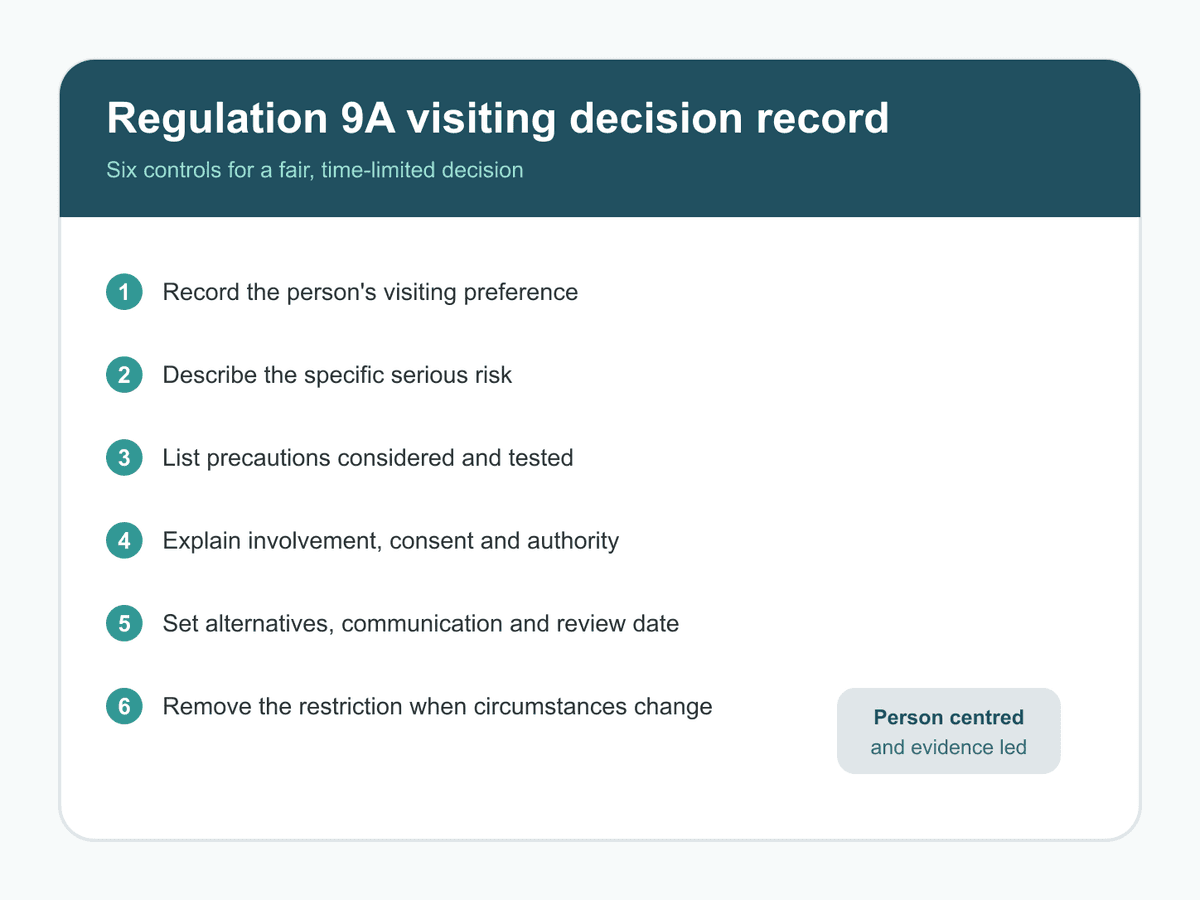
Use a decision record that answers six questions: What does the person want? What is the specific serious risk? Which precautions were considered or tried? Who was involved and who had authority to decide? What alternatives and communication were offered? When will the restriction be reviewed and removed?
The record should separate facts, professional judgement and the person’s account. It should also show why a less restrictive option would not manage the risk. If circumstances change, the restriction should change too. CQC guidance says providers should remove the restriction and allow visiting again as soon as the exceptional circumstances no longer apply.
CQC Regulation 9A communication, staff practice and complaints
A policy does not work if only senior managers know it. Staff who answer the telephone, welcome visitors, plan care, lead shifts and respond to concerns need a shared understanding of the ordinary visiting position, the exceptional circumstances threshold and the escalation route.
- Explain the normal position. Tell residents and visitors how the service supports contact and visits out.
- Communicate any restriction personally. Give the reason, precautions considered, alternatives, review date and named contact.
- Provide an accessible challenge route. Explain the complaints process and how advocacy support can be used.
- Brief staff consistently. Avoid different explanations from different shifts.
- Review themes. Use complaints, compliments, incidents and visiting records to identify policy or training gaps.
The 2026 government review reported concerns about unclear decision making, variable communication and obstacles to raising complaints. Providers should therefore test whether their process feels usable from the resident’s and visitor’s perspective, not only whether a policy document exists.
What changed after the 2026 review of CQC Regulation 9A?
The review did not remove or replace CQC Regulation 9A. It found that the standard had reinforced the importance of visiting and prompted providers to review practice, but that implementation remained uneven. The government said it would develop clearer communications, awareness resources and a public-facing decision process, improve the clarity of Capacity Tracker visiting questions and continue to monitor the position.
Care home providers should treat this as a prompt to improve evidence and consistency now. Do not wait for a future resource before correcting a blanket restriction, an unclear complaints route or a decision record with no review date. At the same time, do not describe proposed future legislation as if it is already in force. The government’s March 2026 announcement on stronger visiting rights says further legislative changes are being explored.
The Capacity Tracker questions are useful monitoring information, but they are not a complete CQC Regulation 9A compliance test. A yes or no return cannot replace individual care planning, risk assessment, consent, communication, complaints handling and documented review.
A first 30 days action plan for care home providers
Days 1 to 7: check scope and policy wording
Confirm which locations and regulated activities are within CQC Regulation 9A scope. Review the policy for blanket rules, vague exceptional circumstances wording and incorrect references to supported living. Check that visits into the home and visits out are both covered.
Days 8 to 14: sample recent decisions
Take a small, representative sample of visiting restrictions or altered arrangements. Check the person’s wishes, the risk described, precautions considered, involvement, alternatives, communication and review. Record gaps without assuming why they occurred.
Days 15 to 21: brief staff and test communication
Use anonymised scenarios to test staff understanding. Ask how they would respond to a resident who wants a visit, a relative challenging a restriction or an infection-control concern. Check that staff know who can authorise a restriction and how to escalate uncertainty.
Days 22 to 30: close actions and set governance
Assign owners and deadlines for policy, training or record changes. Add CQC Regulation 9A to the appropriate governance review. Track restrictions that remain open and require evidence at the next review rather than carrying them forward automatically.
What evidence should managers sample during a visiting policy audit?
A policy review should test real practice as well as the wording on the page. Select a small range of recent visiting decisions, including ordinary visits, visits that needed adjustments and any arrangement that was restricted. The aim is to see whether the service moved from the resident’s wishes to an evidence-based decision, communicated it clearly and reviewed it at the right time. Do not assume that an incomplete record proves poor intent, but treat the missing evidence as a governance gap that needs an owner and a deadline.
Sample the full decision journey
For each sampled record, check whether the file tells a coherent story. A reviewer who was not involved should be able to understand what the person wanted, what risk was identified, which precautions were considered, who took part in the decision and what happened next. Look across care records, risk assessments, daily notes, communication logs, complaints records and governance minutes where these are relevant. One document does not need to hold every detail, but the evidence should connect without contradiction.
- Resident’s wishes: record the person’s preference, including the timing, frequency and people important to them.
- Decision authority: identify who made the decision and the basis on which they were authorised to do so.
- Specific risk: describe the actual health, safety or welfare concern rather than relying on a general label.
- Precautions considered: show which less restrictive options were discussed, tried or ruled out, with reasons.
- Communication: record what was explained, to whom, in what format and how questions or disagreement were handled.
- Review and closure: give the next review date, the evidence needed and the point at which the restriction ended.
Test whether the restriction can end
The strongest review question is not simply whether the original decision was reasonable. Ask whether the evidence still supports it today. Check for updated health information, changes in the environment, the effect of precautions and the resident’s current wishes. Where the risk has reduced, the visiting arrangement should be reconsidered promptly. If a restriction remains, the record should explain why, identify the next review and avoid repeating the previous wording without fresh analysis.
How should infection prevention and safeguarding concerns be handled?
Infection prevention and safeguarding may create genuine visiting concerns, but neither should become an automatic reason for a blanket ban. Start with the particular person, visitor, setting and risk. Separate what is known from what is suspected, obtain appropriate professional advice where needed and consider precautions that preserve contact. The service should also recognise that isolation, loss of family contact and disrupted advocacy can create risks of their own.
Use precautions before restriction
- Consider a different room, route, time or format for the visit.
- Use proportionate hygiene, ventilation or protective measures where the assessed risk requires them.
- Agree supervision or staff support where there is a specific safeguarding concern.
- Offer remote or alternative contact as an additional option, not an automatic substitute for an in-person visit.
- Review whether the precaution remains necessary and remove it when the evidence no longer supports it.
The record should explain why the chosen measure is the least restrictive workable response. If the preferred visit cannot proceed, staff should discuss alternatives with the resident and relevant people rather than presenting a fixed decision. Any safeguarding action should follow the service’s safeguarding process, whilst the visiting decision record remains clear about the person’s wishes, the evidence considered and the review route.
Keep roles and escalation clear
Frontline staff should know who can approve a restriction, who can obtain clinical or safeguarding advice and who must review an urgent decision made outside normal management hours. The registered manager should be able to identify open restrictions, overdue reviews and repeated themes. Where staff disagree or evidence is uncertain, the escalation route should encourage a timely review rather than leaving an informal restriction in place.
A simple governance dashboard for visiting decisions
A monthly governance check can help a provider see whether CQC Regulation 9A is working in practice. Use a small set of measures that prompt action, not a league table that rewards low reporting. Review the number of current restrictions, how many are overdue, whether residents and relevant visitors were involved, the use of alternatives, complaints or concerns and whether repeated issues point to a policy, staffing or communication weakness.
| Governance question | Evidence to review | Action trigger |
|---|---|---|
| Are any visiting restrictions still open? | Restriction log and individual records | Confirm owner, rationale and next review |
| Are reviews completed when due? | Review dates and meeting records | Escalate overdue decisions immediately |
| Were people involved and informed? | Care notes and communication records | Correct gaps and provide accessible information |
| Are themes recurring? | Complaints, incidents, safeguarding and audit findings | Update policy, training or oversight controls |
Record the action, responsible person, deadline and follow-up test for every material gap. At the next governance review, check whether the change improved practice. This closes the loop between policy, individual decisions and sustained oversight, whilst keeping the resident’s rights and experience at the centre.
How Care Sync Experts can help
Care Sync Experts can help care providers review CQC Regulation 9A visiting policies, decision records, staff guidance and governance evidence against current CQC expectations. Our compliance management support can help turn regulatory guidance into workable controls that fit the service.
If you want practical support with a CQC Regulation 9A policy audit or wider compliance review, book a consultation with Care Sync Experts.
Frequently asked questions
Does CQC Regulation 9A allow a care home to stop all visits?
Only exceptional circumstances under CQC Regulation 9A may justify a restriction, and the provider should still consider necessary and proportionate precautions. A blanket rule should not replace individual assessment. Record the serious risk, the person’s wishes, precautions, alternatives, decision authority and review date.
What counts as exceptional circumstances under CQC Regulation 9A?
CQC describes exceptional circumstances as a situation where, despite precautions, visiting or accompaniment would still pose a serious risk to health, safety or welfare. The decision should be evidence-led, individual and reviewed when circumstances change.
Does CQC Regulation 9A apply to supported living?
No. The government review states that supported living and extra care housing are outside CQC Regulation 9A because CQC does not regulate the accommodation and visiting arrangements in those settings in the same way. Providers must still respect the person’s home and applicable rights.
Should a care home review its CQC Regulation 9A visiting policy after the 2026 review?
Yes. The review identified inconsistent awareness, decision making and communication. A provider should check that its policy supports open visiting, individual risk assessment, consent, clear communication, complaints and time-limited review without presenting future government proposals as current law.
Is the Capacity Tracker visiting return enough to show compliance?
No. Capacity Tracker information can support monitoring, but it does not replace the CQC Regulation 9A evidence needed for individual visiting preferences, risk decisions, precautions, involvement, communication, complaints and review. The 2026 government review said the visiting questions and completion instructions would be clarified.
Official source check completed 9 August 2026. Check the latest CQC Regulation 9A guidance and government review before changing a CQC Regulation 9A policy or restriction control. This article provides general compliance information, not legal advice.
Related reading
See the CQC policy pack, 590 policies mapped to all 34 quality statements
- How to Apply for CQC Registration in 2026: Forms, Evidence and Assessment
- CQC Personal Care Form: 7 Essential Application Checks
- Service User Feedback in Health and Social Care: How to Build Better CQC Evidence
- CQC Application Stages: What Happens After You Submit?
- CQC First Assessment: Essential 2026 Guide for Unrated Care Providers
- How to Complete a CQC PIR in 2026: Questions, Evidence and Examples for Care Providers
Browse every article on CQC, Ofsted, CIW and RQIA compliance