CQC First Assessment:
Essential 2026 Guide for Unrated Care Providers

Text to speech
Duration: 00:00
Font size
Published: 20 Aug, 2026
Share this on:
If your adult social care service has been registered for more than a year but has not had a CQC first assessment, treat the wait as an active evidence-management period. CQC’s 2026 priorities include services registered for over a year that have not yet been assessed. That increases relevance, but it does not give any provider a guaranteed inspection date.
The safest response is to keep your registration details, provider information return, risk controls, care evidence, workforce records and improvement actions current every month. Do not create a last-minute paperwork exercise. Build a clear trail that shows what your service does, how leaders know it is working and what changes when evidence identifies a gap.
What the CQC first assessment priority means
CQC’s May 2026 assessment priority update says adult social care activity is focused on urgent and emerging risks, services that have never been assessed where CQC data indicates very high risk, other services flagged as very high risk and services registered for over a year that have not yet been assessed. Its official adult social care provider bulletin describes this as a balanced approach across priority areas.
For an unrated provider, the practical meaning is straightforward. Your service may now sit within a named priority group, so leaders should be able to retrieve current evidence without a scramble. The priority is not a verdict about quality. It does not mean that CQC has identified a concern simply because a service remains unrated.
The priority also sits alongside CQC’s wider work to change its assessment approach. Our CQC assessment changes 2026 guide explains the separate methodology pilots and why providers should continue following current published guidance until the regulator confirms and implements a new approach. This article owns a different question: how an unassessed provider can keep CQC first assessment evidence ready now.
What the priority does not mean
| Unsafe assumption | Safer interpretation | Provider action |
|---|---|---|
| CQC will visit immediately after the first anniversary | The service is within a named priority group, but CQC balances several priorities and retains flexibility | Keep evidence current without predicting a date |
| Unrated means compliant | No rating is not evidence that all standards are met | Use audits, feedback and oversight to test practice |
| Unrated means CQC has concerns | The absence of a rating does not establish a quality finding | Separate known facts from assumptions |
| A large policy folder proves readiness | CQC assesses quality and performance using evidence from several categories | Connect documents to practice, outcomes and improvement |
| Preparation should start only after contact | Core records should be controlled as part of normal governance | Run a recurring readiness cycle |
A good CQC first assessment plan is deliberately date-neutral. It helps the service today, whether CQC contacts the provider next week or later. It also avoids anxiety-driven decisions such as generating duplicate records, rewriting stable policies without evidence or coaching staff to recite slogans.
Build a CQC first assessment evidence map
CQC’s current provider assessment guidance organises evidence across categories and retains the five key questions: safe, effective, caring, responsive and well-led. A provider does not need a separate copy of every record under every heading. It needs an index that points to the live source, names the owner, shows the review date and records what happened after a finding.
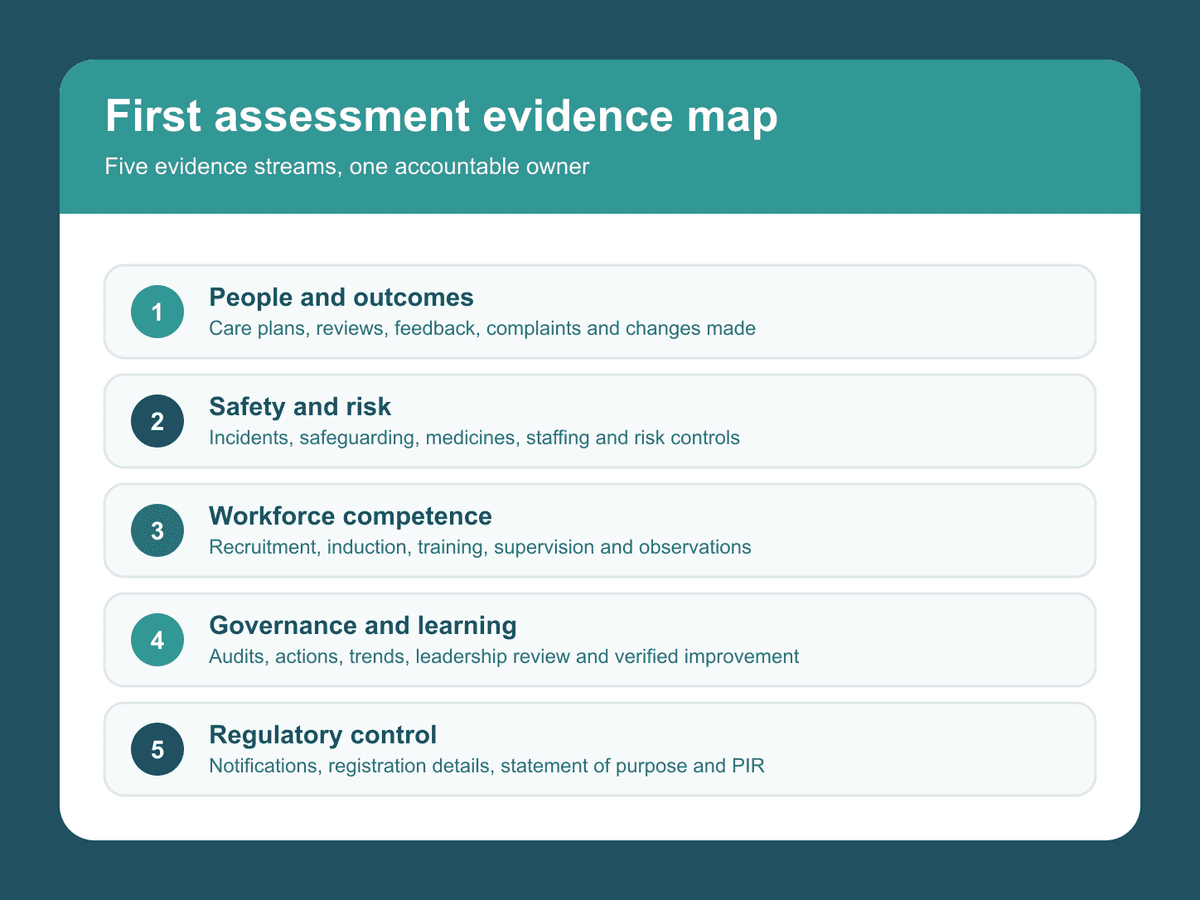
1. People, care and outcomes
Sample care plans, risk assessments, reviews and daily records. Check whether they reflect current needs, preferences, communication requirements and consent decisions. Pair records with feedback, complaints, compliments and evidence of changes made. The aim is not volume. It is a credible connection between what the service planned, what staff delivered and what people experienced.
2. Safety and risk control
Review incidents, safeguarding, medicines, infection prevention, staffing risks and business continuity. For each significant issue, show the immediate response, investigation, learning, accountable action and follow-up check. An action marked complete without a test of impact is weaker than a smaller record that shows the risk reduced.
3. Workforce competence
Check recruitment, induction, mandatory and role-specific learning, supervision, appraisal and observed practice. Training attendance alone does not demonstrate competence. Managers should be able to explain which tasks require direct observation, how concerns are escalated and what evidence supports a decision that a worker can practise safely.
4. Governance and improvement
Bring together audits, meeting minutes, performance measures, complaints themes, incident trends and improvement plans. Assign an owner and deadline to every open action. Then test whether the action changed practice or outcomes. Care Sync’s compliance management support for care providers can help leaders connect policies, audits, actions and inspection readiness into one controlled system.
5. Regulatory control
Confirm that registration details, regulated activities, conditions, registered manager information and statement of purpose remain accurate. Check that required notifications were made through the correct route and retained with the supporting decision record. Review the annual provider information return process rather than waiting for its deadline.
Use a 30-day CQC first assessment readiness cycle
A monthly cycle keeps preparation proportionate. It does not need to repeat a full mock inspection. Each week should have one focused management task, a named owner and a short record of findings.
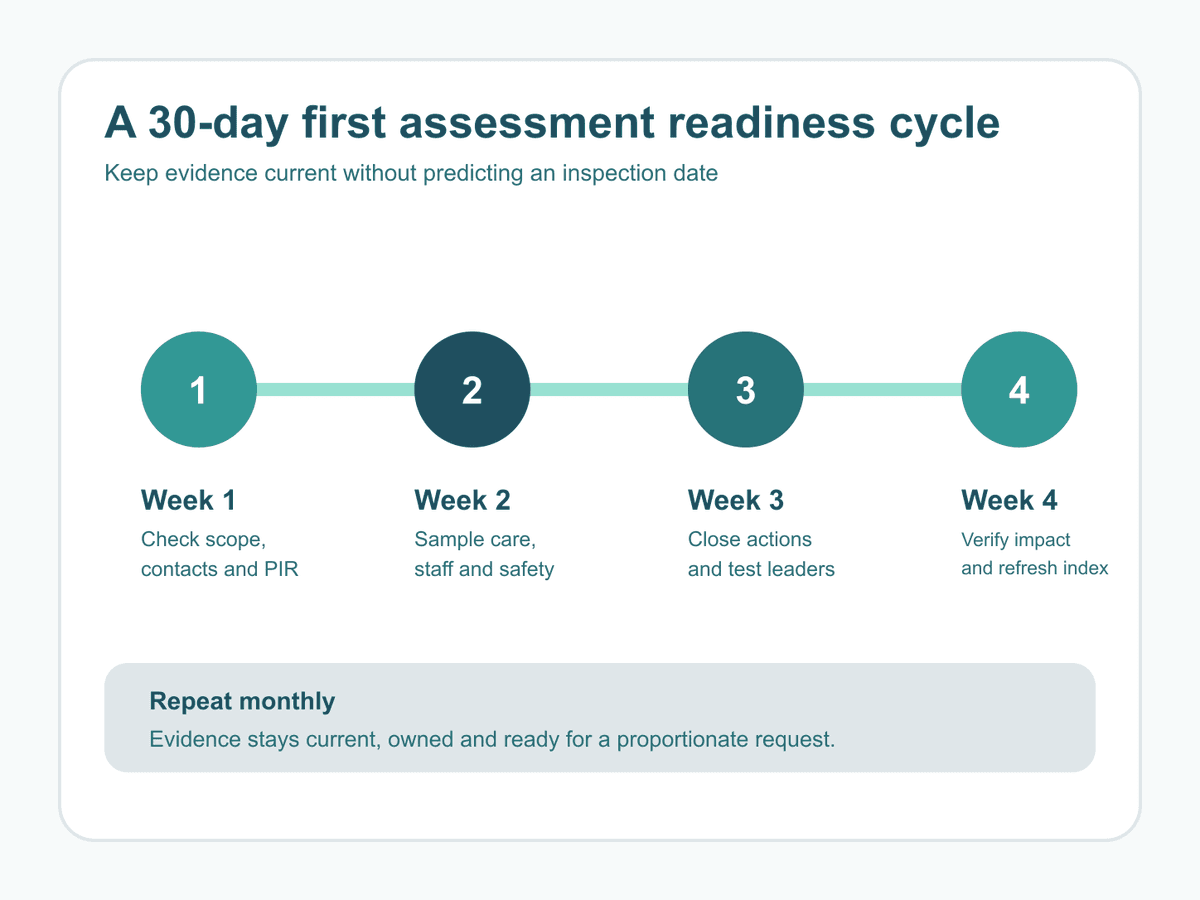
- Week 1, confirm regulatory scope. Check registration details, contacts, regulated activities, statement of purpose, notifications and the PIR calendar.
- Week 2, sample operational evidence. Review a balanced selection of care, risk, medicines, staffing, complaints and feedback records.
- Week 3, close and test actions. Challenge overdue actions, verify completed work and escalate any safety concern through the correct process.
- Week 4, test leadership explanations. Ask managers what the service’s main risks are, what evidence supports that view and what improved during the month.
Record the sample, findings, decisions, owners and next review date. Rotate the detail so the cycle covers the whole service over time. A small domiciliary care service and a larger multi-location provider may use different sample sizes, but both need a method that is proportionate and repeatable.
Prepare registered managers and leaders for evidence conversations
CQC first assessment readiness is not about memorising model answers. Leaders should understand the service well enough to explain current strengths, risks and improvement work in plain language. Their account should agree with frontline practice and records.
- What are the three most important current risks, and how do you know?
- What changed after the most recent incident, complaint or safeguarding concern?
- How are people and relatives involved in decisions and improvement?
- Which workforce competence gap needs the closest oversight?
- Which audit action is overdue, who owns it and what is the risk?
- How do you know that a completed action improved care?
Use these questions in normal governance meetings. If answers rely on general statements such as staff know what to do or policies are up to date, ask for the evidence behind them. A CQC mock inspection can help test the connection between leadership accounts, staff practice and records, but it cannot guarantee the timing or outcome of a real assessment.
Common CQC first assessment preparation mistakes
Waiting for a visit date
A provider can lose months of useful improvement time by treating CQC first assessment readiness as an event. Keep the evidence index, risk picture and action plan current as part of everyday governance.
Creating evidence after the fact
Do not reconstruct meetings, checks or decisions that did not happen. Record gaps truthfully, take proportionate action and retain the follow-up evidence. A transparent improvement trail is safer than a polished but unreliable record.
Ignoring the PIR until the deadline
CQC’s adult social care PIR guidance says registered managers receive an annual request and a four-week deadline. Build the underlying evidence throughout the year so the return reflects current practice and outcomes.
Confusing legal standards with an assessment framework
The CQC Fundamental Standards are legal minimum requirements. Assessment questions and evidence categories help CQC judge quality. Providers need to understand both, but should not present draft methodology changes as current law.
Overloading staff with inspection scripts
Staff should know how to deliver care safely, find current information, raise concerns and explain their role. Rehearsed phrases are not a substitute for competence. Use supervision, observation and team discussion to build genuine understanding.
What to do when CQC contacts your service
- Verify the request. Confirm the sender, location, deadline, scope and secure submission route.
- Name one coordinator. Keep a request log so evidence, owners and deadlines are visible.
- Use existing records. Provide the information requested, not a new volume of documents created for appearance.
- Check accuracy and confidentiality. Make sure the material relates to the correct service and only includes necessary personal information.
- Disclose genuine gaps. Explain immediate safeguards, corrective action, ownership and follow-up.
- Keep a submission receipt. Record what was sent, when, by whom and through which authorised route.
Current CQC guidance indicates that providers do not need to send assessment evidence proactively unless it is requested. Keep evidence ready, but use the regulator’s specified channel and timetable when a request arrives.
How Care Sync Experts can help
Care Sync Experts can help an unrated provider review its evidence map, governance controls, policy alignment and mock assessment readiness. The purpose is to identify real gaps, assign proportionate actions and build a reliable operating system for compliance.
If your service has been registered for more than a year and you want an independent readiness review, book a consultation with Care Sync Experts.
Frequently asked questions
When will CQC carry out a first assessment after registration?
There is no fixed CQC first assessment date published for every adult social care service. CQC’s 2026 priorities include services registered for over a year without an assessment, alongside risk-led priorities. Keep evidence current without assuming a guaranteed timetable.
Does being registered for more than a year guarantee an immediate CQC assessment?
No. It places the service within a named priority group, but CQC describes a balanced approach and retains flexibility to respond to urgent risks and exceptional circumstances.
Should an unrated provider send evidence to CQC before it is requested?
Keep the evidence organised and current, but do not submit it proactively unless CQC asks or a separate statutory process requires it. Follow the instructions, scope and secure route in any request.
What evidence should an unrated care provider keep ready?
Maintain current evidence on people’s care and outcomes, safety and risk, workforce competence, governance and improvement, and regulatory control. Each source should have an owner, review date, finding and follow-up where relevant.
Does an unrated service still need to complete a PIR?
Yes. CQC says adult social care services submit a provider information return each year. Registered managers receive the request and should complete it with the latest service information by the stated deadline.
Can a mock inspection guarantee the outcome of the first CQC assessment?
No. A mock inspection can identify gaps and test whether records match practice, but it cannot control CQC’s timing, evidence collection or judgement. Treat it as an improvement tool, not a promise.
Official source check completed 5 August 2026. Review the latest CQC assessment priority update, provider assessment guidance and adult social care PIR guidance before changing your compliance process.
Related reading
Book a CQC mock inspection, from £1,000 plus VAT
- CQC Assessment Changes 2026: What Adult Social Care Providers Need to Do Now
- How to Apply for CQC Registration in 2026: Forms, Evidence and Assessment
- CQC Personal Care Form: 7 Essential Application Checks
- Service User Feedback in Health and Social Care: How to Build Better CQC Evidence
- CQC Application Stages: What Happens After You Submit?
- CQC Regulation 9A After the 2026 Review: A Practical Visiting Policy Guide for Care Home Providers
Browse every article on CQC, Ofsted, CIW and RQIA compliance