Inspection and compliance16:02
How to Get Outstanding at CQC: The 3.5% Secret (2026)
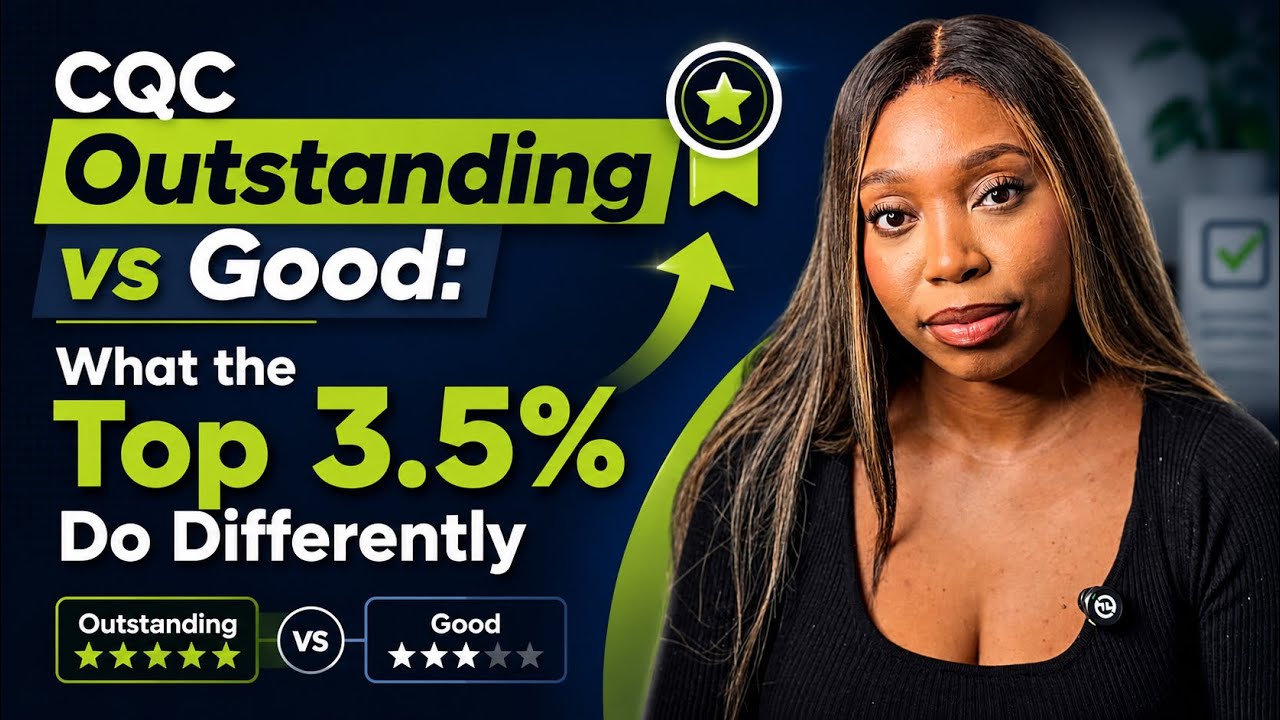
What the small number of domiciliary care services rated Outstanding by CQC do differently. It is not bigger budgets: it is five shifts in thinking, from compliance to impact.
In this video
Transcript
3,094 words, about 13 minutes to read. Press a time to play from that moment.
What Makes a Domiciliary Care Service Outstanding?
Hi, and welcome back to our page. Only 3.5% of domiciliary care services in England are rated outstanding by the CQC. 3 and 1/2% out of thousands of services, only a tiny fraction have reached the top. So, what do they know that everyone else doesn't?
When I speak to other providers about this, most of them assume that the answer is resources, that outstanding services have bigger budgets, more staff, better technology and fancy systems. That's just out of reach for a small domiciliary care provider. And that's not what I found, not even close.
The most outstanding services we encountered were small, fewer than 50 clients, teams of 15 or 20, operating from a modest office. Nothing flashy, nothing expensive, but something about them was fundamentally different. Not in what they had, but in how they thought, in what they prioritised, and in the way every single person in the organisation understood what they were there to do.
In this episode, I'm going to show you what the difference actually is. Not theory, not a wish list, real examples from real services that have achieved outstanding under the current framework. What they did, what inspectors wrote about them, and the five shifts in thinking that separate 3.5% from everyone else.
Outstanding Does Not Mean Perfect
Because the truth is, most of you are closer to outstanding than you think. You're just looking at it the wrong way. Before we get into what outstanding looks like, I need to clear out the biggest misconception I hear from providers. Most registered managers I speak to believe that outstanding means perfect. Zero mistakes, flawless documentation, every box ticked, every policy pristine and every audit immaculate.
That's not what outstanding means, and chasing perfection is what actually holds providers back from reaching it. Under the single assessment framework, CQC score each quality statement on a scale of one to four. A score of one means significant concerns, a score of four means evidence of high-quality care. To achieve outstanding overall, you need at least two key questions rated outstanding, and the remaining ones rated good.
You don't need all five outstanding, you don't need every single quality statement at four. That's important to understand. The services that achieve outstanding are not the ones that are perfect everywhere, they're the ones that are genuinely exceptional in specific areas, usually caring and well-led, while being solid good across everything else.
What CQC Inspectors Look For
Here's something that might surprise you. When I look at the inspection reports of outstanding domiciliary care services, the language inspectors use is very revealing. They don't write about perfect paperwork, they don't praise immaculate filing systems, they write about people, about relationships, about moments of care that went beyond what was required and made a genuine difference in someone's life.
Outstanding isn't about doing more of the same, it's about doing something fundamentally different with the care you already provide. Let me show you what I mean. I've been through a recent inspection report from a domiciliary care service rated outstanding under the current framework, and the stories in them are remarkable.
One service rated outstanding in December 2024 was supporting a person who had become confined to an upstairs bedroom. Their world had shrunk to four walls. They couldn't get downstairs, they couldn't see their garden, and they couldn't feel fresh air on their face. The care team refused to accept that.
They worked with the person, with their family, with health professionals, and they found a way to help that person relocate to a room downstairs, where they could see their garden, where they could feel the breeze, and where their world opened up again. The inspector wrote that this had, and I quote, "transformed their quality of life and boosted their self-esteem."
Real Examples of Outstanding Care
That's not a medication audit, it's not a training matrix, this is a human being whose life was measurably better because the people caring for them saw beyond the care plan and saw the person first. The same service was supporting someone who'd been recently bereaved and was experiencing depression. The staff noticed this.
They didn't just tick a box and note it in the daily record, they took the time to understand what the person was going through, and through conversation, they discovered that this person had lost touch with an old friend. The care team helped them reconnect, first through letters, then through visits. Those two people ended up sharing Christmas dinner together.
The inspector described the staff as people who didn't just help with physical needs, but took the time to truly understand them as a person. In another outstanding service, a smaller provider with just 24 people using the service was described by CQC as especially flexible in meeting people's rapidly changing needs to ensure they remained in their homes rather than a health and social care setting.
Think about what this means. When someone's condition changed, when things got harder, this service didn't just say, "Well, that's outside our remit." or "We need to reassess the package." They adapted. They flexed. They did whatever it took to keep the person at home, where they wanted to be. And the inspector wrote that the service ensured people's families were supported, too, and feedback from them was very moving.
Very moving. That's the language inspectors use about outstanding services. Not adequate, not sufficient, not compliant. Very moving. That's the difference, and it doesn't come from a bigger budget. It comes from a different way of thinking about what care actually means.
Shift 1: From Meeting Needs to Enriching Lives
So, what are these outstanding services doing differently? After studying their reports and comparing them with services rated good, I have identified five fundamental shifts in how they approach care. These are not extra tasks. They're changes in perspective. Shift one: from meeting needs to enriching lives. A good service meets the needs identified in the care plan. The person is washed, dressed, medicated and fed.
Their physical needs are attended to. That's good care. An outstanding service asks a different question, however. Not just what does this person need, but what would make this person's life better? In one outstanding service, staff discovered that a client was a lifelong football fan who had stopped being able to attend matches because of their health. The care team arranged to take them to a game.
They went with them for support, and that person got to see their team play live again. Was it part of their care plan? No. Was it part of their contracted hours? Probably not. Was it the kind of thing that makes an inspector write "above and beyond" in their report? Absolutely. This doesn't mean you need to organise elaborate outings for every single client.
It means training your staff to notice what matters to people beyond their care needs, to listen for the things that people mention in passing, and to ask, "What do you miss? What would make your day better? And what used to bring you joy?" And then act on it, even in small ways.
A cup of tea made exactly how they like it, a conversation about something they care about, help with reconnecting with an old hobby. These moments add up, and they're exactly what inspectors are looking for when they assess caring.
Shift 2: From Recording Care to Evidencing Impact
Shift two. From recording care to evidencing impact. Good services keep good records. They document what care was delivered, and when it was delivered, and by whom. That's essential, and that's the baseline. Outstanding services go further. They evidence what difference the care made. This is the shift from "We supported Mrs Jones with her mobility" to "When we started supporting Mrs Jones, she couldn't walk to her front door.
After 3 months of working with the physiotherapist's recommendations and encouraging daily practice, she walked to the end of her garden for the first time in 2 years." That's an outcome. And it's impact, and it's documented not just in the care plan review, but in the daily notes that show the journey, the small steps, the setbacks, the breakthroughs, and the person's own words about how they feel.
Not every person you support will have dramatic progress to report. Some people's needs are stable, some are deteriorating, but even in those situations, outstanding services evidence impact differently. They show that the person's dignity was maintained during decline, that their wishes were respected, and that their quality of life was preserved as much as possible, that their family was supported through a difficult time.
Impact isn't always about getting better, it's about making a difference, whatever the circumstances. Shift three. From staff compliance to staff passion. In good services, staff are trained, they attend their mandatory courses, they pass their competency assessments, and they follow procedures. In outstanding services, staff are passionate.
Shift 3: From Staff Compliance to Staff Passion
They don't just do the job, they care about the job. They talk about the people they support with genuine warmth and knowledge. They can describe not just what care they deliver, but why it matters. Remember what I said in episode two, about CQC speaking to your staff in hour-long phone calls. When inspectors call staff from an outstanding service, they hear something different.
They hear people who genuinely know and care about their clients. Staff who can tell you about Mrs Davis' grandchildren, who know that Mr Hassan's favourite meal is lamb biryani, and that he likes to pray at specific times. Those are the ones who noticed that someone seemed lower than usual last week and took the time to sit with them.
Fortunately, you cannot train passion, but you can create the conditions for it. Outstanding services invest in their staff, not just in training, but in valuing them. Recognising their contributions, giving them the time and the trust to build real relationships with the people they support, and making sure they're not rushed so that every visit becomes a task list.
The CQC describes the culture of outstanding services. They use phrases like, "Staff felt valued and proud to work there." And the whole culture of the service demonstrated a caring approach. That culture doesn't just happen by accident. It's built by leadership that genuinely cares about its workforce. Shift four, from isolated care to connected communities. Good services work with health and social care professionals when required.
They communicate with the GPs, they attend reviews, and they share information. Outstanding services go beyond professional partnerships. They connect people they support with their wider community. One outstanding service was described as having developed excellent relationships with a wide range of community partners from the fire service to local charities, and played a very active role in ensuring older people are a valued part of their community.
Shift 4: From Isolated Care to Connected Communities
Think about what this means for domiciliary care specifically. Your clients are in their own homes. Many of them are isolated. The world outside their front door can feel distant and inaccessible. Outstanding services bridge that gap. They help people maintain connections. They introduce them to community resources. They make sure that being cared for at home doesn't mean being cut off from life.
This can be as simple as knowing what's available in your local area. Befriending services, community lunch clubs, library home delivery services, faith groups, hobby groups and Age UK activities. Your staff are in people's homes every single day. They see loneliness. They see isolation. Outstanding services do something about it. Shift five, from reactive improvement to relentless innovation. Good services fix problems when they find them.
They audit, they identify issues, they take action, they close the loop. If you watched episode eight, you know how important that cycle is as well. Outstanding services do all of that, but they also look for ways to make things better even when nothing's wrong. They're not just fixing problems, they're actively seeking ways to improve. An outstanding service introduced robotic companion pets with people living with dementia.
Not because anyone complained about a lack of companionship, not because an audit found a gap, but because the team was always thinking about more ways they could improve people's lives. They researched the evidence for therapeutic companionship. They trialled it, they measured the impact, and they found it made a real difference to people's well-being.
Shift 5: From Reactive Improvement to Relentless Innovation
Another service invested in creative technology: tracking tools for safety, smart doorbells to support independence, specialised transport for people who have reduced mobility. They weren't waiting for problems to solve, they were proactively looking for ways to help people live more independently and with a bit more dignity. This is the quality statement on learning, improvement and innovation under well-led.
CQC want to see that you're not just maintaining standards, you're raising them continuously, intentionally and creatively. And it doesn't require a huge budget, it requires curiosity, a willingness to ask, "Is there a better way to do this?" and the culture to let ideas come from anywhere, including your frontline staff.
Before I give you your action steps, I need to share something people in the sector don't actually talk about because it's uncomfortable, but it is important. Outstanding isn't permanent. One domiciliary care service had achieved outstanding, but was later issued a formal warning notice by CQC for failing to meet regulations on safe care, safeguarding and governance. Outstanding to warning notice in a matter of months.
How does that happen? It happens when a service stops doing the things that made it outstanding in the first place. When the focus shifts, when complacency creeps in, and when the leadership assumes that a rating on a certificate means the work is done. Outstanding isn't a destination, it's a way of operating. The moment you stop actively pursuing it, you start losing it.
Why Outstanding Ratings Are Not Permanent
The services that sustain outstanding over time are the ones where the rating is a reflection of their culture, not a goal of their culture. They would operate exactly the same way whether CQC were watching or not, because it's who they are. This is why everything we've covered in this series matters.
The evidence gathering from episode two, the care plan rigour from episode four, the medication management from episode five, the safeguarding culture from episode seven, the governance system from episode eight, the leadership grid from episode nine. All of those foundations have to be solid and sustained. Outstanding is built on top of good, not instead of it.
Each step should feel like something a provider can start today, regardless of their current rating. So, how do you start moving towards outstanding? Let me give you six concrete actions. Action one, start collecting stories, not just data.
When something remarkable happens in your service, when a staff member goes above and beyond, when a person you support achieves something meaningful, when a family member tells you their parent is happier than they've been in years, write it down.
Six Actions to Move Towards Outstanding
Not in the daily notes, in a dedicated file. Build a portfolio of impact. These stories are the evidence that separates outstanding from good. Action two, ask every person you support one question. What would make your life better? Not, are you happy with your care? That's a compliance question. What would make your life better is an outstanding question.
The answer will tell you where the opportunities are.
Start Collecting Impact Stories
And when you act on those answers, document what you did and the difference it made. Action three, create a recognition culture for your staff. When staff do something exceptional, celebrate it. Share it in team meetings and note it in supervision records. Make it visible. Outstanding services have staff who feel valued and proud. That doesn't happen without deliberate recognition from leadership.
Action four, map your community connections. What resources exist in your local area that could benefit the people you support? Befriending services, activity groups, faith organisations, libraries, community centres, charities.
Ask What Would Make Life Better
Create a resource list and share it with your team. Make connecting people with their community part of your care approach, not an afterthought. Action five, dedicate time for innovation. In one team meeting per quarter, ask your staff, "What could we do better? What have you seen that other services do well? And what would make things easier or better for the people you support?"
Give ideas space to breathe. When a good idea comes up, try it. Measure the impact and document the learning. That is innovation evidence.
Build a Staff Recognition Culture
And action six, review one outstanding inspection report. Go to the CQC website, search for domiciliary care services rated outstanding in your area. Read their report, not to copy what they do, but to understand the language CQC use, the phrases and the evidence that impressed them, the stories they choose to highlight as well. That report is your blueprint for what excellence looks like in the inspector's eyes.
I want to finish with something that I've been thinking about throughout this entire series. The providers who achieve outstanding aren't superhuman by any means.
Map Community Connections
They're not working with unlimited resources, and they're not doing something that's beyond their reach. What they are doing is caring, genuinely, deeply, practically caring about the people they support, about the staff who deliver their care, about the families who trust them, and about getting better every single day. They've made a decision that compliance is the floor, not the ceiling.
That meeting needs is the starting point, not the finish line. That their job is not just about providing care, but making lives better. And here's the thing that matters most. The people you support do not care about your rating.
Create Time for Innovation
They don't care whether the certificate on your wall says good or outstanding. What they care about is whether you know them, whether you listen to them, and whether you help them live the life they want to live. And if you do that truly and consistently, the rating will follow. In the next episode, I'm going to cover something intensely practical, the 48-hour document request.
When CQC send you that email asking for 25 documents, most providers panic. I'm going to show you exactly what they ask for, how to package it so professionally that inspectors are impressed before they even arrive, and how to turn that moment of panic into your first opportunity to shine.
Study an Outstanding CQC Inspection Report
That's episode 11. Make sure you're subscribed so you don't miss it. And if you've watched this episode and thought of a moment when your team went above and beyond, make sure to drop it in the comments. Thank you for watching, and we'll catch you on the next one.
Transcribed from the video's captions and lightly edited. Where the wording differs, the video is the record.
Want help with this?
Tell us where you are now and we will tell you honestly what it will take, and what we would do first.
More on inspection and compliance
All inspection and compliance videos 14 minutes 34 secondsThe Secret to a Well-Led CQC Rating: Are You Answering This Question?Inspection and compliance
 4 minutes 18 secondsCQC Inspectors Are Looking For This, And It's Not In Your FilesInspection and compliance
 4 minutes 39 secondsCare Notes: Don't Make This Mistake. A Coroner Found It in Her FileInspection and compliance
 13 minutes 2 secondsIs Your Governance Real? How to Prove It to the CQCInspection and compliance
 13 minutes 49 secondsThe 10 Types of Abuse: Is Your Care Agency Ready for 2026?Inspection and compliance
 13 minutes 43 secondsThe Missing Link in Your CQC Staff Files (And How to Fix It)Inspection and compliance