Inspection and compliance4:18
CQC Inspectors Are Looking For This, And It's Not In Your Files
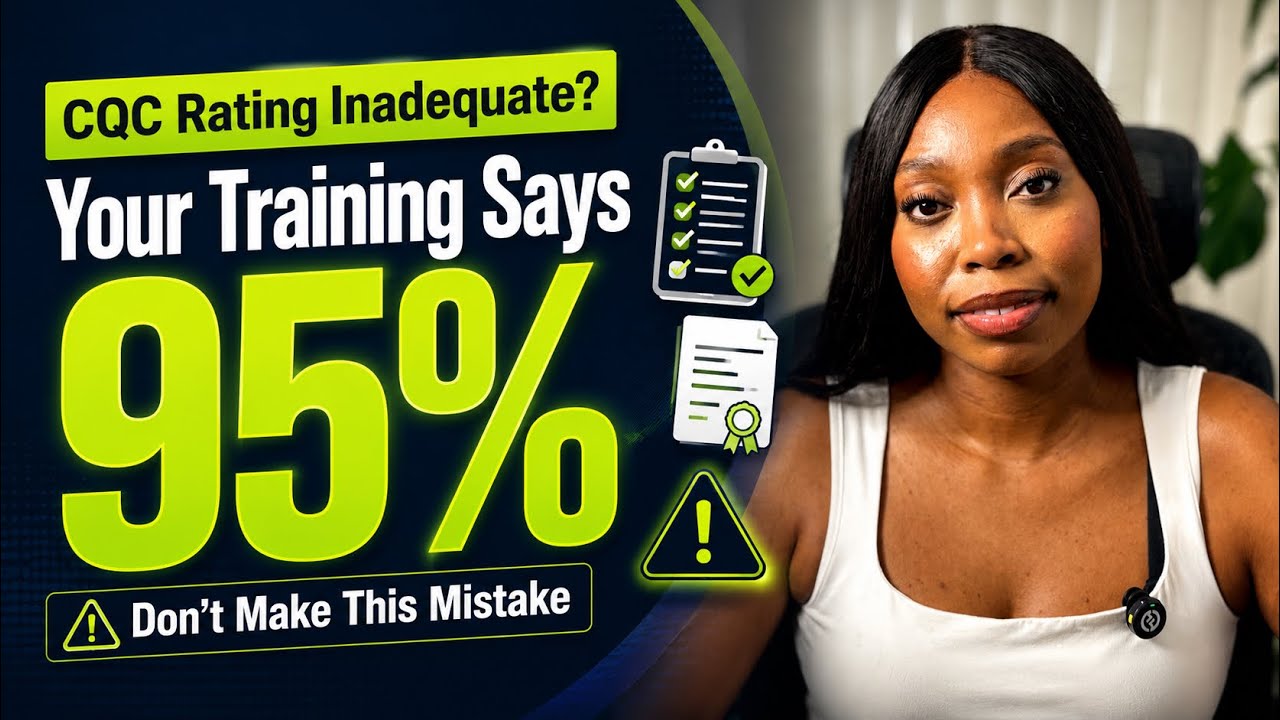
Two home care services with the same policies and paperwork can get opposite CQC ratings. What inspectors look for beyond your files.
In this video
Transcript
859 words, about 4 minutes to read. Press a time to play from that moment.
CQC Is Not Just Grading Your Paperwork
Hi, and welcome back to our page. You've got two home care services, same policies, same training matrix sitting at 95%, same audits running every single month. However, one walks away with outstanding, and the other is rated inadequate. Nothing on paper explains it. So, what is the inspector actually seeing that you can't?
Stay with me because once you understand this, you'll never look at your own paperwork the same again.
What Inspectors Are Actually Looking For
It's a mistake almost every provider makes. They believe CQC is weighing their paperwork. They're not. Under this current framework, inspectors don't just check that policy exists. They gather evidence from real life, what your staff actually say, what the people you support actually experience, and what your records actually show happened on a difficult day.
So, your document isn't the finish line, it's the starting point, which means when two services are on the exact same tools, the rating never comes from tools. It comes from one thing, whether those tools are genuinely lived or simply filed.
Why Two Similar Services Get Different Ratings
Do you want to know if this isn't just my opinion? An analysis of 181 CQC reports from January this year found something striking. The difference between outstanding and inadequate was rarely about intent and rarely about effort. Most providers are actually working incredibly hard.
The struggling ones simply could not show that their leaders had a clear current picture of what was happening in practice, and this is on a day-to-day basis.
The Difference Between Compliance and Learning
In a struggling service, everything is present.
The medication policy is written, the training records are green, the audit is scheduled and ticked. But, when something goes wrong, their response is slow. An incident gets logged, an action plan gets written, and then 3 months later, the same incident happens again. The system records problems, it doesn't learn from them. In an outstanding service, the same incident becomes a lesson.
The next supervision references it directly. Practice actually changes, and this is the whole game. One word, embedment.
When Training Becomes Just a Tick Box
Let me show you exactly where this falls apart because it happens most often in training. Most care training today runs through e-learning. Staff click through modules, they reach a multiple-choice quiz at the end, they guess their way to pass, and the metric turns green. It says trained. But, ask yourself honestly, did anyone actually learn anything? Or did they simply complete something?
Here's what people forget. When you train to become a proper vocational trainer, you're not just handed a subject to deliver. You're taught the reason for the learning and how people actually learn.
Why Embedding Knowledge Matters
You're taught to build training that sticks across a whole team because the people in your service don't all learn the same way, and that's key. And this is the mistake that quietly sinks services. They treat the process as a goal. Finishing the modules becomes the achievement, but the process was never meant to be the goal.
The process is just a route to knowledge that a carer can then apply. This comes into play in someone's home on a hard day when no document is in front of them. I think that's where tick box compliance crashes into quality.
Four Questions to Test Your Service
One's about getting it done, the other's about whether anything was understood because there's little point in any of it unless it ends up embedded in practice and in knowledge and understanding. Training that doesn't change what a carer does is not training at all. It's just a record. So, how do you know which kind of service you actually run?
Four honest questions you can ask yourself this week. One, can a member of your team explain a risk without reading from a document? If the knowledge only lives on paper, it doesn't really live at all. Two, when something goes wrong, do you change how you work or do you just write another action plan? Action plans are easy, changed practice is the evidence.
Three, is your training matrix measuring competence or is it just measuring attendance? Sitting in a session isn't the same as being able to do the job safely. Four, are your policies genuinely referenced in supervisions or are they filed and forgotten? A policy nobody mentions is a policy nobody follows.
Turning Policies Into Real Practice
Here's the encouraging part. If a couple of those hit a nerve, that's exactly where your improvement is hiding. You don't need new policies, you don't need a new system, you already own the tools. The work is bringing them to life. So, I'll leave you with this. Think of one of your policies in your service that you're genuinely confident is lived, truly understood and truly used.
Now, think of one that you suspect is sitting on a shelf gathering dust. Be honest about that second one because that's the gap between a service that looks compliant and a service that actually is. If you want help turning your paperwork into practice that an inspector can see and your team can feel, that's is what we do.
Find the Gap in Your Service
Tell me your answer in the comments and subscribe for more videos like this. And I look forward to seeing you on the next one.
Transcribed from the video's captions and lightly edited. Where the wording differs, the video is the record.
Want help with this?
Tell us where you are now and we will tell you honestly what it will take, and what we would do first.
More on inspection and compliance
All inspection and compliance videos 4 minutes 39 secondsCare Notes: Don't Make This Mistake. A Coroner Found It in Her FileInspection and compliance
 16 minutes 2 secondsHow to Get Outstanding at CQC: The 3.5% Secret (2026)Inspection and compliance
 14 minutes 34 secondsThe Secret to a Well-Led CQC Rating: Are You Answering This Question?Inspection and compliance
 13 minutes 2 secondsIs Your Governance Real? How to Prove It to the CQCInspection and compliance
 13 minutes 49 secondsThe 10 Types of Abuse: Is Your Care Agency Ready for 2026?Inspection and compliance
 5 minutes 5 secondsFamily on the Same Double-Up Call? It's Allowed. Here's the ProblemInspection and compliance