Can you use the DBS Update Service for CQC registration?
Text to speech
Duration: 00:00
Font size
Published: 2 Feb, 2026
Share this on:
If you are applying for CQC registration in 2026, you cannot use the DBS Update Service to meet CQC’s DBS requirement.
Care Quality Commission states that it cannot accept DBS checks from the Update Service because it cannot verify your identity in person against the certificate, as required by the Disclosure and Barring Service. Even if your DBS Update Service check shows as current and clear after dbs update service login, CQC will reject your application if you rely on it.
What CQC accepts instead (at a glance):
- Not a registered healthcare professional?
Apply for a CQC countersigned enhanced DBS check. - Registered healthcare professional (e.g., NMC, GMC, HCPC)?
Use an enhanced DBS (not countersigned) and post the original paper certificate to CQC. - All applicants:
Your DBS must be Enhanced, include the correct barred list, and be under 12 months old at submission.
Why this matters: Since mid-2025, rejected applications go to the back of the queue. A simple mistake, like submitting an update service DBS instead of the required certificate, can cost you months.
Why CQC cannot accept the DBS Update Service
CQC rejects the DBS Update Service because it does not allow them to complete the identity checks required by the Disclosure and Barring Service.
The update service exists to help employers confirm whether an existing DBS certificate has changed since it was issued. It provides a status check, not a fresh DBS certificate and not identity verification. When an employer uses the dbs update service check, they must first see the original paper certificate, verify the person’s identity in person, and confirm the certificate level and barred list match the role. That in-person step is mandatory.
CQC processes applications from thousands of providers across England. They cannot meet every applicant face-to-face to verify identity after a login dbs update or dbs online account login check. Because they cannot complete that verification step, they cannot rely on the Update Service at all.
Instead, CQC requires DBS evidence that already includes verified identity checks. That is why they insist on either:
- a CQC countersigned enhanced DBS check, where identity is verified through the Post Office on CQC’s behalf, or
- an enhanced DBS from registered healthcare professionals, whose professional registration already includes robust identity verification.
This distinction explains a common point of confusion. The DBS Update Service can show that a certificate remains unchanged, but it cannot prove who is presenting it. CQC must confirm both the certificate details and the applicant’s identity. The Update Service only covers one of those requirements.
If you submit a CQC application using the Update Service instead of the required DBS certificate, CQC will reject the application without assessment. In 2026, that rejection does not pause your place in the queue. It resets it.
What DBS check does CQC require for registration?
CQC will only assess your application if your DBS evidence meets all of the requirements below. Miss one, and CQC will reject the application outright.
CQC requires an enhanced DBS check
CQC does not accept Basic or Standard checks. You must submit an enhanced DBS check.
An enhanced DBS shows:
- Convictions, cautions, reprimands, and warnings
- Relevant information held by local police
- Barred list information (where requested)
If your certificate does not clearly say Enhanced, do not submit it.
Choose the correct barred list
Your enhanced DBS must include the right barred list for the service you are registering:
| Service users | Barred list required |
| Under 18 only | Children’s barred list |
| 18 and over only | Adults’ barred list |
| All ages | Adults’ and children’s barred lists |
CQC checks this closely. If you select the wrong barred list, CQC will reject your application even if everything else looks correct.
Follow the strict 12-month rule
CQC will not accept a DBS certificate that is more than 12 months old at the point you submit your application.
There are no exceptions:
- 13 months old → rejected
- 12 months and 1 day old → rejected
If your DBS is close to expiry and you expect any delay, apply for a new one before you submit.
Do not rely on the Update Service or shortcuts
CQC will not accept:
- Certificates checked through the DBS Update Service
- Status results from an update service DBS check
- Shortcuts via third-party portals that cannot meet CQC’s criteria
CQC requires DBS evidence that already includes verified identity checks. That is why they accept either a CQC countersigned enhanced DBS or, for certain professionals, an enhanced DBS supported by professional registration.
For CQC registration, your DBS must be Enhanced, include the correct barred list, be under 12 months old, and be submitted through the correct route.
READ: Care Policies and Procedures: How to Implement Them Correctly in 2026
Which DBS route applies to you? (Decide in 30 seconds)
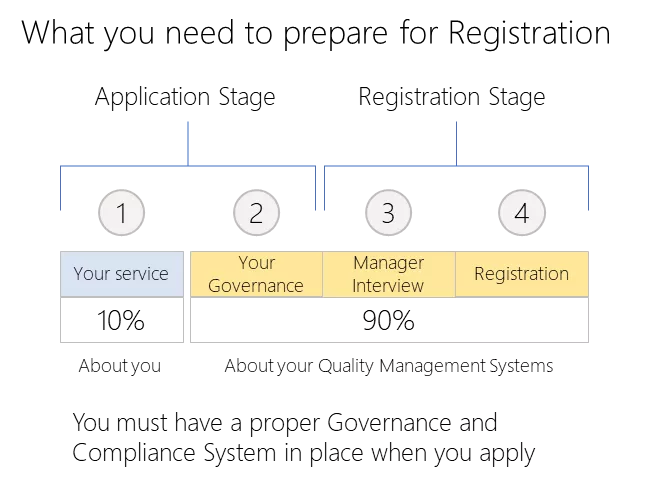
Use this quick decision guide to choose the correct DBS route before you apply. Picking the wrong route is one of the fastest ways to get rejected.
Step 1: Are you a registered healthcare professional?
Ask yourself this first. Are you currently registered with any of the following bodies?
- General Dental Council (GDC)
- General Medical Council (GMC)
- General Pharmaceutical Council (GPhC)
- Health and Care Professions Council (HCPC)
- Nursing and Midwifery Council (NMC)
- Social Work England
Step 2: Follow the correct path
If you are not registered with any of these bodies, you must apply for a CQC countersigned enhanced DBS check.
CQC uses this route because it includes verified identity checks carried out through the Post Office on their behalf.
If you are registered with one of these bodies, you still need an enhanced DBS, but it does not need to be countersigned by CQC.
Instead, you must:
- Ensure the DBS is Enhanced
- Ensure it includes the correct barred list
- Ensure it is under 12 months old
- Post the original paper certificate to CQC with your application
Step 3: Ignore the Update Service
This decision does not change if:
- You can access your certificate through dbs update service login
- Your update service DBS shows as current
- You have previously passed dbs tracking or a status check
The DBS Update Service never replaces the correct DBS route for CQC registration.
Your professional registration status decides your DBS route. The Update Service does not.
READ MORE: Latest CQC Reports, Regulated Activities (2026)
If you are not a registered healthcare professional, apply for a CQC countersigned enhanced DBS
If you are not registered with the GMC, NMC, HCPC, GDC, GPhC, or Social Work England, CQC requires a CQC countersigned enhanced DBS check. This is the only DBS route CQC will accept for non-healthcare professionals.
What “CQC countersigned” actually means
A countersigned DBS allows CQC to meet the Disclosure and Barring Service’s identity-verification rules without meeting you in person. CQC authorises additional checks, and the Post Office verifies your identity on CQC’s behalf. This step is why CQC accepts the certificate, and why the DBS Update Service cannot replace it.
Step-by-step: how to get the CQC countersigned enhanced DBS
- Apply online through CQC’s DBS portal (the official route for registration applicants).
- Choose your identity documents and receive a confirmation letter with a barcode.
- Visit a participating Post Office for identity verification and pay the fee.
- Wait for processing while DBS completes police checks and issues your certificate.
- Receive the original paper certificate by post and keep it safe.
How long it takes (plan for this)
CQC states the countersigned process can take up to 60 working days (around 12 weeks). Many certificates arrive sooner, but delays happen, especially where multiple police forces must check records. You cannot submit your CQC application until the certificate arrives.
Best practice: Apply for the countersigned DBS first, then prepare your statement of purpose, policies, business plan, and training plan while you wait. This parallel approach prevents months of avoidable delay.
Cost and common pitfalls
- The total cost typically includes the enhanced DBS fee plus Post Office identity-check fees (amounts vary).
- Do not rely on an employer’s DBS, an update service DBS, or a third-party shortcut.
- Do not submit scans or screenshots; CQC requires the original certificate in the correct route.
Bottom line: If you are not a registered healthcare professional, the CQC countersigned enhanced DBS is non-negotiable. Next, we cover the rules for registered healthcare professionals, including how to submit the original certificate correctly and avoid rejection.
If you are a registered healthcare professional, you still need an enhanced DBS
If you are registered with a recognised healthcare professional body, CQC applies a different DBS route, but the standards remain strict. You still need an enhanced DBS check with the correct barred list. The difference is how you prove your identity.
Who counts as a registered healthcare professional?
CQC accepts non-countersigned enhanced DBS certificates only if you are registered with one of the following bodies:
- General Dental Council (GDC)
- General Medical Council (GMC)
- General Pharmaceutical Council (GPhC)
- Health and Care Professions Council (HCPC)
- Nursing and Midwifery Council (NMC)
- Social Work England
CQC accepts this route because these bodies already carry out robust identity and professional standing checks during registration.
What you must submit
If you fall into this category, you must:
- Obtain an enhanced DBS (not Basic or Standard)
- Include the correct barred list for your service
- Ensure the certificate is less than 12 months old
- Use your current legal name, with all previous or legal names listed
- Post the original paper DBS certificate to CQC (no copies, scans, or digital versions)
CQC will not accept screenshots, PDFs, or evidence from a dbs update service login, even if your update service status shows as clear.
Where to send your certificate
Post your original enhanced DBS certificate to:
CQC National Customer Service Centre
Citygate
Gallowgate
Newcastle upon Tyne
NE1 4PA
CQC returns your certificate by registered post after processing.
Third-party DBS providers: proceed carefully
CQC may accept an enhanced DBS from a third-party provider only if the certificate meets all their criteria. If it does not, CQC will require you to apply for a CQC countersigned enhanced DBS instead.
If you want to eliminate all risk, many applicants choose the countersigned route even when they qualify as healthcare professionals.
Professional registration removes the need for countersigning, not the need for an enhanced DBS. In the next section, we’ll give you a simple pre-submission checklist to make sure your DBS evidence passes CQC review first time.
SEE ALSO: Starting a Care Home in the UK: Best 2026 Guide
DBS checklist before you submit your CQC application
Use this checklist immediately before submission. If you cannot tick every box, pause and fix it. Submitting anyway will lead to rejection.
- You have an enhanced DBS check (not Basic, not Standard)
- The DBS includes the correct barred list for your service (adults, children, or both)
- The certificate is under 12 months old on the day you submit
- You are not relying on the DBS Update Service, a status check, or a screenshot
- You used the correct route:
- CQC countersigned enhanced DBS (if not a registered healthcare professional), or
- Enhanced DBS + original certificate posted to CQC (if a registered healthcare professional)
- All current and previous names on the certificate match your application
- You have the original paper certificate ready (no scans or copies)
If any box remains unticked, do not submit your application. CQC will reject it without assessment, and you will lose your place in the queue.
Common DBS scenarios (and exactly what to do)
These are the situations that cause the most delays in CQC registration. Use the guidance below to choose the correct next step and avoid rejection.
“My DBS is on the Update Service from my current employer”
What this means: You can access your record via dbs update service login and the status shows as clear.
Why it’s a problem: CQC does not accept Update Service checks for registration.
What to do: Apply for a new DBS through the correct CQC route. Your employer’s DBS, even if current, will not work.
“My DBS is 11 months old”
What this means: Your certificate looks valid today but may expire soon.
Risk: If it passes the 12-month mark before or during submission, CQC will reject it.
What to do: Apply for a new DBS now. Do not gamble on timing.
“I lost my DBS certificate but I can see it online”
What this means: You can view status via dbs login or an update service DBS check.
Problem: DBS does not issue replacement certificates.
What to do: Apply for a new DBS. There is no workaround.
“I’m starting a domiciliary care or supported living service”
What this means: You’re registering a regulated service, often as provider and manager.
What to do: Apply for a CQC countersigned enhanced DBS with the adults’ barred list (or both lists if you support all ages). Start this first.
“I’m a nurse or social worker applying as registered manager”
What this means: You hold professional registration (e.g., NMC, HCPC).
What to do: Use an enhanced DBS (not countersigned), ensure it’s under 12 months, and post the original certificate to CQC with your application.
“I’m both the provider and the registered manager”
Good news: You need one DBS only.
Rule: Use the route that matches your status (healthcare professional or not). The same DBS covers both roles.
“My DBS shows convictions or information”
What this means: Disclosure does not automatically block registration.
What CQC does: Assesses relevance, timing, pattern, and evidence of rehabilitation.
Hard stop: If you appear on a barred list, CQC cannot register you for that group.
Most DBS problems come from timing, route selection, or reliance on the Update Service. Fix these early, and your application moves forward.
LEARN MORE: New Rules for Care Home Payments in 2026
DBS Update Service login and tracking: what it can and cannot do
People often search for dbs update service login, dbs login, or dbs online account login when they want to check the status of an existing certificate. The Update Service has a purpose—but CQC registration is not it.
What the Update Service actually does
After you sign in to your update service DBS account, you can:
- See whether your DBS certificate has changed since it was issued
- Allow employers to run a status check
- View a history of checks carried out on your certificate
This is why employers use the service. It helps them confirm ongoing suitability after they have already seen your original certificate and verified your identity in person.
What the Update Service cannot do for CQC
The Update Service does not:
- Replace an enhanced DBS check
- Verify your identity for a regulator
- Produce a certificate CQC can assess
- Extend the 12-month validity rule
- Convert an employer DBS into a registration DBS
Even if dbs tracking or a dbs update service check shows “no change,” CQC still requires DBS evidence that already includes verified identity checks. The Update Service only shows status—it does not prove who you are.
“Tracking” vs “status checks” (clear this confusion)
Many people search for terms like track dbs, dbs tracking service, or disclosure and barring service tracking service. In practice:
- DBS tracking usually means checking the progress of a new DBS application
- The Update Service only shows status changes on an existing certificate
They are not the same thing, and neither replaces the DBS route CQC requires.
Avoid shortened links and fake portals
Only use official GOV.UK or CQC websites. Avoid shortened URLs (for example, a random tinyurl site) claiming to offer fast DBS checks or Update Service shortcuts. These sites do not meet CQC requirements and can expose your personal data.
The Update Service helps employers. It does not help with CQC registration. Use it for employment checks if you wish, but never submit it as DBS evidence to CQC.
Conclusion
CQC registration does not fail because people ignore the rules. It fails because people assume.
They assume the DBS Update Service works because it worked for employment.
They assume an employer DBS transfers across.
They assume “11 months old” is close enough.
They assume they can fix the DBS later.
CQC does not work on assumptions. It works on evidence.
In 2026, CQC applies DBS rules mechanically and without discretion. If the DBS is wrong, outdated, or submitted through the wrong route, CQC does not pause your application. It rejects it and sends you to the back of the queue. No appeal. No partial review.
That is why the DBS step is not paperwork.
It is the gatekeeper.
Get it right, and your application moves forward. Get it wrong and months disappear.
The safest approach is simple:
- Ignore the Update Service for registration purposes
- Choose the correct DBS route based on your professional status
- Apply early so time works for you, not against you
- Submit only when every requirement is met
If you treat DBS as a formality, CQC will treat your application the same way.
If you treat it as the foundation of your registration, you put yourself in the strongest possible position to succeed.
That single decision often determines whether your care service opens on schedule or sits in limbo for another year.
Get your DBS right the first time (and avoid months of delay)
The rules are clear in 2026:
- The DBS Update Service does not work for CQC registration
- Your DBS must be Enhanced, include the correct barred list, and be under 12 months old
- Your professional status decides whether you need a CQC countersigned enhanced DBS or an enhanced DBS with the original certificate posted
- One DBS mistake can push your application to the back of the queue
Most delays we see happen because applicants rely on the Update Service, use an employer DBS, or submit a certificate that expires mid-process. All of these are avoidable.
Get a free DBS & CQC registration check
At Care Sync Experts, we guide care providers through CQC registration every day. We help you:
- Choose the correct DBS route before you apply
- Time your application so your DBS stays valid
- Prepare and review your documents before submission
- Avoid rejections that cost weeks or months
If you want a quick check before you submit, or full support from DBS to approval, get in touch and let’s make sure your application moves forward the first time.
This guide reflects CQC guidance updated on 19 December 2025 and is current for 2026. Always check official CQC updates for changes.
FAQ
Can I use the DBS Update Service for CQC registration?
No. CQC does not accept DBS checks from the DBS Update Service. Even if your status shows as clear after dbs update service login, CQC will reject the application because they cannot verify your identity through the service.
How long does a DBS last for CQC registration?
For CQC purposes, a DBS certificate must be less than 12 months old on the day you submit your application. If it is over 12 months old, CQC will reject it without review. This answers the common question: how long does a DBS last for registration? The answer is 12 months, strictly.
How long does a CQC countersigned enhanced DBS take?
CQC states the countersigned process can take up to 60 working days (around 12 weeks). Some checks complete faster, but delays can occur depending on police checks and application accuracy.
Do I need a new DBS if I already have one through my employer?
In most cases, yes. Employer DBS checks, even Enhanced ones, are for employment purposes. Unless you are a registered healthcare professional and meet all criteria, CQC will require a CQC countersigned enhanced DBS. An employer DBS or update service DBS will not transfer.
Related reading
- Service User Feedback in Health and Social Care: How to Build Better CQC Evidence
- How Long Does CQC Registration Take? 2026 Update
- How Much Does CQC Registration Cost in 2026?
- CQC Registration for Domiciliary Care Providers: Complete 2026 Guide
- CQC Supported Living Registration in 2026: The Complete Guide
- How to Apply for CQC Registration in 2026: Forms, Evidence and Assessment
Browse every article on CQC, Ofsted, CIW and RQIA compliance